

This article was automatically translated from the original Turkish version.
+1 More
Pitch Drop Experiment is a physics experiment initiated in 1927 at the University of Queensland in Australia with the aim of observing the flow behavior of pitch, a substance with extremely high viscosity, over long time scales【1】. The experiment is also sometimes referred to in Turkish as “Ses perdesi düşüşü deneyi” or “zift damlası deneyi”, and in English literature as “Pitch Experiment”. It is widely cited as a classic example for understanding fluid mechanics and the concept of viscosity due to its demonstration that certain materials appearing solid and rigid at room temperature are in fact extremely slow-flowing liquids【2】.
The pitch used in the experiment is a highly viscous substance similar to asphalt【3】. In everyday observation, this material may behave like a hard and brittle solid and even fracture under mechanical impact. However, over long time scales, it exhibits the properties of a very slow-flowing liquid due to molecular motion. Consequently, under the influence of gravity, the substance flows at an extremely slow rate, and the formation of droplets can only be observed after years of continuous monitoring【4】.

Label defining pitch, 1915.(National Museums Scotland)
The Pitch Drop Experiment was initiated in 1927 by physics professor Thomas Parnell at the University of Queensland【5】. The purpose of the experiment was to demonstrate to his students that the distinction between solids and liquids is not as clear-cut as everyday experience suggests【6】.
To prepare the experiment, the pitch was first heated until it became fluid and poured into a glass funnel. The material was then left undisturbed for several years to allow it to settle evenly and eliminate any air bubbles within. This waiting period ensured a more homogeneous structure inside the funnel and facilitated a more consistent flow【7】.
Subsequently, the bottom of the funnel was cut open to allow the pitch to flow out through a narrow opening at an extremely slow rate. The experimental setup was installed in the physics department of the University of Queensland and has been running continuously since its inception【8】.
Over time, the experiment became one of the university’s most famous scientific demonstrations and has earned a place in the literature of the history of science as a striking example of long-term experimental observation【9】.
The development of the experiment has occurred through several key phases: its establishment by Thomas Parnell in 1927, the formation of the first pitch drop in 1938, John Mainstone assuming oversight of the experiment in 1961, and the transfer of responsibility to Andrew White following Mainstone’s death in 2013【10】.

Professor John Mainstone during the Pitch Drop Experiment at the University of Queensland.(National Museums Scotland)
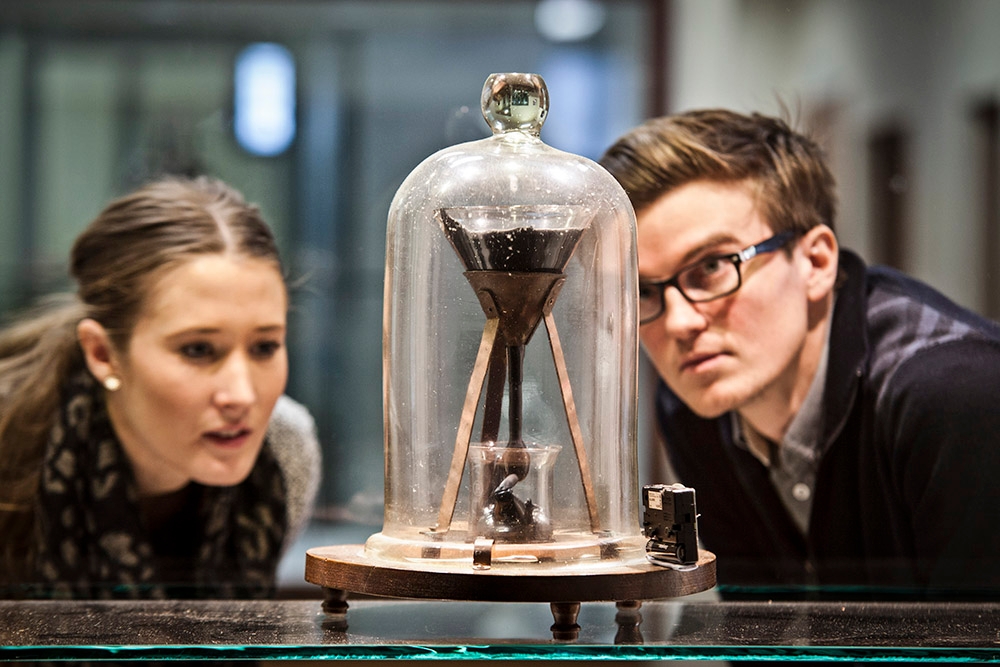
The experimental setup consists of a glass funnel. The upper part of the funnel is filled with pitch, while the lower end has been cut to form a narrow opening【11】. Under the influence of gravity, the pitch moves downward at an extremely slow rate and forms a droplet at the narrow opening【12】. As the droplet grows, its mass increases until it eventually overcomes surface tension, detaches, and falls【13】. Due to the extremely high viscosity of the pitch, this process proceeds at an exceedingly slow pace, and it may take years for the droplet to reach the point of detachment.
Viscosity is a measure of a fluid’s resistance to flow. According to assessments made in the context of the Pitch Drop Experiment, the viscosity of pitch is approximately ten billion times greater than that of water. This value indicates that the flow rate of pitch is nearly imperceptible on everyday time scales【14】.
Pitch Drop Experiment (ThePitchDrop)
After the experiment began, the first droplet fell from the funnel in 1938. Subsequent droplets have formed at similarly long intervals. Observations indicate that the time between droplet formations typically ranges between eight and thirteen years【15】.
The recorded years of droplet formation to date are as follows:
One of the most notable features of the Pitch Drop Experiment is that the moment of droplet detachment has rarely been directly observed. Because the detachment process occurs very rapidly, researchers have often only realized a droplet had fallen when they noticed a new droplet beginning to form beneath the funnel【16】.
In later stages of the experiment, camera systems were installed beneath the funnel to directly observe droplet formation. Particularly during the 2000s, with advances in digital imaging technology, continuous recording cameras were added to the setup, enabling the experiment to be viewed live over the internet【17】.
The formation of the ninth droplet was recorded in 2014【18】. The shorter duration of this droplet’s formation compared to previous ones suggests that changes in ambient temperature may affect the viscosity of pitch【19】.
The Pitch Drop Experiment is regarded as an important experimental model for understanding the behavior of fluids over extremely long time scales【20】. It provides a tangible example demonstrating that some materials appearing solid are in fact highly viscous liquids【21】.
At the same time, due to its extraordinary longevity, it is recognized as one of the world’s longest-running scientific experiments and is officially recorded in the Guinness World Records for this distinction【22】. The experiment continues today at the University of Queensland, with the pitch’s flow being regularly monitored【23】.
The experiment is also considered a compelling example of the importance of long-term observation in scientific research. This decades-long monitoring process is regarded as one of the experimental studies demonstrating that certain physical processes can only be understood over extremely long time scales【24】.
[1]
University of Queensland. “Pitch Drop Experiment.” Erişim: 16 Mart 2026.https://smp.uq.edu.au/pitch-drop-experiment
[2]
University of Queensland News. “Explainer: The Pitch Drop Experiment.” Erişim: 16 Mart 2026.https://news.uq.edu.au/2014-11-10-explainer-pitch-drop-experiment
[3]
National Museums Scotland. “Pitch Drop: One of the Longest Demonstrations in the World.” Erişim: 16 Mart 2026.https://www.nms.ac.uk/discover-catalogue/pitch-drop-one-of-the-longest-demonstrations-in-the-world
[4]
University of Queensland News. “Explainer: The Pitch Drop Experiment.” Erişim: 16 Mart 2026.https://news.uq.edu.au/2014-11-10-explainer-pitch-drop-experiment
[5]
University of Queensland. “Pitch Drop Experiment.” Erişim: 16 Mart 2026.https://smp.uq.edu.au/pitch-drop-experiment
[6]
University of Queensland News. “Explainer: The Pitch Drop Experiment.” Erişim: 16 Mart 2026.https://news.uq.edu.au/2014-11-10-explainer-pitch-drop-experiment
[7]
University of Queensland. “Pitch Drop Experiment.” Erişim: 16 Mart 2026.https://smp.uq.edu.au/pitch-drop-experiment
[8]
University of Queensland. “Pitch Drop Experiment.” Erişim: 16 Mart 2026.https://smp.uq.edu.au/pitch-drop-experiment
[9]
National Museums Scotland. “Pitch Drop: One of the Longest Demonstrations in the World.” Erişim: 16 Mart 2026.https://www.nms.ac.uk/discover-catalogue/pitch-drop-one-of-the-longest-demonstrations-in-the-world
[10]
University of Queensland. “Pitch Drop Experiment.” Erişim: 16 Mart 2026.https://smp.uq.edu.au/pitch-drop-experiment
[11]
University of Queensland. “Pitch Drop Experiment.” Erişim: 16 Mart 2026.https://smp.uq.edu.au/pitch-drop-experiment
[12]
University of Queensland News. “Explainer: The Pitch Drop Experiment.” Erişim: 16 Mart 2026.https://news.uq.edu.au/2014-11-10-explainer-pitch-drop-experiment
[13]
University of Queensland News. “Explainer: The Pitch Drop Experiment.” Erişim: 16 Mart 2026.https://news.uq.edu.au/2014-11-10-explainer-pitch-drop-experiment
[14]
University of Queensland News. “Explainer: The Pitch Drop Experiment.” Erişim: 16 Mart 2026.https://news.uq.edu.au/2014-11-10-explainer-pitch-drop-experiment
[15]
The Conversation. “Explainer: The Pitch Drop Experiment.” Erişim: 16 Mart 2026.https://theconversation.com/explainer-the-pitch-drop-experiment-33734
[16]
The Conversation. “Explainer: The Pitch Drop Experiment.” Erişim: 16 Mart 2026.https://theconversation.com/explainer-the-pitch-drop-experiment-33734
[17]
University of Queensland News. “Explainer: The Pitch Drop Experiment.” Erişim: 16 Mart 2026.https://news.uq.edu.au/2014-11-10-explainer-pitch-drop-experiment
[18]
The Conversation. “Explainer: The Pitch Drop Experiment.” Erişim: 16 Mart 2026.https://theconversation.com/explainer-the-pitch-drop-experiment-33734
[19]
The Conversation. “Explainer: The Pitch Drop Experiment.” Erişim: 16 Mart 2026.https://theconversation.com/explainer-the-pitch-drop-experiment-33734
[20]
University of Queensland News. “Explainer: The Pitch Drop Experiment.” Erişim: 16 Mart 2026.https://news.uq.edu.au/2014-11-10-explainer-pitch-drop-experiment
[21]
University of Queensland News. “Explainer: The Pitch Drop Experiment.” Erişim: 16 Mart 2026.https://news.uq.edu.au/2014-11-10-explainer-pitch-drop-experiment
[22]
National Museums Scotland. “Pitch Drop: One of the Longest Demonstrations in the World.” Erişim: 16 Mart 2026.https://www.nms.ac.uk/discover-catalogue/pitch-drop-one-of-the-longest-demonstrations-in-the-world
[23]
University of Queensland. “Pitch Drop Experiment.” Erişim: 16 Mart 2026.https://smp.uq.edu.au/pitch-drop-experiment
[24]
University of Queensland News. “Explainer: The Pitch Drop Experiment.” Erişim: 16 Mart 2026.https://news.uq.edu.au/2014-11-10-explainer-pitch-drop-experiment


No Discussion Added Yet
Start discussion for "Pitch Drop Experiment" article
History
Experimental Setup and Working Principle
Droplet Formation and Observations
Recent Observations
Scientific Significance