

badge icon

This article was automatically translated from the original Turkish version.

Article

Planet Gear System

Quote

Planetary gear system (or epicyclic gear system) is a compact gear mechanism consisting of a central sun gear, multiple planet gears rotating around it, and an outer ring gear with internal teeth. This system is particularly used in applications requiring high torque and precise speed control. The behavior of a planetary gear system depends on which component is held stationary, which serves as the input, and which serves as the output. Different combinations can achieve speed increase, speed reduction, reverse direction, or direct drive.
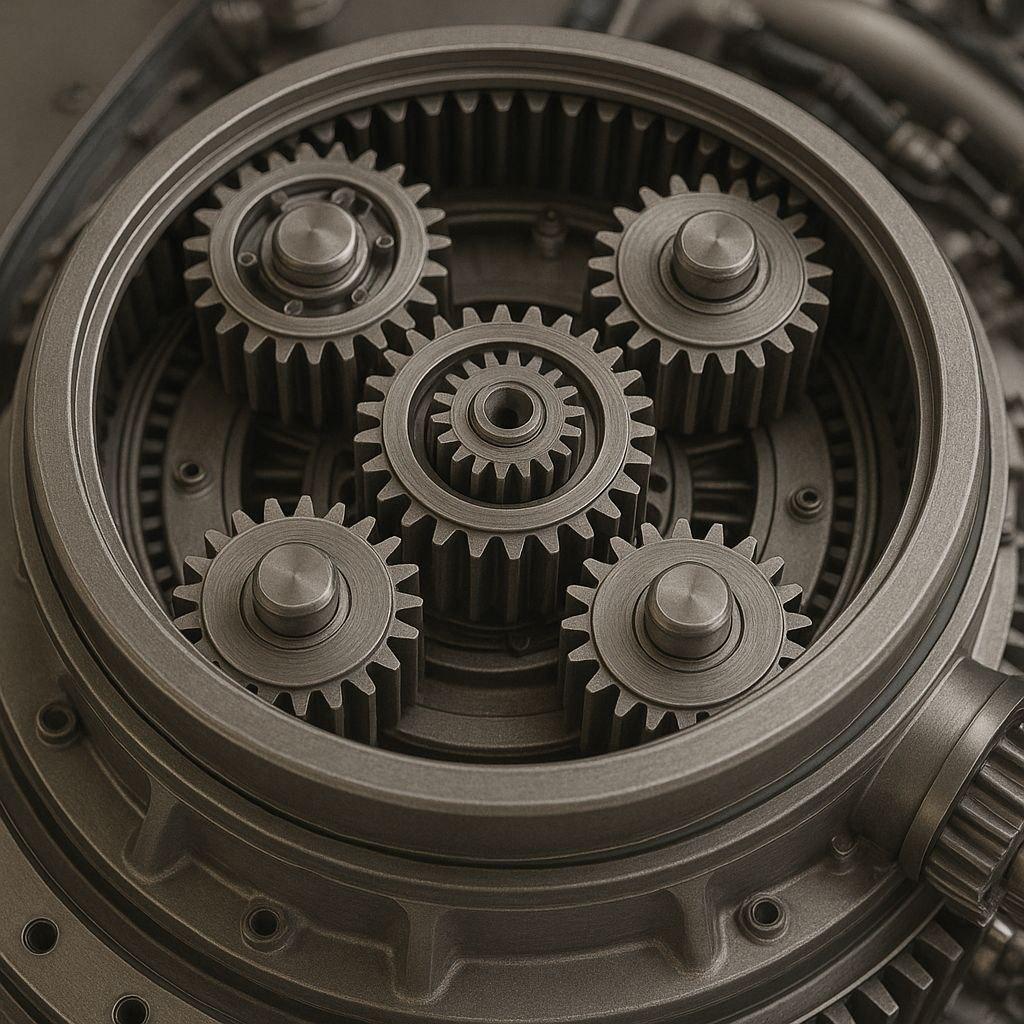

A single-stage planetary gear system with one sun gear, four planet gears, and one ring gear (generated by artificial intelligence.)

Basic Components

A planetary gear system has four fundamental components.

Sun Gear

  • Located at the center of the system.
  • In direct mesh with the other gears.

Planet Gears

  • Rotate around the sun gear.
  • Mounted on a carrier called the planet carrier.
  • Typically three or more planet gears are used to distribute load.

Ring Gear

  • A ring with internal teeth on the outer periphery.
  • In mesh with the planet gears.

Planet Carrier

  • Connects and supports the planet gears.


Elements of a planetary gear system (Planetary Mechanisms)

Basic Definitions

  • Speed: All parallel shafts rotating in the same direction are assigned the same sign. The driving side is generally taken as the reference direction. Clockwise rotation is designated as positive (+) and counterclockwise as negative (–).
  • Speed ratio (i): If the input and output shafts rotate in the same direction, i > 0 (positive); if they rotate in opposite directions, i < 0 (negative). A positive speed ratio (+) is called a “plus reducer,” in which the output speed is lower than the input speed. A negative speed ratio (–) is called a “minus reducer,” in which the output speed is higher than the input speed.
  • Torque: Torques are signed according to their direction of rotation. If the applied torque acts in the direction of rotation, it is assigned a positive (+) sign; otherwise, it is negative (–).
  • Power (efficiency): Power input to the planetary system (reducer) is positive (+), while output power is negative (–). This is because the reaction torque on the shaft connected to the planetary system acts opposite to the direction of output rotation. The power lost between input and output is negative (–) and is dissipated as heat.
  • Pitch: The arc distance along the pitch circle between the flank of one tooth and the flank of the adjacent tooth.
  • Module: A constant ratio between meshing gears. It is defined as the pitch divided by π (pi).
  • Pitch circle diameter: The diameter of the circle along which two gears theoretically mesh without slipping.
  • Outer diameter: The largest diameter of the gear. It depends on the pitch circle diameter, module, and number of teeth.
  • Root diameter: The diameter of the circle that defines the bottom of the gear teeth.
  • Tooth thickness: The width of the tooth along the pitch circle.
  • Tooth space: The width of the space between two adjacent teeth along the pitch circle.
  • Tooth height: Half the difference between the outer diameter and the root diameter.
  • Addendum height: The portion of a tooth that lies above the pitch circle.
  • Clearance height: The portion of a tooth that lies below the pitch circle.
  • Center distance: Half the sum of the pitch circle diameters of two spur gears.

Advantages

  • High torque transmission – Multiple planet gears share the load.
  • Compact design – Occupies less space compared to other gear systems.
  • Speed ratio – Capable of achieving high speed ratios.
  • Versatility – Enables multiple speed ratios and directions of rotation.
  • Balanced load distribution – Reduces vibration and wear.

Disadvantages

  • Maintenance – As enclosed systems, maintenance is costly and complex.
  • Bearing – Due to the complex structure, bearing alignment must be highly precise.
  • Lubrication – As enclosed systems, active lubrication methods are generally not feasible.

Applications

  • Automotive: Automatic transmissions, differentials.
  • Industrial: Robotics, conveyor systems.
  • Energy: Wind turbines.
  • Aerospace: Helicopter transmissions.
  • Power Tools: Drills, mixers.

Author Information

Avatar
AuthorFurkan AyganDecember 9, 2025 at 7:41 AM

Tags

Discussions

No Discussion Added Yet

Start discussion for "Planet Gear System" article

View Discussions

Contents

  • Basic Components

    • Sun Gear

    • Planet Gears

    • Ring Gear

    • Planet Carrier

  • Basic Definitions

  • Advantages

  • Disadvantages

  • Applications

Ask to Küre