

This article was automatically translated from the original Turkish version.
+2 More
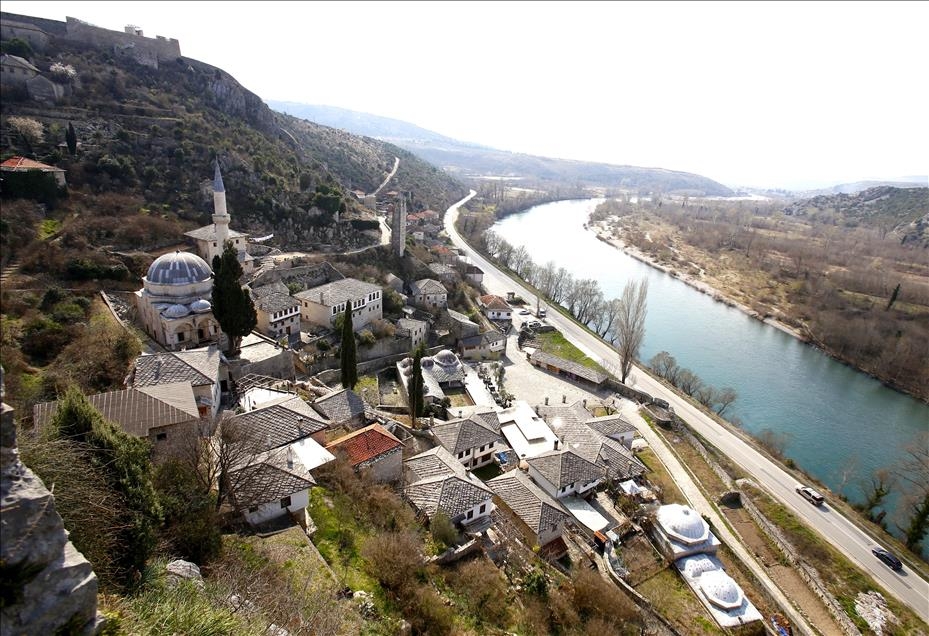
Počitelj (Bosnian: Počitelj) is a historic settlement located within the boundaries of the Čapljina municipality in the Herzegovina-Neretva Canton of southern Bosnia and Herzegovina. It preserves its architectural fabric from the Medieval and Ottoman periods. Situated on the left bank of the Neretva River, the town has been on UNESCO’s Tentative List of World Heritage Sites since 2007 due to its stonework architecture and strategic military layout.

Počitelj - Bosnia and Herzegovina (Anadolu Ajansı)
The origins of Počitelj as a settlement date back to the period of the Medieval Kingdom of Bosnia. Although there is no consensus among historical sources regarding the exact date of the construction of the core fortress, prominent researchers such as Jireček and Ashboth attribute its initial construction to King Tvrtko I of Bosnia, suggesting the years 1383 or 1388. The town’s name first appears in written records in edicts issued in 1444 by King Alfonso V of Aragon and Emperor Frederick III of the Holy Roman Empire.【1】 Due to its strategic location, Počitelj was a critical point for regional dominance. After the Ottoman conquest of Bosnia in 1463, it passed into Hungarian hands and served as a defensive outpost manned by a Hungarian garrison until 1471.
In September 1471, the town came under Ottoman control following a siege led by Ottoman forces under the command of Herceg Vojvoda Hamza Bey. This victory was formally recognized in a congratulatory letter dated 20 September 1471 from the Dubrovnik Senate, marking a historic turning point.【2】 Following the conquest, the fortress was reinforced with paid guards (müstahfız) brought from Balkan cities such as Thessaloniki, Niš, Belgrade, and Ioannina, as required by Ottoman defense strategy. Initially recorded in early census documents as a small military garrison, the settlement gradually expanded toward the riverbank, developing into a civilian Muslim town (kasaba) centered around the military core.【3】
In the 16th century, Počitelj’s strategic value reached its peak as it lay directly on the Ottoman-Venetian frontier. A coordinated defense system was established in conjunction with the Seddülislam Fortress built at Gabela, serving as a barrier against Venetian and Uskok attacks originating from the Adriatic.

"The Jewel of Herzegovina" Počitelj (Anadolu Ajansı)
In the late 17th century, during the Ottoman-Venetian wars of 1693, the town suffered destruction and was set on fire. However, it was rebuilt between 1701 and 1702 under the supervision of Nevesinli Receb Pasha, who oversaw the reconstruction of its walls and the complete encirclement of the settlement. The establishment of the captaincy headquarters in 1713 and the appointment of a kadı (judicial magistrate) in 1782 transformed Počitelj into a major administrative center by combining its military strength with civil and legal authority. Until the 19th century, the town retained the title “Key of Herzegovina,” but as the frontier shifted and military needs declined, it lost its administrative function and evolved into a settlement preserving its historic fabric.【4】
Počitelj is located approximately 27 kilometers south of Mostar and 32 kilometers from Metković on the Adriatic coast. The town is built on a rocky outcrop overlooking the strategic Neretva Valley, which connects the Adriatic coast to the interior of the Balkans and served as a major trade and communication route. Its physical structure consists of a defensive fortress at the highest point, with civilian architecture descending in terraced steps toward the river. Due to the limited availability of arable land in the region, Počitelj was designed not as an economic production center but as a strategic military outpost and transit point to control regional traffic and ensure security.
Počitelj is regarded as one of the finest examples of Ottoman urban planning in the Balkans. Its physical development conforms perfectly to the amphitheater-like natural topography, creating an integrated fabric where military and civilian life are interwoven. The urban structure begins with the inner fortress at the summit and extends downward in a stepped sequence of stone buildings, narrow streets, and terraced gardens. The settlement, covering an area of 3.25 hectares, features buildings arranged so that they do not obstruct each other’s views or sunlight.【5】
The monumental religious structure that defines Počitelj’s silhouette is the mosque built between 1562 and 1563 (H. 970) by Mûsâ’s son Hacı Ali. This structure is considered one of the representative examples of Ottoman architecture in Bosnia and Herzegovina, embodying the classical style through its square plan measuring 9.60 x 9.60 meters, its tall drum-supported main dome, and its penwork decorative elements.【6】 The minaret adjacent to the mosque, though damaged during wartime conflicts, has been restored to its original appearance.【7】

Počitelj Architectural Structure (Anadolu Ajansı)
The social and economic transformation of the town was significantly shaped by the contributions of Şişman İbrahim Paşa (Ibrahim Kethüda), the steward of Grand Vizier Köprülüzâde Fazıl Ahmed Pasha. In the mid-17th century, he commissioned the construction of a madrasa, caravanserai (han), bathhouse, and clock tower, which transformed Počitelj from a military outpost into a cultural and commercial center (kasaba).【8】 The six-domed madrasa building and the clock tower rising defiantly over the valley form the town’s monumental center.
The core of Počitelj’s civilian architecture consists of houses renowned for their regional stonework. These homes are characterized by roofs covered with thin, flat stones locally known as “kayağan taşı.” Typically enclosed by high stone walls, the residences feature a layout with storage and kitchen spaces on the ground floor and living areas (sofa) and principal rooms on the upper floor. The Gavran Kaptan House, built in the 18th century and the largest civilian structure in the town, exemplifies domestic architecture of its era through its large windows, woodwork, and interior layout.【9】
With the incorporation of Bosnia and Herzegovina into the Habsburg (Austria-Hungary) Empire in 1878, the town completely lost its centuries-old functions as a “frontier garrison” and “Key of Herzegovina.” The emergence of new transportation routes and modern administrative centers away from Počitelj led to its economic and social stagnation.
During this period, as the population declined, Počitelj was rediscovered in the mid-20th century thanks to the preservation of its physical fabric. Restored in the 1960s for tourism, the settlement became a meeting point for painters, sculptors, and writers from around the world through the establishment of the international “Počitelj Artists’ Colony” in 1964.【10】

Historic Turkish Village Počitelj (Anadolu Ajansı)
The Bosnian War of 1991–1995 marked one of the most significant periods in the town’s history. During the conflict, native Muslim residents were expelled as a result of attacks by Croatian nationalist forces, and a systematic campaign of destruction targeting Počitelj’s historic identity was initiated. In particular, during bombardments in 1993, the minaret of the Hacı Ali Mosque — an example of Ottoman architecture — was demolished, causing the central dome to collapse. 【11】 Additionally, the Şişman İbrahim Paşa Bathhouse, the madrasa, and numerous historic houses were either completely destroyed or severely damaged.【12】
Following the end of the war, rehabilitation efforts supported by UNESCO, the World Monuments Fund (WMF), and the international community restored Počitelj. The restoration project completed in 2003 reconstructed the Hacı Ali Mosque, the clock tower, and the historic han according to their original forms, and a large portion of the ruined stone houses were repaired.【13】 As a result, a significant portion of the displaced local population returned to the town.
[1]
UNESCO, "The historic urban site of Počitelj" whc.unesco.org, accessed 7 March 2026. https://whc.unesco.org/en/tentativelists/5092/.
[2]
Machiel Kiel, "Počitelj" TDV İslam Ansiklopedisi, accessed 7 March 2026, https://islamansiklopedisi.org.tr/pocitel.
[3]
Machiel Kiel, "Počitelj" TDV İslam Ansiklopedisi, accessed 7 March 2026, https://islamansiklopedisi.org.tr/pocitel.
[4]
Machiel Kiel, "Počitelj" TDV İslam Ansiklopedisi, accessed 7 March 2026, https://islamansiklopedisi.org.tr/pocitel.
[5]
Machiel Kiel, "Počitelj" TDV İslam Ansiklopedisi, accessed 7 March 2026, https://islamansiklopedisi.org.tr/pocitel.
[6]
Machiel Kiel, "Počitelj" TDV İslam Ansiklopedisi, accessed 7 March 2026, https://islamansiklopedisi.org.tr/pocitel.
[7]
Machiel Kiel, "Počitelj" TDV İslam Ansiklopedisi, accessed 7 March 2026, https://islamansiklopedisi.org.tr/pocitel.
[8]
Machiel Kiel, "Počitelj" TDV İslam Ansiklopedisi, accessed 7 March 2026, https://islamansiklopedisi.org.tr/pocitel.
[9]
Machiel Kiel, "Počitelj" TDV İslam Ansiklopedisi, accessed 7 March 2026, https://islamansiklopedisi.org.tr/pocitel.
[10]
Machiel Kiel, "Počitelj" TDV İslam Ansiklopedisi, accessed 7 March 2026, https://islamansiklopedisi.org.tr/pocitel.
[11]
Machiel Kiel, "Počitelj" TDV İslam Ansiklopedisi, accessed 7 March 2026, https://islamansiklopedisi.org.tr/pocitel.
[12]
UNESCO, "The historic urban site of Počitelj" whc.unesco.org, accessed 7 March 2026. https://whc.unesco.org/en/tentativelists/5092/.
[13]
UNESCO, "The historic urban site of Počitelj" whc.unesco.org, accessed 7 March 2026. https://whc.unesco.org/en/tentativelists/5092/.


History and Foundation
Geographical Location
Architectural Structure and Urban Fabric
Modern Period and Cultural Heritage