


This article was automatically translated from the original Turkish version.
+2 More
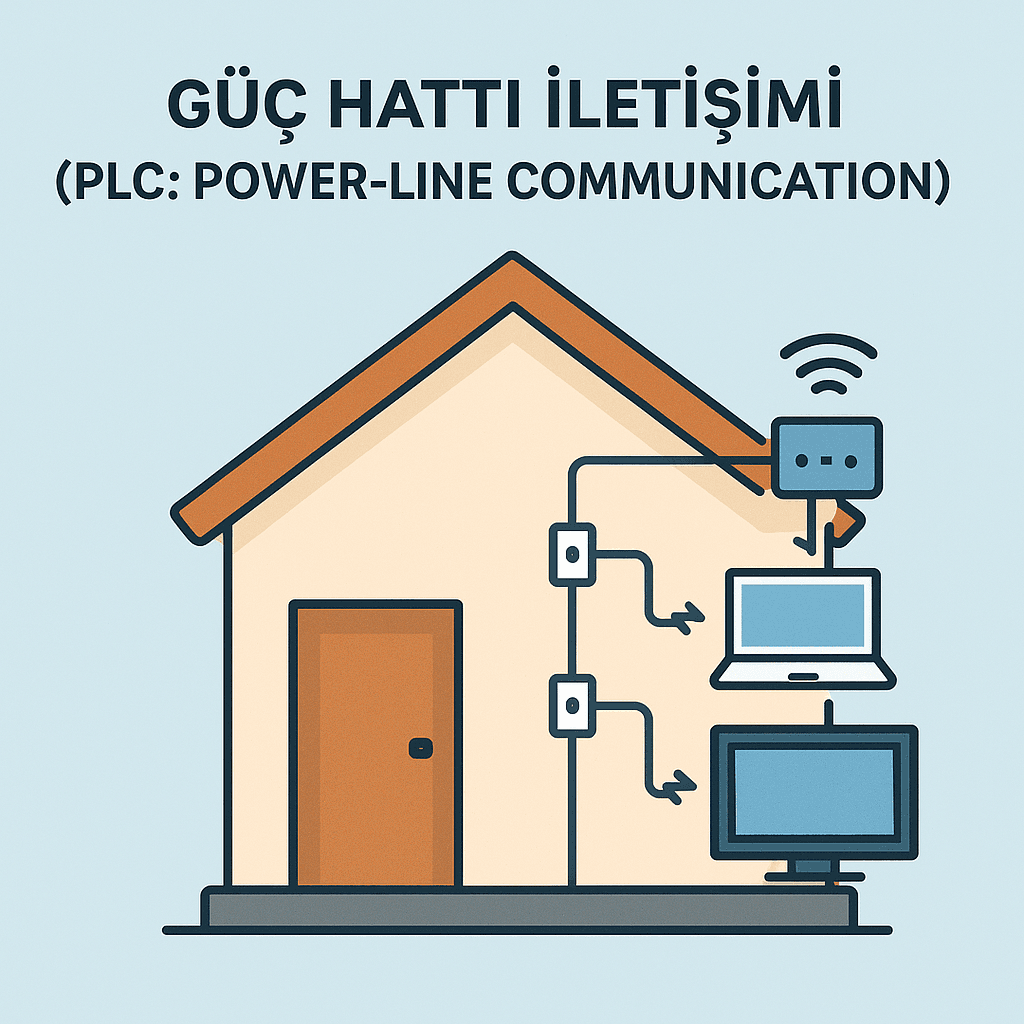
Generated with Artificial Intelligence.
Power Line Communication (PLC)
Name(s) | Power Line Communication | ||||||||
|---|---|---|---|---|---|---|---|---|---|
English Name | Power-Line Communication (PLC) | ||||||||
Definition(s) | A wired communication technology that enables data transmission over existing electrical transmission lines. | ||||||||
Scope(s) | Low and high voltage power lines medium | ||||||||
Classification(s) | Ultra Wideband PLC (30–300 Hz) Narrowband PLC (3 kHz–500 kHz) Broadband PLC (1 MHz–30 MHz) | ||||||||
Main Application Area(s) | Remote meter reading Smart Grids SCADA systems Home automation Energy monitoring and management | ||||||||
Advantage(s) | Utilization of existing infrastructure No additional cabling required Provides communication in rural and hard-to-reach areas | ||||||||
Standards | CENELEC (Europe) FCC (USA) ARIB (Japan) | ||||||||
Power-Line Communication (PLC) is a communication technology based on the principle of using existing power lines, originally designed for electrical energy transmission, as a medium for data transmission. This method enables the transmission of information over low, medium, or high-voltage power lines without requiring additional cabling. PLC technology provides economical and practical solutions, particularly in hard-to-reach areas, by simultaneously performing both communication and energy transmission over the same lines.

Visual Explaining Power-Line Communication (Generated by Artificial Intelligence)
The earliest examples of PLC technology date back to the 19th century. In 1838, Edward Davy proposed a system for measuring battery voltage levels over telegraph lines. In the early 20th century, inventors such as Chester Thoradson developed PLC-based systems for remote meter reading, although their commercial success remained limited. The first practical applications emerged in the 1950s under the name “Ripple Control,” used to manage public lighting systems. From the 1990s onward, PLC evolved into a more sophisticated communication infrastructure, standardized by CENELEC in defined frequency bands.
PLC technology is categorized into three types based on the frequency bands used:
Compared to classical communication media, power lines are highly complex and unfavorable for communication. The channel characteristics vary over time and are both frequency-dependent and location-dependent. Power lines exhibit problems such as impedance mismatches, signal reflections (multipath propagation), high noise levels, and significant attenuation. Therefore, channel modeling is critical in PLC systems.
The model developed by Zimmermann and Dostert assumes that signals on power lines reach the receiver via multiple paths. These signals arrive superimposed with time delays, amplitude attenuation, and phase shifts.
Power line channels are not limited solely to Additive White Gaussian Noise (AWGN). The following types of noise are observed in the channel:
Efficient signal transmission in PLC systems depends on impedance matching between the transmitter, channel, and receiver. In low-voltage networks, impedance can vary between 10–1000 Ω. Imbalances in channel impedance lead to signal attenuation. Two primary coupling methods are used to connect PLC devices to power lines:
Modulation techniques used in PLC systems vary according to the challenges of the transmission medium:
PLC technology is currently used in various fields:
The advantages of PLC systems include the reuse of existing electrical infrastructure, low installation and operational costs, and the ability to provide communication even in remote areas with inadequate infrastructure. PLC technology can be integrated into applications such as remote meter reading, home automation, and distribution automation systems. This enables data transmission at the home area network (HAN), neighborhood area network (NAN), or field area network (FAN) levels.
However, PLC systems have certain technical limitations:
Power-Line Communication (PLC) is an innovative communication technology that uses power transmission lines as a medium for data transmission, reducing infrastructure costs and improving accessibility. With the development of smart grids, PLC has found widespread application in areas such as remote meter reading, distribution automation, and home energy management. However, this technology faces technical limitations including the structural complexity of the channel, the diversity of noise types, impedance mismatches, and electromagnetic interference. Nevertheless, most of these challenges can be overcome through advanced channel modeling and modulation techniques. PLC continues to be an important alternative in the pursuit of low-cost, accessible, and sustainable communication infrastructure.
BAL, Güngör, Recep GÜLÖNÜ, and Şevki DEMİRBAŞ. "Enerji Hatları Üzerinden Elektrik Sayacının Okunması ve Deneysel Analizi." Gazi University Journal of Science Part C 4, no. 1 (2016): 1–11.
KABALCI, Yasin, Uğur SORGUCU, and İbrahim DEVELİ. "Haberleşme Ortamı Olarak Enerji Hatlarının Kullanımının İncelenmesi." Erciyes Üniversitesi, 2022.
TANRIÖVEN, Kürşat, Ferhat DALDABAN, and Ali Uğur ÇELİK. "Elektrik Dağıtım Sisteminde Enerji Hatları Üzerinden Haberleşmede Geniş Bant Haberleşme." Erciyes Üniversitesi Elektrik Elektronik Mühendisliği Bölümü, 2015.
“Güç Hattı Haberleşmesi (PLC) Nedir ve Nasıl Çalışır?” Medium Türkiye. Accessed [insert date]. https://medium.com/türkiye/güç-hattı-haberleşmesi-plc-nedir-ve-nasıl-çalışır-3aa5885b70b7.
“What is Power Line Communication (PLC) and How Does It Work?” Circuit Digest. https://circuitdigest.com/article/what-is-power-line-communication-plc-and-how-does-it-work.

Generated with Artificial Intelligence.
Power Line Communication (PLC)
Name(s) | Power Line Communication | ||||||||
|---|---|---|---|---|---|---|---|---|---|
English Name | Power-Line Communication (PLC) | ||||||||
Definition(s) | A wired communication technology that enables data transmission over existing electrical transmission lines. | ||||||||
Scope(s) | Low and high voltage power lines medium | ||||||||
Classification(s) | Ultra Wideband PLC (30–300 Hz) Narrowband PLC (3 kHz–500 kHz) Broadband PLC (1 MHz–30 MHz) | ||||||||
Main Application Area(s) | Remote meter reading Smart Grids SCADA systems Home automation Energy monitoring and management | ||||||||
Advantage(s) | Utilization of existing infrastructure No additional cabling required Provides communication in rural and hard-to-reach areas | ||||||||
Standards | CENELEC (Europe) FCC (USA) ARIB (Japan) | ||||||||
No Discussion Added Yet
Start discussion for "Power Line Communication (PLC)" article
Historical Development
Technical Classification and Frequency Bands
Characteristics of the Power Line Channel
Multipath Channel Model
Noise Types and Effects
Impedance Matching and Coupling Techniques
Modulation Techniques
Applications and Use Cases
Advantages and Limitations