This article was automatically translated from the original Turkish version.
Origin(s) | Medial supracondylar process of the humerus coronoid process of the ulna | ||||||||
|---|---|---|---|---|---|---|---|---|---|
Adhesion | Lateral surface of the radius (middle portion) | ||||||||
Nerve | Median nerve (C6–C7) | ||||||||
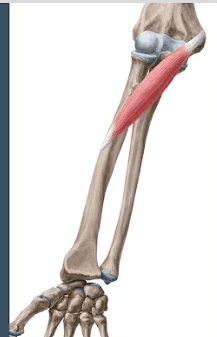
Pronator Teres Muscle is one of two muscles responsible for pronation of the forearm, performing this action together with the pronator quadratus. In anatomical position, it functions to rotate the palm posteriorly. This muscle runs obliquely between the radius and ulna and holds clinical significance due to its role in forming the medial boundary of the cubital fossa and the passage of the median nerve through its deeper layers.
The pronator teres muscle is characterized by a two-headed structure. The humeral head originates from the medial supracondylar ridge of the humerus and the common flexor tendon; this head is larger and more superficial. The ulnar head arises from the medial surface of the coronoid process of the ulna. The muscle travels obliquely across the anterior surface of the forearm and inserts onto the lateral surface of the radius, just distal to the attachment site of the supinator muscle. The median nerve courses between the two heads of the muscle. The lateral border of the pronator teres forms the medial boundary of the cubital fossa.
The pronator teres muscle develops embryologically from the mesoderm and is innervated by the median nerve, which arises from the medial and lateral cords of the brachial plexus. It is classified among the superficial flexor muscles of the anterior compartment of the forearm. Occasionally, the ulnar head may be absent, or variations may occur with additional muscle bundles originating from structures such as the biceps brachii or brachialis.
The muscle is innervated by the median nerve (C6–C7 root levels), which originates from the brachial plexus. Signals originating from the precentral gyrus of the cerebral cortex and traveling via the corticospinal tracts to spinal segments C5–T1 reach the pronator teres through the median nerve to induce contraction. The corticospinal pathway and the medulla spinalis play important roles in the neural transmission to this muscle. Its vascular supply is provided by arterial branches similar to those supplying the other superficial flexor muscles of the forearm; however, no specific arterial name is identified in this text.
The pronator teres rotates the forearm into pronation, turning the palm posteriorly. This movement is particularly prominent during elbow flexion. It also contributes weakly to elbow flexion and works in conjunction with the pronator quadratus. The most well-known clinical condition associated with this muscle is Pronator Teres Syndrome. In this syndrome, compression of the median nerve between the two heads of the muscle results in numbness, pain, and difficulty with pronation in the forearm. Although this condition presents symptoms similar to carpal tunnel syndrome, it has distinct clinical findings—for example, the Phalen test is negative while the Tinel sign is positive in the forearm. The tendon of the pronator teres is also used in tendon transfer procedures; for instance, in patients with radial nerve palsy, the pronator teres tendon may be redirected to the extensor carpi radialis brevis tendon to restore wrist extension.
Bozkurt, Murat, and Alaittin Elhan. "Pronator Teres Kasının Morfolojik Özellikleri Üzerine Bir Çalışma." Gazi Medical Journal 17, no. 3 (2006): 131–134.
Kenhub. "Pronator Teres Kası."Kenhub Anatomi Library. Accessed July 18, 2025. https://www.kenhub.com/en/library/anatomy/pronator-teres-muscle.
PhysioPedia. "Pronator Teres." Physio-Pedia. Accessed July 18, 2025. https://www.physio-pedia.com/Pronator_Teres.
TeachMeAnatomy. "Pronator Teres." TeachMeAnatomy.info. Accessed July 18, 2025.
Çiftci, Mehmet Ertuğrul. "Median Sinirin Pronator Teres Kasındaki Anatomik Seyri Üzerine Morfometrik Bir Çalışma." Master's thesis,Atatürk Üniversitesi, 2006. http://earsiv.atauni.edu.tr/xmlui/bitstream/handle/123456789/1248/mehmet_ertu%C4%9Frul_%C3%A7iftci_tez.pdf?sequence=1.

Origin(s) | Medial supracondylar process of the humerus coronoid process of the ulna | ||||||||
|---|---|---|---|---|---|---|---|---|---|
Adhesion | Lateral surface of the radius (middle portion) | ||||||||
Nerve | Median nerve (C6–C7) | ||||||||
No Discussion Added Yet
Start discussion for "Pronator Teres Muscle" article
Anatomical Structure
Embryological Origin and Classification
Innervation and Vascular Supply
Function and Clinical Relevance