This article was automatically translated from the original Turkish version.
+2 More
Location | Eğirdir Türkiye Isparta | ||||||||
|---|---|---|---|---|---|---|---|---|---|
Architecture(s) | Acropolis Public Buildings Stoa Agora | ||||||||
Settlement | Hellenistic Period, Roman Period, Early Byzantine Period | ||||||||
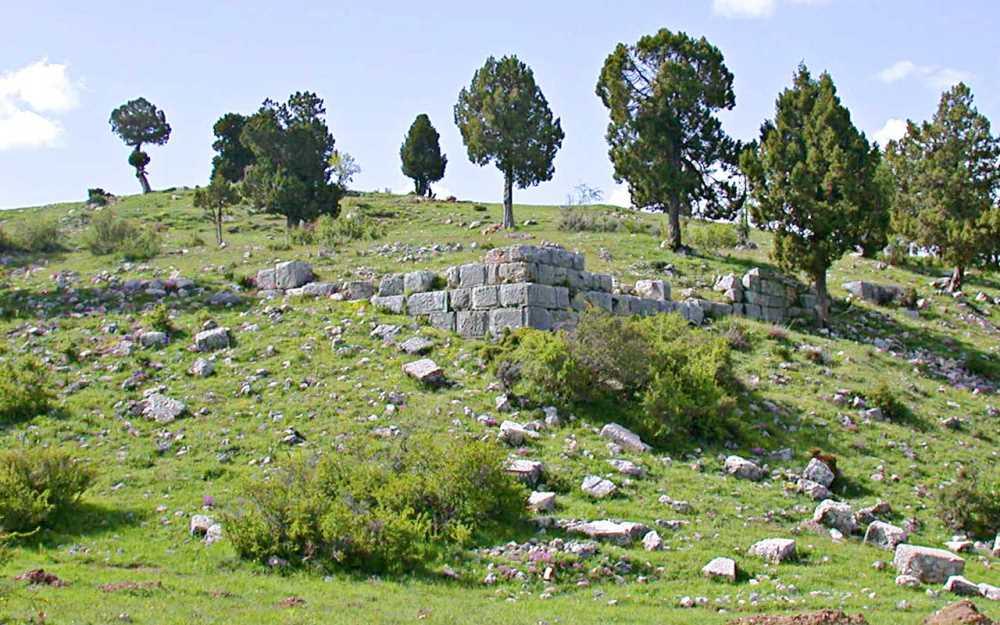
Prostanna Ancient City is an ancient settlement located approximately 1.5 km northwest of Akpınar village in the Eğirdir district of Isparta, on the Camili Plateau. Founded on the southern slopes of ancient Mount Viarus, the settlement initially emerged as a defensive site and later underwent urbanization during the Hellenistic Period.
Ancient sources indicate that Ptolemy placed Prostanna in Central Pisidia, while Hierocles situated it between Tymbriada and Konane.
The earliest epigraphic record mentioning Prostanna dates to 113 BCE. This inscription, erected on Delos by the people of Prostaenneis, is significant for demonstrating the city’s ties to Rome. During the Roman Imperial Period, Prostanna minted coins in its own name, a practice that continued from the 1st century BCE to the end of the 3rd century CE.
Due to its strategic location, Prostanna was fortified during the Hellenistic Period. Situated on the slopes of Mount Viarus southwest of Eğirdir Lake, the settlement was positioned to control the surrounding road networks. However, during the Roman period, Prostanna did not develop as extensively as other regional cities due to its distance from major trade routes.
In Late Antiquity, the Acropolis of Prostanna was re-fortified. Ceramics found at the site indicate that the settlement persisted until the 5th–6th centuries CE. During the Byzantine Period, Prostanna was identified with Eudoxiopolis, mentioned in Hierocles’ list.
The city is situated in a position connecting Parlais, Seleukeia Sidera, and Tymbriada. Defensive structures including towers, city walls, and outposts were constructed around it. Mount Viarus (approximately 1750 m) served as a natural acropolis, and agricultural terraces were built around the settlement.
Prostanna Ancient City is located on the southern slopes of Mount Viarus and follows a topographically adapted urban layout. Due to the limited availability of natural flat areas, extensive terracing systems were employed. These terraces served both defensive and residential purposes and also created arable land.
The city exhibits a military character. Around the Acropolis, eight towers and extensive curtain walls were constructed, with entrance gates protected by this defensive system. To the south of the Acropolis, a structure with outpost function and surrounding walls has been identified. Additionally, towers and outposts were built at strategic points near the city. A long fortification wall was constructed along the southern slope of Mount Viarus, used as an upper refuge area.
The central point of the city is the Acropolis. To the north of the Acropolis, an agora, a stoa, and other public buildings have been identified. The areas to the east and northeast of the Acropolis were terraced for civilian habitation. Dense ceramic finds in these zones confirm the presence of residential structures.
Public and religious buildings have been identified in the northern sector of the Acropolis. Temples and altar areas have also been located within the city. These structures formed the center of the city’s religious and social life.
Within the city, shops, stone quarries, square-plan buildings, and various functional structures have been identified. Water channels and water supply points play a significant role in the city’s infrastructure. In addition to defensive, religious, and public buildings, terraced walls constructed for agricultural purposes are an integral part of the city’s architectural plan.
Surface surveys conducted at Prostanna Ancient City have yielded numerous ceramic and coin finds.
The ceramics recovered at the site date from the 1st century BCE to the 5th–6th centuries CE. Bowls and plates are particularly abundant among these finds. Decorated ceramics form a significant group, with some examples documented through drawings. These discoveries confirm continuous occupation of the city from the Hellenistic Period through the Early Byzantine Period.
Typological analysis of the coins demonstrates that Prostanna minted its own currency from the 1st century BCE until the end of the 3rd century CE. This indicates that the city possessed a politically and economically independent identity.
In addition to dense ceramic fragments found around the Acropolis, stone quarries, water channels, a necropolis area, and various architectural remains have been documented. These findings reveal that the city possessed a sophisticated infrastructure for both defense and daily life.
Research on the city began in the late 19th century. Michael Ballance, during his surveys in the region in 1957, suggested that Prostanna may have been established before the Hellenistic Period and originally functioned as a military outpost. The work of Mehmet and Nesrin Özsait contributed significantly to identifying the city’s name and documenting its epigraphic material. Since 2013, systematic research has been conducted under the leadership of Assoc. Prof. Dr. Fikret Özcan as part of the Northern Pisidia Surface Survey Project.
Kızıl Yalçın, Fatma, and Fikret Özcan. "Prostanna Antik Kenti." *Süleyman Demirel Üniversitesi Sosyal Bilimler Enstitüsü Dergisi*, no. 23/1 (2016): 135–162. Accessed September 27, 2025. https://dergipark.org.tr/tr/download/article-file/281572
Kızıl Yalçın, Fatma. *Prostanna Antik Kenti*. Master's thesis, Süleyman Demirel Üniversitesi, Sosyal Bilimler Enstitüsü, 2015. Accessed September 27, 2025. https://tez.yok.gov.tr/UlusalTezMerkezi/tezDetay.jsp?id=kZ0hjYHc6ndRF7eTBwxo8A&no=uXCW-v5cuWQJ8XFcw0A2tQ
T.C. Ministry of Culture and Tourism Isparta Provincial Directorate of Culture and Tourism. "Ören Yerleri." Accessed September 27, 2025. https://isparta.ktb.gov.tr/TR-70971/oren-yerleri.html
Türkiye Kültür Portalı. "Prostanna Harabesi - Isparta." Accessed September 27, 2025. https://www.kulturportali.gov.tr/turkiye/isparta/gezilecekyer/prostanna-harabesi

Location | Eğirdir Türkiye Isparta | ||||||||
|---|---|---|---|---|---|---|---|---|---|
Architecture(s) | Acropolis Public Buildings Stoa Agora | ||||||||
Settlement | Hellenistic Period, Roman Period, Early Byzantine Period | ||||||||
No Discussion Added Yet
Start discussion for "Prostanna Ancient City" article
History
Geographical and Strategic Features
Architectural Structures
Defensive Structures
Acropolis and Public Buildings
Religious Structures and Areas
Other Architectural Elements
Archaeological Findings
Ceramics
Coins
Other Finds
History of Research