


This article was automatically translated from the original Turkish version.
+1 More
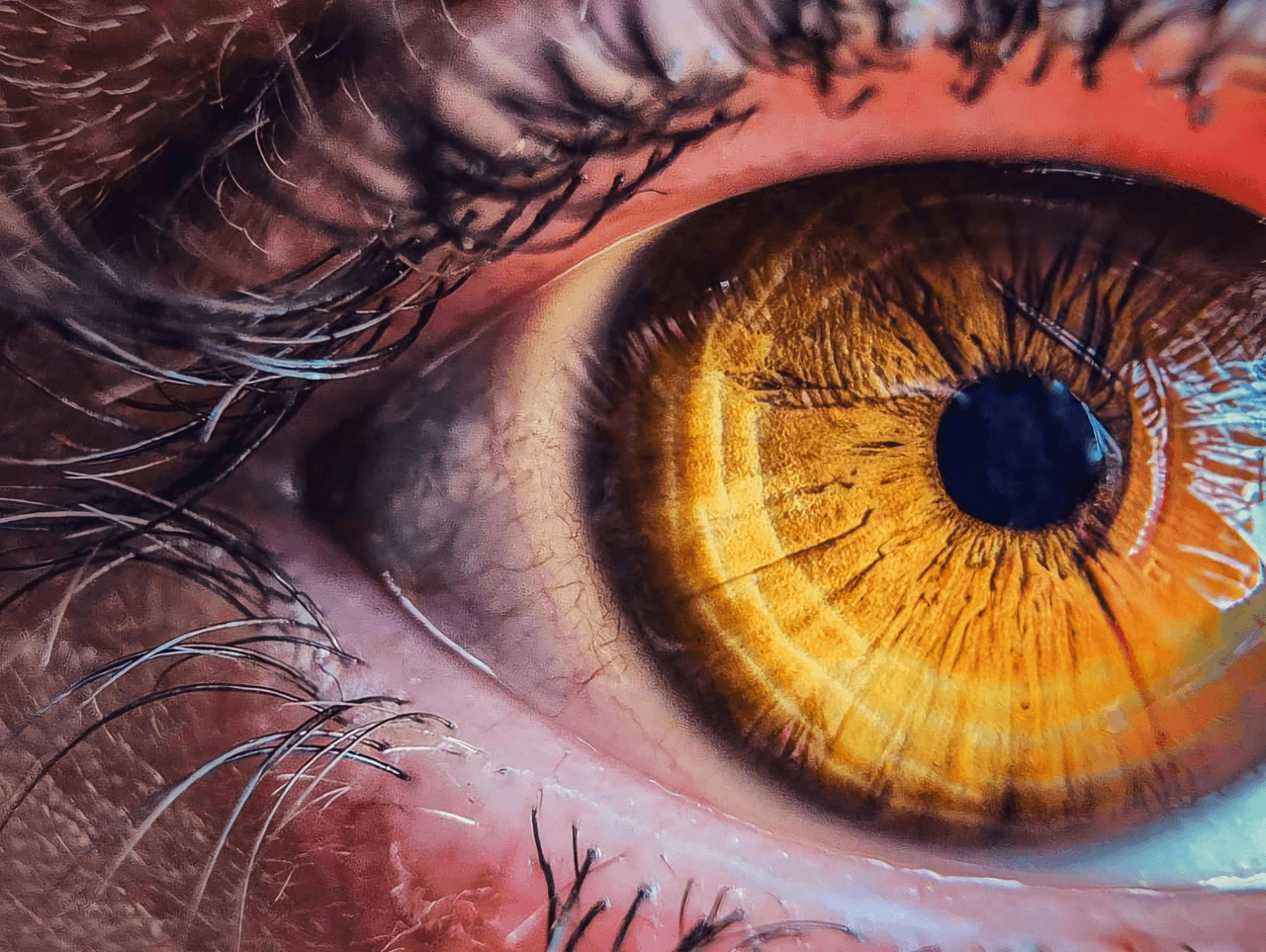
Pupil
(Generated with Artificial Intelligence)
Pupil Reflex
Function(s) | Retina protection Light regulation | ||||||||
|---|---|---|---|---|---|---|---|---|---|
Clinical Conditions | Mydriasis Miosis | ||||||||
Muscle Structures | Dilatator pupillae Sphincter pupillae | ||||||||
Nervous Relationship | N. oculomotorius (third cranial nerve) | ||||||||
Reflex | Pupillary light reflex | ||||||||
Control | Autonomic nervous system | ||||||||
Anatomical Structure | Iris aperture | ||||||||
System | Visual system | ||||||||
Pupil (Pupilla) is a natural opening located at the center of the iris that regulates the amount of light entering the eye. In normal adult individuals, pupil diameter typically ranges between 3.9 and 4.2 mm but exhibits a dynamic structure influenced by age, ambient lighting conditions, and the eye’s focusing state (accommodation).

Anatomical Structure of the Eye
(Generated by Artificial Intelligence)
The pupillary light reflex is a response of retinal photoreceptors and melanopsin-containing ganglion cells to light stimulation. This reflex pathway follows a complex circuit composed of four main neurons: the stimulus originates in the retina, is transmitted to the pretectal nucleus, then proceeds to the Edinger-Westphal nuclei on both sides, and finally reaches the pupillary sphincter muscle via the ciliary ganglion to induce constriction.
When light is shone into one eye, symmetrical constriction of both pupils (consensual response) occurs due to the distribution of the signal to bilateral nuclei in the brainstem.
Pupil size reflects the dynamic balance between the sympathetic and parasympathetic branches of the autonomic nervous system. The parasympathetic system, via the oculomotor nerve (third cranial nerve), stimulates the pupillary sphincter muscle to cause constriction (miosis), while the sympathetic system, through a long pathway originating in the hypothalamus, activates the dilator muscle to induce dilation (mydriasis). Activity in the locus coeruleus and levels of norepinephrine release are closely associated with instantaneous changes in pupil diameter. Due to this neurobiological linkage, the pupil develops a sensitive response mechanism not only to light but also to cognitive load, attention level, decision-making processes, and emotional arousal.
Abnormalities in the pupillary reflex provide critical data for localizing neurological and ophthalmological disorders. Damage to the afferent pathway causes relative afferent pupillary defects such as Marcus Gunn pupil, resulting from failure of light stimuli to reach the brain. Efferent pathway defects manifest clinically as Horner syndrome, characterized by miosis, ptosis, and enophthalmos due to sympathetic injury, or Adie’s tonic pupil. Additionally, subclinical changes in pupillary responses are reported to serve as potential biomarkers for diagnosing neurodegenerative conditions such as glaucoma, Parkinson’s disease, and Alzheimer’s disease, as well as psychiatric conditions including major depression, post-traumatic stress disorder, and autism.
Traditional pupillary examination is primarily conducted using a penlight and clinical observation, making assessment heavily dependent on the clinician’s experience and visual interpretation. To mitigate these limitations, digital pupillometry employs advanced optoelectronic systems capable of measuring pupil diameter and reflex response with millimeter and millisecond precision. Pupillometers using infrared light and high-speed cameras record numerical data on initial pupil diameter, constriction velocity and amplitude, re-dilation duration, and total reflex time. Thus, the pupillary reflex becomes an objective biometric measurement evaluated through quantitative parameters.

Digital Pupillometer
(Generated by Artificial Intelligence)
Modern pupillometers generate a time-dependent graph known as the pupillary light reflex curve, enabling detailed analysis of the pupil’s entire response to light stimuli. Parameters include initial pupil diameter, minimum diameter, constriction latency, constriction velocity, and re-dilation velocity. These quantitative measurements serve as important early warning indicators in intensive care units for monitoring conditions such as traumatic brain injury, intracranial hemorrhage, and increased intracranial pressure. The ability of devices to detect even minor pupillary changes facilitates early identification of neurological deterioration.
In recent years, the development of portable and smartphone-based pupillometry systems has enabled the use of this technology outside clinical settings. Mobile applications integrating high-resolution cameras, infrared sensors, and image processing algorithms can automatically measure pupil diameter and present results as numerical data. Artificial intelligence-assisted image analysis methods reduce measurement errors by identifying pupil boundaries in real time and ensure reliable outcomes under varying lighting conditions.
These technological advances extend beyond neurological evaluation and have established pupillometry as a significant measurement tool in ophthalmology, psychology, and neuroscience research. Pupillometric data are used as objective indicators of visual attention, cognitive load, decision-making processes, and emotional arousal. Moreover, pupillometry is increasingly recognized for detecting autonomic nervous system alterations in the early stages of glaucoma, diabetic neuropathy, and certain neurodegenerative diseases.
In the future, pupillometry systems supported by artificial intelligence, machine learning, and big data analytics are expected to evaluate pupillary responses in conjunction with individual physiological characteristics, leading to more precise diagnostic and monitoring methods. In this direction, digital pupillometry is becoming an increasingly central tool in both clinical medicine and neuroscience research.
Warning: The content in this article is provided solely for general encyclopedic informational purposes. The information herein must not be used for diagnosis, treatment, or medical advice. Always consult a physician or qualified healthcare professional before making decisions regarding health matters. The author and KÜRE Encyclopedia assume no responsibility for any consequences arising from the use of this information for diagnostic or therapeutic purposes.
Lisowski, Łukasz, Jolanta Lisowska, Anna Charytonowicz, Zofia Mariak, Iwona Obuchowska, and Joanna Konopińska. “The Diagnostic Significance of Pupillary Reflex Pathways: Insights from Classical Examination and Advanced Pupillometry.” *Frontiers in Neuroscience.* Accessed February 20, 2026. https://www.frontiersin.org/journals/neuroscience/articles/10.3389/fnins.2025.1677431/full
Memetoğlu, Mehmet Erdem. “Gözler Beynin Aynasıdır: Pupilometri ve Psikolojideki Uygulamaları.” *Türkiye Bütüncül Psikoterapi Dergisi.* Accessed February 20, 2026. https://dergipark.org.tr/tr/download/article-file/2465730
Türk, Hacı Murat, Gökhan Bitirgen, Gözde Satırtav, and Hurkan Kerimoğlu. “Pupilla Işık Yanıtını Karakterize Etmek: Kantitatif Pupillometri.” *Türk Oftalmoloji Dergisi.* Accessed February 20, 2026. https://www.oftalmoloji.org/pdf/bda9171a-fae8-4995-8276-2138323f1e16/articles/tjo.39049/tjo-48-185.pdf

Pupil
(Generated with Artificial Intelligence)
Pupil Reflex
Function(s) | Retina protection Light regulation | ||||||||
|---|---|---|---|---|---|---|---|---|---|
Clinical Conditions | Mydriasis Miosis | ||||||||
Muscle Structures | Dilatator pupillae Sphincter pupillae | ||||||||
Nervous Relationship | N. oculomotorius (third cranial nerve) | ||||||||
Reflex | Pupillary light reflex | ||||||||
Control | Autonomic nervous system | ||||||||
Anatomical Structure | Iris aperture | ||||||||
System | Visual system | ||||||||
Neurophysiological Mechanism and Light Reflex
Autonomic Control and Cognitive Interaction
Clinical Pathologies and Diagnostic Biomarkers
Digital Pupillometry and Technological Advances