


This article was automatically translated from the original Turkish version.
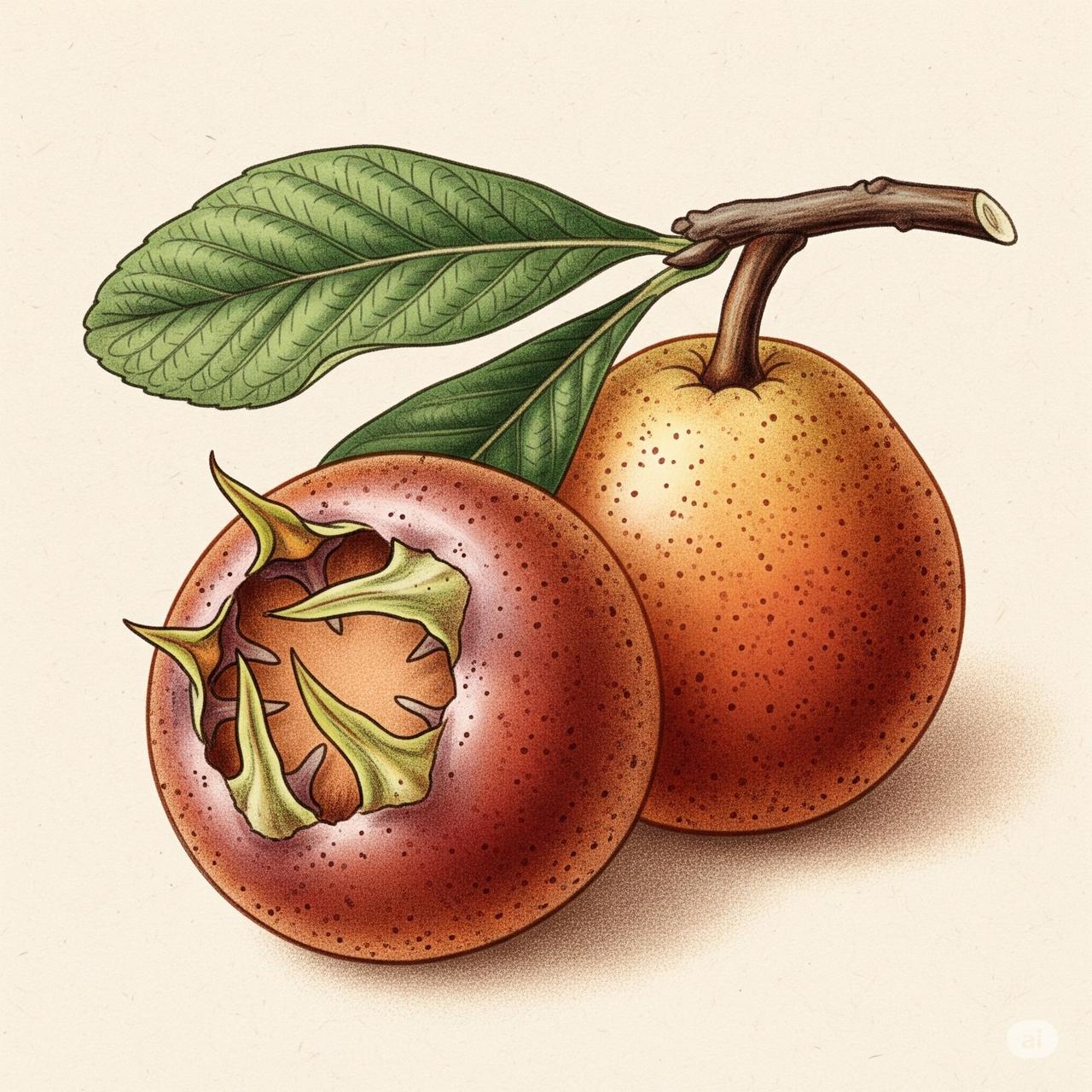
Quince (Mespilus germanica)
Scientific Name(s) | Mespilus | ||||||||
|---|---|---|---|---|---|---|---|---|---|
Genus | Mespilus | ||||||||
Specie(s) | M. germanica | ||||||||
Superclass | Rosaceae | ||||||||
Order | Rosales | ||||||||
Medlar (Mespilus germanica L.) is a deciduous fruit tree belonging to the Rosaceae (rose) family, with a small crown structure.
This species typically grows to a height of 3–5 metres and features white-pink, fragrant, and self-fertile flowers. It is pollinated by bees, with flowering occurring generally between May and June.
As a climacteric fruit, medlar fruits become edible after harvest when their high tannin content and astringent taste diminish, resulting in softening and browning of the flesh.
The genus Mespilus is native to Southwest Asia and Southeast Europe, with approximately 189 species reported. The only species widely known for commercial and consumption purposes is Mespilus germanica. Historically, this species is believed to have been cultivated in northern Iran around 3,000 years ago, introduced to Rome around 200 BCE, and reached Greece approximately 700 years ago. Today, it is cultivated only in limited areas, with various local and registered varieties grown in Germany, the Netherlands, and Türkiye.
The number of flowers emerging from flower buds varies among genotypes, averaging between 32 and 75. Fruit set rates range from 36.2% to 68%. Fruits are typically round-oval in shape, five-seeded, and fleshy. Fruit weights vary, with yields ranging from 5 to 15 kg per tree. High yields have been observed in some genotypes grafted onto quince, particularly in individuals aged 5 to 10 years.
Image of Medlar Fruit. (Darly)
Medlar fruit is rich in sugars, organic acids, pectin, carotenoids, and polyphenols. Its polyphenol oxidase activity has been found to be higher than in many other fruit types. This characteristic enhances the fruit’s antioxidant capacity and may offer potential health benefits.
Eleven superior genotypes identified in this study (e.g., 60 NT 001, 60 NA 001) have been conserved in controlled plots for further observation and registration. These selection efforts, aimed at preserving local varieties and evaluating them commercially, contribute to the sustainability of genetic diversity.
A field survey conducted in Tokat identified a total of 2,605 natural medlar populations. High densities were particularly observed in the villages surrounding Niksar district. From these populations, 293 genotypes were selected through preliminary screening, and subsequently, 62 genotypes were chosen based on fruit size, tree yield, and other morphological and physiological criteria.
All of these genotypes have been diagnosed as belonging to the species Mespilus germanica L.

Image of Medlar Fruit and Medlar Tree. (Generated by YZ.)

Illustration of the interior of a Medlar Fruit. (Generated by YZ.)
Medlar fruits were dried using microwave, convective, and vacuum drying methods, then ground into powder. This powder was used in biscuit production, substituting 0% (control), 10%, 20%, and 30% of wheat flour. The resulting biscuits were evaluated for physical, chemical, nutritional, and sensory properties.

Illustration of Biscuit Production Steps Using Medlar Powder. (Generated by YZ.)
Aydos, Merve, and Nilgün Ertaş. "Fonksiyonel Bisküvi Üretiminde Farklı Yöntemlerle Kurutulmuş Muşmula (Mespilus germanica) Meyve Tozu Kullanımı." *Harran Tarım ve Gıda Bilimleri Dergisi* 27, no. 1 (2023): 113–124. Accessed May 23, 2025. https://dergipark.org.tr/en/download/article-file/2660553.
Gerçekcioğlu, Resul, and Özlem Yiğithanoğlu. "Tokat Doğal Muşmula (Mespilus germanica L.) Popülasyonundan Seçilen Genotiplerin Performansları (Seleksiyon II)." *Meyve Bilimi* 10, no. 2 (2023): 216–225. Accessed May 23, 2025. https://dergipark.org.tr/en/download/article-file/3485433.

Quince (Mespilus germanica)
Scientific Name(s) | Mespilus | ||||||||
|---|---|---|---|---|---|---|---|---|---|
Genus | Mespilus | ||||||||
Specie(s) | M. germanica | ||||||||
Superclass | Rosaceae | ||||||||
Order | Rosales | ||||||||
No Discussion Added Yet
Start discussion for "Quince (Mespilus germanica)" article
Origin and Distribution
Fruit Characteristics and Yield
Nutritional Content and Functional Properties
Conservation and Breeding Studies
Medlar in Tokat Ecology
Benefits of Medlar Fruit
Use of Medlar (Mespilus germanica) Powder in Functional Food Production: A Biscuit Example
Findings