


This article was automatically translated from the original Turkish version.
+1 More
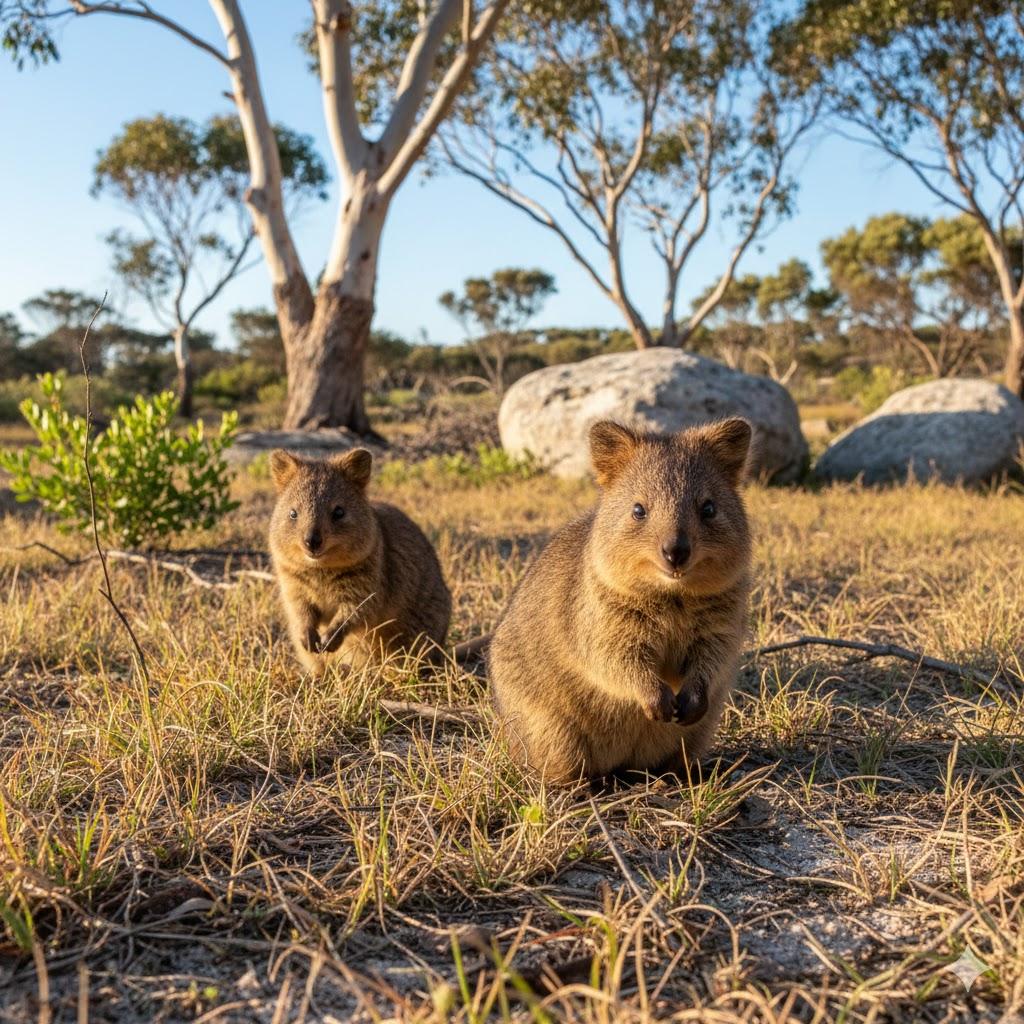
Quokka
(Yapay Zeka İle Oluşturulmuştur)
Quokka (Setonix brachyurus) is a small marsupial belonging to the kangaroo family, native to the southwestern region of Western Australia. This species is commonly referred to as “the world’s happiest animal” and is typically concentrated in predator-free areas such as Rottnest Island.
The species Setonix brachyurus survives in several isolated mainland populations along the southwestern coast of Western Australia. These populations are surrounded by conservation areas and national parks receiving annual rainfall of 1000 mm or more. The quokka’s range is shrinking due to threats such as global climate change and introduced predators, particularly fox and cats. However, on neighboring islands such as Rottnest Island and Bald Island, where these predators are absent, larger populations persist.

Quokka (Setonix brachyurus)
Generated by Artificial Intelligence
Setonix brachyurus is a specialist of dense vegetation in Agonis swamp habitats, which provide shelter from predators. On Rottnest Island, plants such as Gahnia trifida offer refuge during hot days. Quokkas must live near freshwater sources due to their high water requirements. Additionally, vegetation that regenerates after fires supports their diet.
The quokka is among the smallest kangaroos. It is recognized by its powerful hind legs and coarse brown fur. Males typically weigh between 2.7 and 4.2 kg while females are slightly smaller, ranging from 1.6 to 3.5 kg. These animals have a hunched back and short forelimbs. Their tail length varies between 25 and 30 cm. Joeys are nursed in the mother’s pouch for approximately six months.
The breeding season of Setonix brachyurus peaks between January and March. Females usually give birth to a single joey, which immediately begins nursing in the mother’s pouch. The joey is nursed for about six months. Social structures differ between sexes: females are more solitary, while males are more dominant and establish hierarchies. Males defend females after mating.

Quokka (Setonix brachyurus)
Generated by Artificial Intelligence
During lactation, quokka joeys receive high levels of iron from their mother’s milk. Iron concentration in the milk is up to eight times higher than plasma iron levels. When joeys begin to leave the pouch, these levels decline sharply. Joeys reach adult hemoglobin levels in the blood by approximately 180 days, while non-heme iron concentrations in the liver rise rapidly. This indicates that joeys build critical iron reserves before leaving the pouch.
Quokkas are herbivores, primarily feeding on succulents, shrubs, herbaceous plants and grasses. They also consume fruits and seeds. Rather than chewing their food, they swallow it, regurgitate it, and chew it again. They can climb trees in search of food. Their feeding habits vary seasonally; during dry periods, they tend to expand their range toward areas closer to freshwater sources.
The quokka has experienced a significant population decline since the introduction of predators to Australia, particularly the European red fox (Vulpes vulpes) and dingoes. Human encroachment and habitat destruction further threaten the species’ survival. Climate change, including rising temperatures and reduced rainfall, exacerbates these challenges. Conservation efforts focus on protecting this species within natural reserves and parks.
Austen, Jill M., Andrea Paparini, Simon A. Reid, James A. Friend, and William G. F. Ditcham. “Molecular Characterization of Native Australian Trypanosomes in Quokka (Setonix brachyurus) Populations from Western Australia.” Parasitology International 65, no. 3 (June 2016): 205–208. Accessed February 18, 2026. https://doi.org/10.1016/j.parint.2015.12.005
Hayward, Matt W., Paul J. de Tores, Michael L. Augee, Barry J. Fox, and Peter B. Banks. “Home Range and Movements of the Quokka *Setonix brachyurus* (Macropodidae: Marsupialia), and Its Impact on the Viability of the Metapopulation on the Australian Mainland.” *Journal of Zoology* 263, no. 3 (July 2004): 219–228. Accessed February 18, 2026. https://doi.org/10.1017/S0952836904005060
Hayward, Matt W., Peter B. Banks, and Paul J. de Tores. “Habitat Use of the Quokka, *Setonix brachyurus* (Macropodidae: Marsupialia), in the Northern Jarrah Forest of Australia.” *Journal of Mammalogy* 86, no. 4 (August 22, 2005): 683–688. Accessed February 18, 2026. https://doi.org/10.1644/1545-1542(2005)086[0683:HUOTQS]2.0.CO;2
Mclean, Ian, Elissa Z. Cameron, Wayne L. Linklater, Natalie T. Schmitt, and Karin S. M. Pulskamp. “Partnerships in the Social System of a Small Macropod Marsupial, the Quokka (Setonix brachyurus).” Behaviour 146, no. 1 (2009): 89–112. Accessed February 18, 2026. https://doi.org/10.1163/156853908X390940
Quokka
(Yapay Zeka İle Oluşturulmuştur)
No Discussion Added Yet
Start discussion for "Quokka (Setonix brachyurus)" article
Habitat and Distribution
Biogeographic Features and Natural Habitat
Physical Characteristics and Size
Reproduction and Social Structure
Iron Status and Milk-Mediated Iron Transfer
Feeding Habits
Conservation Status and Threats