

This article was automatically translated from the original Turkish version.
Origin(s) | United States (1960s) | ||||||||
|---|---|---|---|---|---|---|---|---|---|
Eye Color | Bright blue | ||||||||
Feather Structure | Semi-long, Silky | ||||||||
Character | Calm, Social, People-oriented, Kind | ||||||||
Weight(s) | Male: 6.5–9 kg Female: 4.5–6.5 kg | ||||||||
Name Origin | It earned the name "ragdoll" because of its tendency to remain loose and calm when picked up. | ||||||||
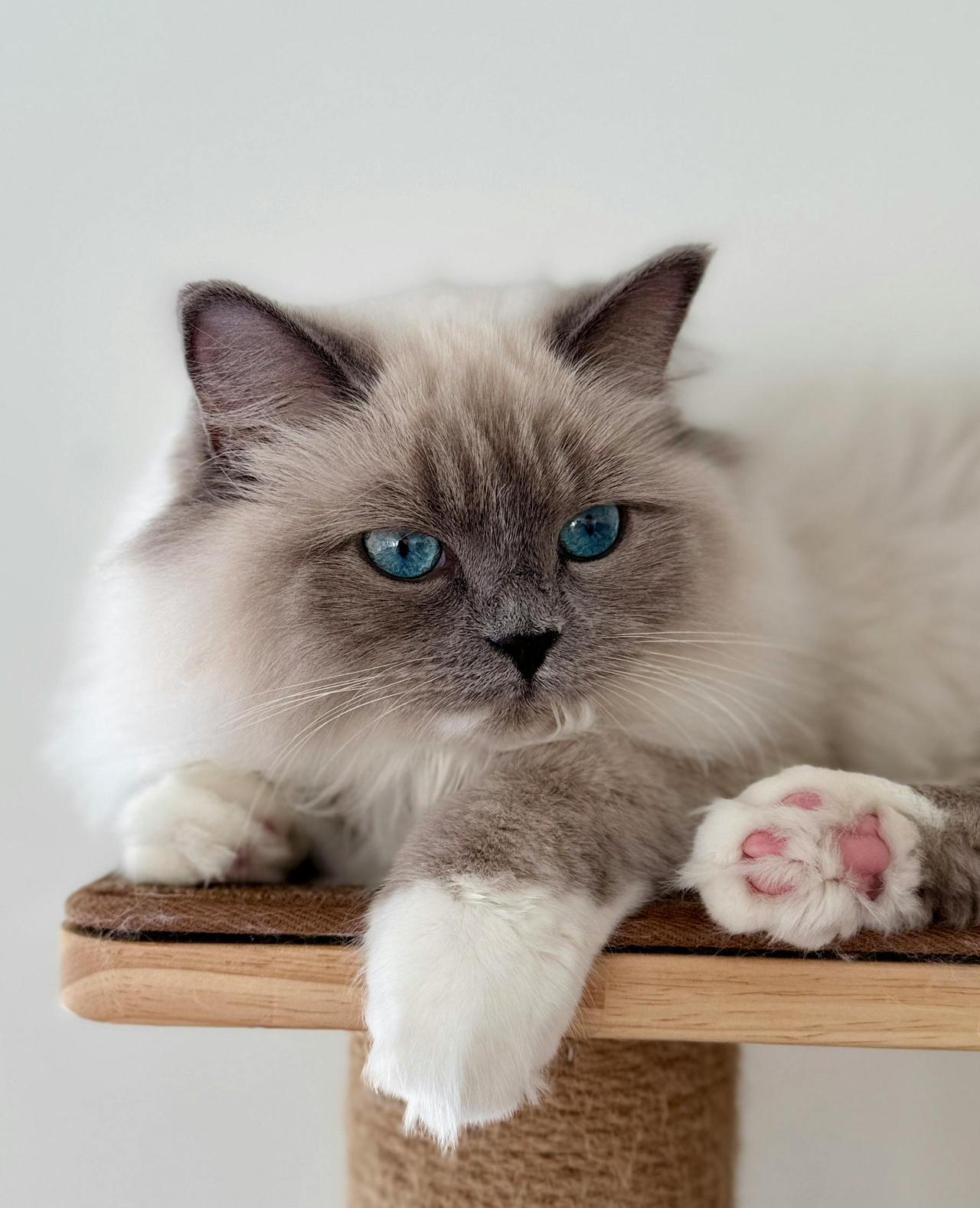
The Ragdoll cat is a large-sized domestic breed known for its soft temperament, blue eyes, and semi-long fur. It derives its name from its tendency to go limp and remain motionless, like a rag doll, when picked up. Developed in the United States during the 1960s, this breed is now a popular household pet in many parts of the world.
Ragdoll cats are distinguished by their large and muscular build. Females typically weigh between 4.5 and 6.5 kg, while males range from 6.5 to 9 kg. Their heads are broad with full cheeks and a strong jaw. The ears are medium in size, slightly forward-facing, and rounded at the tips. Their most distinctive features are their large, round, and bright blue eyes.
Their fur is semi-long, dense, and silky in texture. The coat is generally resistant to matting and can be easily maintained with regular grooming. Ragdoll cats exhibit several color patterns including “colorpoint” (dark extremities), “mittened” (gloved paws), and “bicolor” (two-color). Color variations include seal, blue, chocolate, lilac, cream, and red.

Ragdoll cat (Pexels)
Ragdoll cats are known for their calm, affectionate, and social nature. Their human-oriented disposition makes them particularly suitable for families with children and elderly individuals. They rarely display loud or aggressive behavior. They typically enjoy being held and often remain relaxed when carried. They adapt quickly to home environments and generally get along well with other pets.
This breed has a high level of intelligence and benefits from mental stimulation through interactive toys and activities. They also tend to be vocal but their meows are usually gentle in tone.
The semi-long, silky fur of the Ragdoll is resistant to tangling, resulting in relatively low grooming needs. Regular brushing once or twice a week, preferably with a steel-toothed comb, is recommended to maintain healthy, shiny fur. This helps remove dead hair and prevents occasional matting. During seasonal transitions—especially in spring and autumn—shedding increases, so more frequent grooming is advisable.
Although the Ragdoll breed typically exhibits a quiet and calm demeanor suited to indoor living with low stress levels, it is important to encourage interaction with toys to provide mental and physical stimulation. Due to their tendency toward weight gain, portion control is essential and a balanced diet in accordance with veterinary advice should be maintained.
The origins of the Ragdoll cat trace back to the 1960s in California, United States, where a breeder named Ann Baker developed the breed. It is believed to have been created through crossbreeding between Persian, Burmese, and other local varieties. The early examples’ calm temperament and loose muscle structure formed the foundation of the breed’s defining traits.
Many international organizations, including the Cat Fanciers’ Association (CFA) and The International Cat Association (TICA), officially recognize the Ragdoll cat. While CFA accepts only individuals with blue eyes, TICA similarly prioritizes eye color as a key standard. Color variations and patterns are subject to specific guidelines within the breed standard.
CFA. "Ragdoll." The Cat Fanciers’ Association. Accessed June 29, 2025. https://cfa.org/breed/ragdoll/
Pexels. “Close-Up Portrait of a Ragdoll Cat with Blue Eyes JPG.” Pexels. Accessed June 29, 2025. https://www.pexels.com/photo/close-up-portrait-of-a-ragdoll-cat-with-blue-eyes-29578139/
Pexels. “Fluffy Ragdoll Cat Relaxing on Scratch Post JPG.” Accessed June 29, 2025. https://www.pexels.com/photo/fluffy-ragdoll-cat-relaxing-on-scratch-post-30638936/
TICA. "Ragdoll." The International Cat Association. Accessed June 29, 2025. https://tica.org/wp-content/uploads/2018/08/TICA-Ragdoll-Breed-Introduction.pdf

Origin(s) | United States (1960s) | ||||||||
|---|---|---|---|---|---|---|---|---|---|
Eye Color | Bright blue | ||||||||
Feather Structure | Semi-long, Silky | ||||||||
Character | Calm, Social, People-oriented, Kind | ||||||||
Weight(s) | Male: 6.5–9 kg Female: 4.5–6.5 kg | ||||||||
Name Origin | It earned the name "ragdoll" because of its tendency to remain loose and calm when picked up. | ||||||||
Physical Characteristics
Temperament
Care
History
Breed Recognition and Standards