


This article was automatically translated from the original Turkish version.
The operational safety and performance of railway tracks are directly related to the durability and smoothness of the connections between rails. In high-speed rail lines and heavy-load routes, continuous welded rail (CWR) technology has become the standard. To meet this standard, rails must be joined with high strength. One of the methods used for this purpose is arc welding. In particular, electric arc welding is preferred as a powerful and controlled welding method, especially in factory environments and certain specialized field applications.
Arc welding is a type of welding that joins metal by melting it using an electric arc created between an electrode and the workpiece (in this case, the rail end). The use of an electric arc as a heat source enables the achievement of high temperatures and localized melting. The joining of railway rails by arc welding is typically carried out using two main methods:
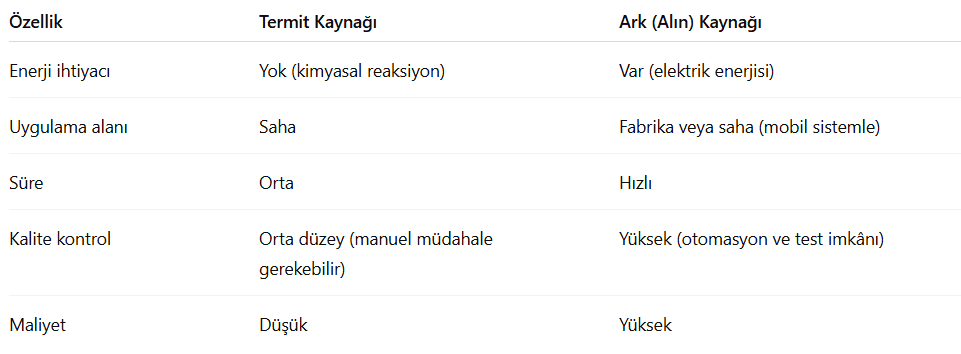
Comparison of Thermite and Arc Welding (MEGEP, 2011)
Quality control in arc welding is performed through post-weld ultrasonic testing (UT), magnetic particle testing (MT), and visual inspection. Additionally, conformity to the rail profile is evaluated after grinding using specialized profile templates. Internal structural defects in welds can be monitored in real time using modern systems.
Electric arc welding is a technology that provides high strength, precision, and repeatability in joining railway rails.
In particular, when applied in factory assembly or using mobile flash butt welding machines, arc welding outperforms other methods in both efficiency and quality. Due to its more controlled and testable results compared to thermite welding, it is widely preferred in new high-speed rail projects. In Türkiye, flash butt welding technologies are employed within TCDD, and these applications are supported through dedicated personnel training programs.
Arslan, Elvan. 2019. “Alüminotermit Ray Kaynağı (Termit Kaynağı).” *Elvan Arslan Net*, July 17, 2019. Accessed May 25, 2025. https://elvanarslannet.wordpress.com/2019/07/17/alimunotermit-ray-kaynagi-termit-kaynagi/.
Ministry of National Education of the Republic of Türkiye. 2020. *Yerli Kaynak Teknikleri Dersi: Termit Kaynağı*. İstanbul: Şişli Mesleki ve Teknik Anadolu Lisesi. Accessed May 25, 2025. https://sislimem.meb.k12.tr/meb_iys_dosyalar/34/20/758019/dosyalar/2020_06/01024134_Yleri_Kaynak_Teknikleri_Dersi__Termit_KaynaYY.pdf.
Professional Qualifications Institution. 2022. *Railway Track Construction, Maintenance and Repair Machine Operator Level 4*. Ankara: MYK. Accessed May 25, 2025. https://www.myk.gov.tr/images/articles/editor/220512/DEMRYOLU_YOL_YAPIM_BAKIM_VE_ONARIM_MAKNES_OPERATR_seviye_4.pdf.
T.C. Millî Eğitim Bakanlığı. 2011. *Makine ile Yol Tamiratına Hazırlık*. Ankara: MEGEP. Accessed May 25, 2025. https://megep.meb.gov.tr/mte_program_modul/moduller_pdf/Makine%20Ile%20Yol%20Tamirat%C4%B1na%20Haz%C4%B1rl%C4%B1k.pdf.
İcik, Sinan. 2018. *Demiryolu Makineleri*. Scribd. Accessed May 25, 2025. https://www.scribd.com/document/406046510/Demiryolu-Makineleri.
İstanbul Teknik Üniversitesi. 2020. *Alüminotermit Kaynağı*. POLEN Dijital Arşiv. Accessed May 25, 2025. https://polen.itu.edu.tr/items/83547205-b53c-4452-b390-1f648e94daec.
[1]
MEB, 2020; İTÜ POLEN, 2020.

Principle of Arc Welding and Its Role in Railways
Arc Welding Application Process (Example: Flash Butt Welding)
1. Preparation
2. Preheating and Arc Formation
3. Melting and Forging
4. Grinding and Final Processing
Advantages and Limitations of Arc Welding
Advantages
Limitations
Quality Control and Inspection Processes