


This article was automatically translated from the original Turkish version.
Rain gardens, also known as "bioretention areas," are shallow depressions designed to collect and vegetate stormwater with the goal of allowing water to infiltrate naturally into the soil. The primary function of these systems is to manage surface runoff generated by impervious surfaces in urban areas—such as rooftops, roadways, sidewalks, and parking lots—while improving water quality and contributing to groundwater recharge.
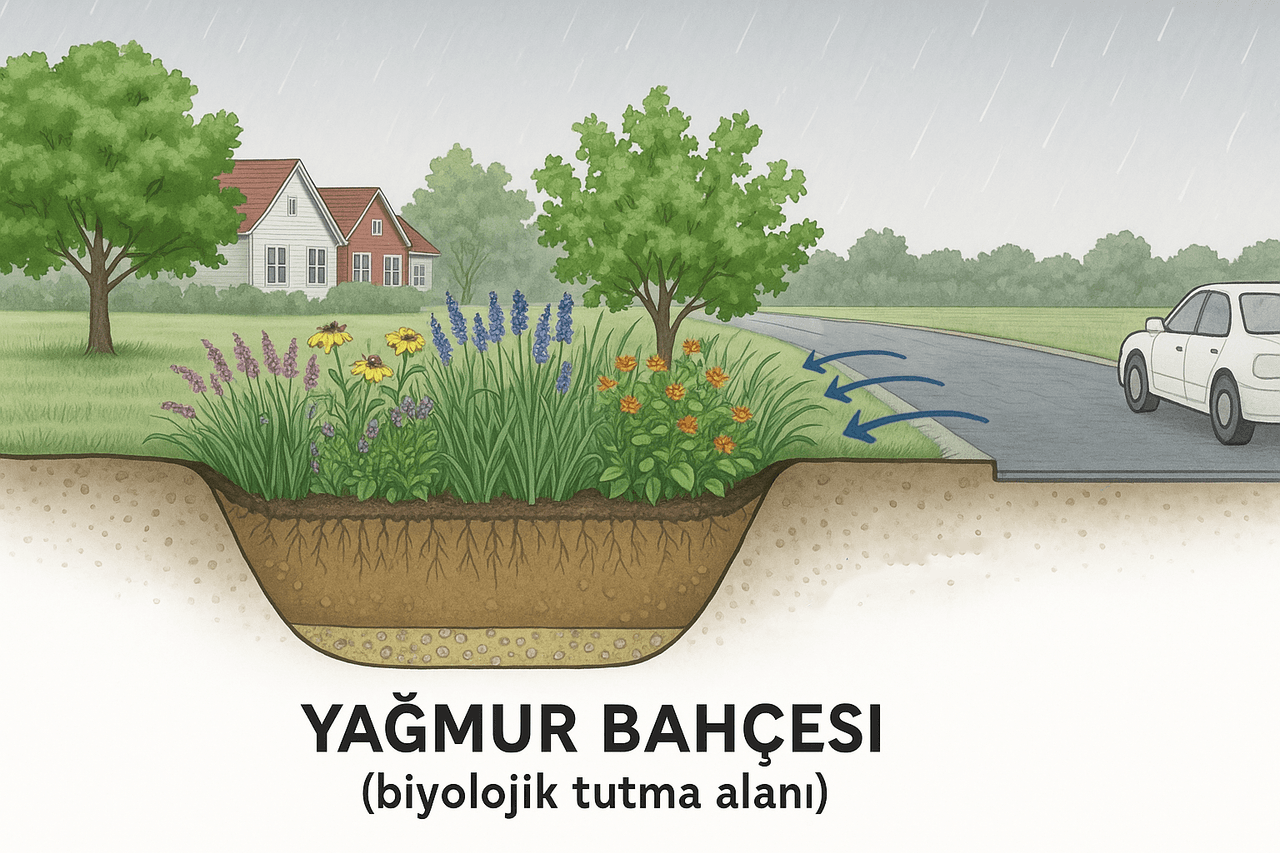
Representative Example of a Rain Garden (Generated by Artificial Intelligence.)
The proliferation of impervious surfaces and the reduction of green spaces in urban areas prevent stormwater from adequately infiltrating into the soil, leading to increased surface runoff and a range of hydrological problems. Traditional stormwater collection systems rapidly channel water into sewer networks, which can result in insufficient recharge of groundwater resources and contamination of receiving water bodies. To address these issues, sustainable urban stormwater management models have been developed. Among these approaches are Water Sensitive Urban Design (WSUD) from Australia, Sustainable Urban Drainage Systems (SUDS) from the United Kingdom, and Low Impact Development (LID) from the United States. Rain gardens are one of the most commonly applied ecological solutions within these innovative frameworks.
The foundational principles of sustainable stormwater management and, by extension, rain gardens include preserving the hydrological functions of urban areas, facilitating the infiltration of stormwater into groundwater, and adopting ecological rather than structural approaches in stormwater collection. Additional principles include managing stormwater at its source, maximizing the use of surface and subsurface infiltration potential, slowing the velocity of water flow from source to discharge point, addressing stormwater management at the watershed scale through an integrated approach, and transforming stormwater into an alternative water supply source.
Proper site selection is essential for the effective functioning of a rain garden. To avoid damage to building foundations, the garden must be located at least 3 meters away from building eaves. It should not be installed directly on top of or immediately adjacent to existing septic systems. Low-lying areas that consistently retain water, have low infiltration rates, or are naturally wet are generally unsuitable. Where possible, open areas receiving direct sunlight should be preferred, and locations beneath the canopy of large trees should be avoided due to potential root damage and shading.
Gentle or slightly sloped areas (less than 12% gradient) are preferable to flat terrain. In fact, soil excavated from the depression can be used to construct a berm on the lower side. An optimal slope of approximately 10% is often recommended. Finally, areas with a high groundwater table are unsuitable for rain garden implementation.
Rain gardens are designed as shallow depressions planted with trees and/or shrubs and covered with a mulch layer or ground cover. They are typically engineered as well-drained, porous beds and are commonly constructed to a depth of 100 to 300 mm (10–30 cm), designed to temporarily store stormwater for several hours up to a maximum of 36 hours after rainfall to prevent mosquito breeding.
During the sizing phase, the dimensions of a rain garden vary depending on factors such as the target depth, the size of the contributing drainage area, soil characteristics, selected plant species, and the expected volume of surface runoff. In clay-rich soils with low infiltration rates, a larger rain garden may be required compared to sandy or silty soils.
The surface area of a typical rain garden may range from 3% to 10% of the total size of its contributing drainage basin. Rain gardens are typically designed with a ponding depth between 7 cm and 20 cm. If the ponding depth exceeds 20 cm, the infiltration time may be prolonged. The slope of the site also influences depth design: for slopes less than 4%, a depth of 7–12 cm is recommended; for slopes between 5% and 7%, 15–18 cm; and for slopes between 8% and 12%, 20 cm. Depth can also be determined based on the soil’s infiltration rate: if infiltration takes longer than 32 hours, a depth of 30–60 cm is recommended; if between 16 and 32 hours, 15–20 cm; and if less than 16 hours, 15 cm.
Examining the layered structure, a typical rain garden cross-section consists, from top to bottom, of vegetation, an optional mulch layer, a specially engineered soil mix (typically composed of 50–60% sandy soil, 20–30% compost, and 20–30% topsoil), and, where necessary for excess drainage in low-permeability soils, a gravel layer and a perforated drainage pipe. In high-engineering applications, the excavated basin may also be lined with a geotextile material.
Plant selection is a critical element affecting both the functionality and aesthetics of a rain garden. The general principle is to prioritize native plant species found in the region’s natural vegetation. These plants are better adapted to local climate conditions, soil structure, and hydrological characteristics and typically require less maintenance. Plants with extensive root systems and high tolerance to pollutants such as oils and heavy metals should be selected. Proper plant selection for the site significantly reduces or eliminates the need for supplemental irrigation.
Rain gardens are typically divided into three distinct zones based on varying soil moisture levels, and planting is arranged accordingly. For the wettest zone—the base or ponding area—plants must be water-tolerant, with strong root systems and the ability to withstand sudden flooding followed by dry periods. For the intermediate zone—the sloped or transition area—plants adapted to semi-dry conditions are suitable. For the driest zone—the berm area—drought-tolerant species are preferred.
Plants are generally planted in a grid pattern at intervals of approximately 20 cm. After planting, the entire surface of the rain garden should be covered with a 5 cm layer of crushed gravel, wood chips, or similar material, taking care not to cover the plant leaves or stems, to facilitate drainage. Following planting, the entire area should be watered to a depth of 2 or 3 cm to help the plants acclimate to their new environment.
After installation, rain gardens may require additional care and irrigation during the first few years until the plants become fully established. Once this adaptation phase is complete, maintenance requirements are minimal, and irrigation is typically needed only during prolonged drought periods. General maintenance activities include monitoring plant health (e.g., signs of wilting or yellowing), replacing or transplanting plants as needed, removing weeds manually, and collecting dead flowers and plant debris in early spring.
After heavy rainfall events, berms should be inspected for erosion and repaired if necessary. If water infiltration in the ponding area is impaired, the soil may be clogged or overly compacted; in such cases, the soil should be loosened or replaced, and accumulated sediment and debris must be removed. Soil pH should be tested, and adjustments made if excessive acidity or alkalinity is detected. If mulch has been applied, it should be regularly inspected, and a new mulch layer added after spring cleaning.
Rain gardens can be designed and implemented across a wide range of soil types—from sandy to clayey—and under various climatic conditions. Their scale can vary from residential gardens to parking lots, roadside strips, school campuses, and other public green spaces. In urban areas with high concentrations of impervious surfaces, they play a vital role in improving the water cycle and enhancing ecosystem services. Converting previously developed but currently unused or abandoned brownfield sites into rain gardens represents a significant step toward sustainable land use.
Rain gardens are only one of several nature-based solutions used within the framework of sustainable stormwater management. Other related systems and concepts include permeable pavements, dry wells, bioswales (also known as vegetated drainage channels), infiltration trenches (infiltration basins), green roofs, rain barrels and cisterns, and detention (delay) basins.
In developed countries such as the United States, Canada, Australia, and the United Kingdom, rain gardens are widely recognized as a best management practice for regulating stormwater runoff and enhancing urban biodiversity. In Türkiye, given the increasing frequency of flooding events, demand for rain gardens is expected to rise in the future; however, it has been noted that sufficient scientific research and studies on this topic are currently lacking.
In today’s context, where sustainable management of urban water resources and stormwater is gaining increasing importance, implementing rain gardens offers an ecologically and economically effective solution. In the future, it is considered essential to conduct more detailed regional studies on the potential for rain garden implementation in Türkiye, investigate the infiltration and redistribution capacities of these systems, and encourage local authorities to promote their adoption. Reducing reliance on and burden on traditional sewer systems through rain gardens can also contribute to cost savings in municipal budgets.
Müftüoğlu, Volkan, and Halim Perçin. “Sürdürülebilir Kentsel Yağmur Suyu Yönetimi Kapsamında Yağmur Bahçesi.” *İnönü Üniversitesi Sanat ve Tasarım Dergisi* 5, no. 11 (2015): 27–37. Accessed May 21, 2025. https://dergipark.org.tr/tr/pub/iujad/issue/8730/109012
Uçkan, Talat, and Füsun Erduran. “Kentsel Alanda Su Sorununa Çözümsel Yaklaşım: Yağmur Bahçesi.” Paper, *2. Uluslararası Mimarlık ve Tasarım Kongresi*, Çanakkale, Türkiye, 2018. Accessed May 21, 2025. https://avesis.comu.edu.tr/yayin/71178329-235e-4b81-8499-28c187399dd9/kentsel-alanda-su-sorununa-cozumsel-yaklasim-yagmur-bahcesi
Özdoğan, İsmail Kuzey, and Abdullah Akpınar. “Kentsel Yeşil Altyapı Sistemlerinde Yağmur Bahçesi Tasarımı: Aydın Örneği.” *Adnan Menderes Üniversitesi Ziraat Fakültesi Dergisi* 20, no. 2 (2023): 219–228. Accessed May 21, 2025. https://doi.org/10.25308/aduziraat.1310846

Historical Context and Principles
Site Selection Criteria
Design and Structural Features
Plant Selection and Design
Maintenance
Application Areas
Related Concepts and Systems
Current Status and Future Perspective