


This article was automatically translated from the original Turkish version.
+1 More
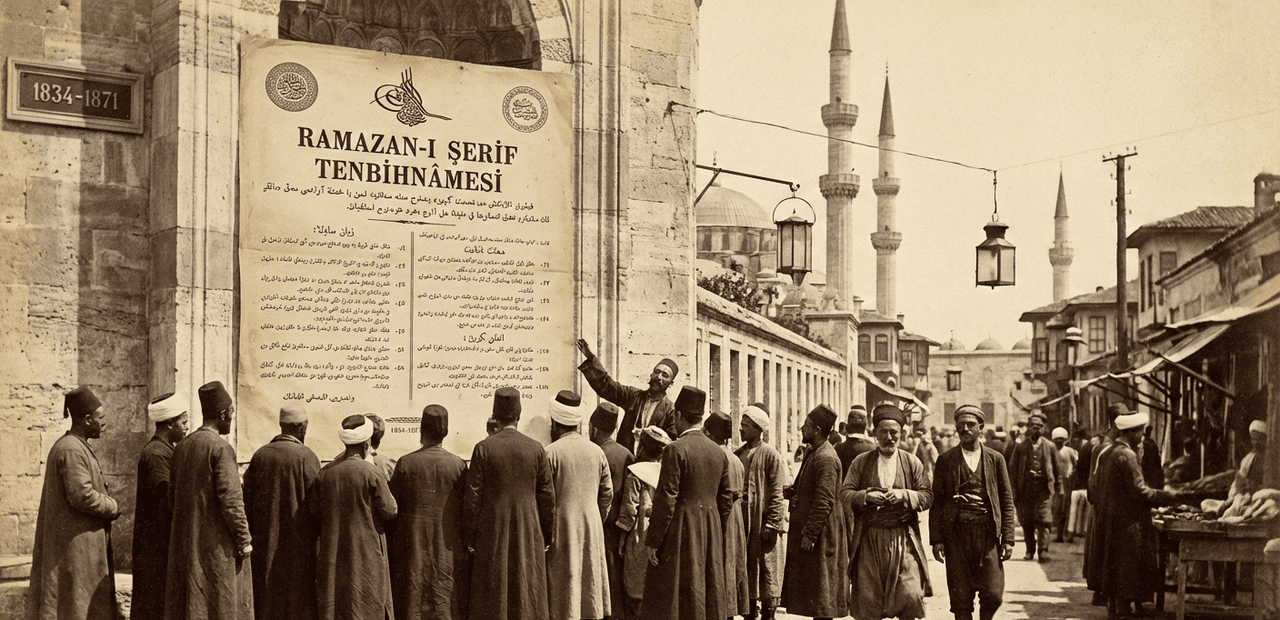
(Yapay Zeka ile Oluşturulmuştur)
Ramadan Warnings
Period(s) | Primarily the 19th century (especially the reign of Mahmud II and the Tanzimat Period) | ||||||||
|---|---|---|---|---|---|---|---|---|---|
Sanction | Te’dîbât-ı şedîde (severe punishment), Judicial prosecution | ||||||||
Scope (Administrative) | Protocol rules during the Sultan's mosque visits, Price controls (narh), Security patrols | ||||||||
Scope (Religious) | Respect for those fasting, Mosque cleanliness, Duties of imams and muezzins | ||||||||
Scope (Social) | Dress codes, Street cleanliness, Mandatory use of lanterns, Business operating hours | ||||||||
Announcement Channels | Takvim-i Vekayi (Official Gazette), Varaka-i Mahsûsa (Special Printed Documents), Neighborhood Imams, Muhtars | ||||||||
Publishing Authority | The Sublime Porte (Prime Ministry), Seraskerlik (General Staff/Interior), Meclis-i Vâlâ | ||||||||
Primary Objective | To ensure public order (asayiş-i belde) and preserve the worship environment | ||||||||
First Printed Example | Tenbihnâme dated 1834 (Hijri 1250) | ||||||||
Ramazan Tenbihnâmeleri are official regulations issued by the Ottoman state to ensure the peaceful continuation of religious observances and the maintenance of social order during the holy month of Ramazan, which holds profound social and religious significance. These documents make visible the state’s regulatory intent in the public sphere through a framework of “warning–monitoring–sanction.”
Common themes in these texts include the cleanliness and order of places of worship, measures to ensure congregational devotion in solemnity, the functioning of markets and bazaars, the regulation of growing nighttime crowds, street safety, and precautions against fire hazards. In this sense, tenbihnâmeler are not merely texts reminding people of the moral conduct expected during a religious period; they are administrative instruments designed to intervene in the practical details of urban life and to foster harmonious coexistence among diverse communities (Muslim and non-Muslim, settled and transient, merchants and officials) on a shared public ground.
The origins of Ottoman regulations concerning Ramazan lie in the classical state conception and the tradition of overseeing the public sphere. Before the Tanzimat, these regulations typically took the form of verbal orders issued by the grand vizier on the sultan’s behalf or limited written decrees. The primary focus during this period was ensuring uninterrupted worship, regulating markets and maintaining fixed prices (narh), and monitoring general moral conduct. However, these early records did not resemble the printed and systematic “tenbihnâme” format that emerged after the Tanzimat; instead, they were ad hoc “buyruldu” or “ferman” decrees issued in response to immediate needs. This state intervention reflected the perception of Ramazan as a matter of social tranquility and spiritual order.
During the reign of Mahmud II, as bureaucratic reforms gained momentum, many previously ad hoc or verbally transmitted regulations were standardized and formalized through an official calendar. From this point onward, the earlier practice of issuing decrees to local administrators was replaced by systematically prepared tenbihnâmeler, aiming to ensure uniform implementation and prevent disorder within the state apparatus.
Over time, provisions such as the sultan’s personal visits among the people to hear complaints, assistance to the poor, and the prohibition of official misconduct expanded the scope of these tenbihnâmeler.【1】 During this process, regulations began to be communicated to the public through neighborhood imams and muhtars, integrating them into the lowest levels of local administration.
With the proclamation of the Tanzimat Fermanı in 1839, tenbihnâmeler underwent significant transformation in both content and form. During this period, special printed paper sheets known as “Varaka-i Mahsûs” were introduced, and documents were mass-produced in state printing houses and distributed throughout İstanbul.【2】 The Tanzimat emphasis on the rule of law and citizens’ rights was reflected in the language of the tenbihnâmeler: they ceased to be mere religious admonitions and became legal texts centered on the concept of public peace. Published in official newspapers such as Takvim-i Vekayi, these texts acquired the character of municipal regulations, incorporating norms of cleanliness and public civility consistent with the state’s modernization efforts.

Ramazan Tenbihnâmeleri'nin Tarihsel Gelişim ve Kurumsallaşma Sürecini İfade Eden Bir Görsel (Yapay Zeka ile Oluşturulmuştur)
In tenbihnâmeler published during the 19th century, the state’s mechanisms of social control became increasingly stringent.【3】 During these years, tenbihnâmeler were prepared and enforced by directly security-oriented institutions such as the Seraskerlik. The language of these documents gradually adopted a more formal and bureaucratic structure, with clearer definitions of offenses and punishments. Although the frequency of such documents declined after the 1870s, tenbihnâmeler remained as concrete historical records of the state’s practice of regulating the public sphere through religious and moral references during the transition from the Ottoman Empire to the Republic.
The primary purpose of Ramazan tenbihnâmeler is to ensure the tranquility of social life during the sacred month known as “şehr-i mübarek.” In the Ottoman state conception, Ramazan is not merely a period of individual worship but a collective time in which the entire public sphere is transformed. Through these documents, the state aims to safeguard public order during a period characterized by increased nighttime activity, crowded streets, and heightened social interaction. Tenbihnâmeler function as administrative shields, reminding all segments of society—Muslim and non-Muslim alike—of shared rules of conduct and preventing disciplinary violations that contradict the spiritual essence of this sacred time.
The scope of tenbihnâmeler includes establishing the necessary physical and spiritual conditions for worship to be performed with reverence. Technical details such as the cleaning and illumination of Cami and mescit (mosques), and the proper performance of duties by imams and muezzins, are specified in these texts. Additionally, prohibitions are clearly stated to protect the rights of those fasting: eating, drinking, and smoking are forbidden in public spaces during daylight hours.
A detailed component of these documents concerns visibility and behavioral norms in public space. Tenbihnâmeler repeatedly remind the public of dress codes for men and women.【4】 For instance, the 1834 tenbihnâme explicitly outlines how the public should behave during the sultan’s Ramazan visits to mosques or his “tebdil-i kıyafet” tours, including how petitions should be presented and how crowds should be orderly positioned.【5】
Tenbihnâmeler also encompass content equivalent to modern municipal services. The cleaning of Istanbul’s narrow streets, the obligation of every household to sweep the area in front of its door, and the proper disposal of waste are framed as both a duty of faith and a state command.【6】 Measures against fire hazards, including mandatory use of lanterns and nighttime patrols by watchmen, are also included.

Uygulama ve Tebliğ Usullerini İfade Eden Bir Görsel (Yapay Zeka ile Oluşturulmuştur)
The dissemination of Ramazan tenbihnâmeler to the public was carried out through a systematic hierarchy extending down to the smallest units of the Ottoman bureaucracy. Before the Tanzimat, announcements were primarily made orally through verbal orders and town criers (tellallar). From the mid-19th century onward, these were replaced by printed documents. These special sheets, known as “Varaka-i Mahsûs,” were printed in state printing houses and distributed across all quarters of Istanbul.【7】
Additionally, the state’s official newspaper, Takvim-i Vekayi, which began publication in 1831, became the primary medium for publishing full texts or summaries of tenbihnâmeler. Through this channel, regulations were formally announced not only to state officials but also to the entire literate public.
To ensure that the rules in tenbihnâmeler reached all segments of society, neighborhood units played a crucial role. The provisions of these documents were personally communicated to local residents by neighborhood imams, muhtars, and elders. Imams, particularly before or after teravih prayers, delivered these rules orally to congregations, blending spiritual admonitions with administrative directives. These officials were also tasked with identifying individuals likely to violate the rules and issuing them prior warnings.
Implementation was not limited to permanent neighborhood residents; temporary residents and non-Muslim subjects were also included. Notifications directed at those staying in inns, single rooms, or guesthouses were carried out through the “Hancılar Kethüdası.”【8】 Kethüdas were responsible for personally announcing and monitoring compliance with Ramazan conduct rules among travelers and merchants. For non-Muslim citizens, social norms such as the prohibition against eating or drinking in public—rooted in communal respect—were communicated through their own religious leaders and neighborhood representatives to preserve social harmony.
To ensure that tenbihnâmeler were not merely paper documents, a strict system of monitoring and enforcement was implemented. The Seraskerlik (an institution equivalent to a combined General Staff and Ministry of Interior), as the highest authority for public order, placed law enforcement units on heightened alert throughout Ramazan. The Zaptiye Müşirliği and police forces monitored compliance with tenbihnâme provisions in streets, coffeehouses, and recreational areas during the busiest hours between iftar and sahur. Violators were threatened with “te’dibât-ı şedîde” (severe punishment); legal proceedings were initiated against those who consumed alcohol, behaved disrespectfully, or disrupted public order.【9】
With the proclamation of the Tanzimat Fermanı in 1839, the Ottoman state pledged legal protection for the lives, property, and honor of its subjects. This transformation directly influenced the language of Ramazan tenbihnâmeler. Tenbihnâmeler published during this period no longer represented mere religious admonitions from the sultan to his subjects; instead, they embodied the state’s determination to protect the rights of all citizens—Muslim and non-Muslim alike—in shared public spaces.
Tanzimat-era tenbihnâmeler systematized state control over the individual. Previously, oversight was largely based on vague notions of “improper conduct.” During this period, it became tied to specific rules and procedures. For example, regulations governing how petitions should be presented during the sultan’s public appearances reflect an effort to standardize bureaucratic interaction with the populace. Through Ramazan, the state assumed the role of educating its subjects and instilling in them a sense of discipline and order.

Tanzimat Dönemi ve Sosyal Dönüşümdeki Yerini İfade Eden Bir Görsel (Yapay Zeka ile Oluşturulmuştur)
The content introduced into tenbihnâmeler during the Tanzimat period reflects the urban transformation of the Ottoman capital. Provisions concerning street cleanliness, the arrangement of lanterns in front of homes, regulation of cart traffic, and dress codes in public spaces symbolize Istanbul’s steps toward becoming a modern metropolis. Ramazan served as a practical arena for testing and inculcating these new norms of social etiquette. In these years, when Westernizing influences were increasingly felt, tenbihnâmeler simultaneously sought to preserve traditional values and functioned as instruments for constructing a “new” and “orderly” social structure.
These documents are fundamental sources for understanding the social geography, class relations, and cultural priorities of 19th-century Istanbul. Details such as which neighborhoods were busiest at certain hours, which forms of entertainment were permitted or restricted, illuminate the worldview of the period. Tanzimat-era tenbihnâmeler serve as a mirror, revealing how the state managed social transformation, which values it prioritized, and how it controlled social dissent or disorder.
Yazıcı, Nesimi. "Ramazan Tenbihnâmeleri." *AÜYFD* XLVI (2005), no. II, pp. 1-11. Accessed February 26, 2026. https://dergipark.org.tr/tr/download/article-file/583048
Yaşar, Beyzanur. “Osmanlı’dan Cumhuriyet’e İstanbul’da Ramazan”. Tarih Kritik Dergisi 5, no. 2 (2026): 146–149. Accessed February 26, 2026. https://izlik.org/JA98GZ98UX.
Çetin, Onur. “Geçmişten Bugüne Ramazan Gelenekleri ve Geleneklerin Yaşatılarak Geleceğe Aktarılmasına Dair Öneriler”. *Türk Ekini* 2020/I (6): 14–36. Accessed February 26, 2026. https://izlik.org/JA59SL72NS.
Özden, H. Ömer. "Türk Ramazan Kültürü." A.Ü. Türkiyat Araştırmaları Enstitüsü Dergisi, no. 30 (2026): pp. 83–109. Accessed February 26, 2026. https://dergipark.org.tr/en/download/article-file/32976
[1]
Nesimi Yazıcı, "Ramazan Tenbihnâmeleri" AÜYFD XLVI (2005), say II, sayfa 11, Erişim 26 Şubat 2026, https://dergipark.org.tr/tr/download/article-file/583048
[2]
Nesimi Yazıcı, (a.g.e), s. 10.
[3]
Nesimi Yazıcı, (a.g.e), s. 3.
[4]
Nesimi Yazıcı, (a.g.e), s. 7.
[5]
Nesimi Yazıcı, (a.g.e), s. 2-3.
[6]
Nesimi Yazıcı, (a.g.e), s. 11.
[7]
Nesimi Yazıcı, (a.g.e), s. 10.
[8]
Nesimi Yazıcı, (a.g.e), s. 2.
[9]
Nesimi Yazıcı, (a.g.e), s. 11.


(Yapay Zeka ile Oluşturulmuştur)
Ramadan Warnings
Period(s) | Primarily the 19th century (especially the reign of Mahmud II and the Tanzimat Period) | ||||||||
|---|---|---|---|---|---|---|---|---|---|
Sanction | Te’dîbât-ı şedîde (severe punishment), Judicial prosecution | ||||||||
Scope (Administrative) | Protocol rules during the Sultan's mosque visits, Price controls (narh), Security patrols | ||||||||
Scope (Religious) | Respect for those fasting, Mosque cleanliness, Duties of imams and muezzins | ||||||||
Scope (Social) | Dress codes, Street cleanliness, Mandatory use of lanterns, Business operating hours | ||||||||
Announcement Channels | Takvim-i Vekayi (Official Gazette), Varaka-i Mahsûsa (Special Printed Documents), Neighborhood Imams, Muhtars | ||||||||
Publishing Authority | The Sublime Porte (Prime Ministry), Seraskerlik (General Staff/Interior), Meclis-i Vâlâ | ||||||||
Primary Objective | To ensure public order (asayiş-i belde) and preserve the worship environment | ||||||||
First Printed Example | Tenbihnâme dated 1834 (Hijri 1250) | ||||||||
Historical Development and Institutionalization
Pre-Tanzimat Period and Origins of the Practice
Reign of Mahmud II and the First Systematic Records
Tanzimat Period and Transition to the “Varaka-i Mahsûs” Format
Late Period Practices and Political Transformation
Purpose and Scope
Implementation and Communication Methods
Oral and Written Communication at the Neighborhood Level
Special Procedures for Inns, Guesthouses, and Non-Muslim Subjects
Monitoring Mechanisms and the Role of the Seraskerlik
Place of Tenbihnâmeler in the Tanzimat and Social Transformation
Reconceptualizing the Citizen-State Relationship
Urban Modernization and Reform of Social Etiquette
Kultural Layers and Historical Significance