

This article was automatically translated from the original Turkish version.
+1 More
Scientific Name(s) | Vanessa atalanta | ||||||||
|---|---|---|---|---|---|---|---|---|---|
Turkish Names | Atalanta, Red Admiral | ||||||||
Distribution(s) | Entire Northern Hemisphere | ||||||||
Conservation Status | IUCN Global: Not Evaluated (NE) Europe: Least Concern (LC) | ||||||||
Vanessa atalanta, commonly known as the “Red Admiral” or “Atalanta,” is a species of butterfly in the family Nymphalidae. It is a migratory butterfly found across much of the Northern Hemisphere.
The scientific classification of Vanessa atalanta is as follows: kingdom Animalia, class Insecta, order Lepidoptera, family Nymphalidae, genus Vanessa, and species Vanessa atalanta. Its common name is the Red Admiral.
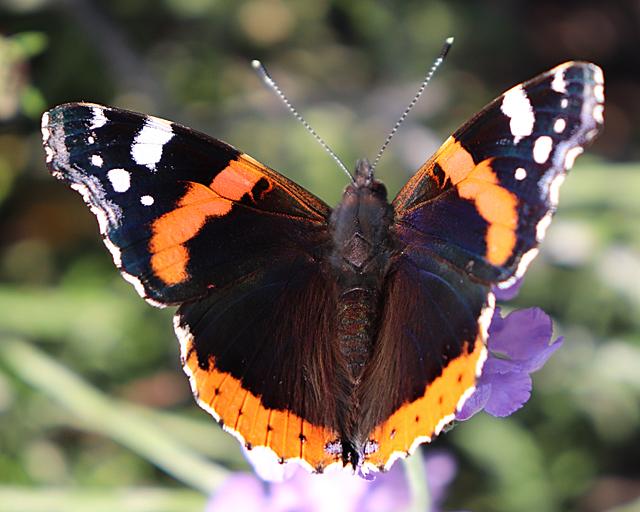
The Red Admiral butterfly is characterized by black hindwings with a distinctive red-orange border. The forewings are also black and feature white markings near the apex. The wingspan ranges from 4.7 to 7.5 cm. Individuals tend to have brighter coloration and larger body mass during summer months compared to winter. Legs and eyes are typically hairy, and the head is moderately large. The mature larva is cylindrical and covered with branched spines arranged in longitudinal rows.
Male Red Admiral butterflies are territorial and patrol areas in search of females. After mating, females lay eggs on the upper surfaces of host plant leaves. The butterfly life cycle begins with an egg, progresses through a larval stage, then a pupal stage within a chrysalis, and finally emerges as an adult. Adults then mate, lay eggs, and the cycle repeats. Most Red Admiral butterflies are bivoltine (two generations per year); however, in northern Canada and the northern United States they are univoltine (one generation per year), while in the southern United States they are trivoltine (three generations per year).
Red Admiral butterflies inhabit large portions of the Northern Hemisphere. In the Western Hemisphere, they range from northern Canada to Guatemala; in the Eastern Hemisphere, from Scandinavia and northern Russia southward to North Africa and China. They are also found on Atlantic islands including Bermuda, the Azores, and the Canary Islands, and on the Hawaiian Islands in the Pacific. Additionally, they have been introduced to New Zealand, where they now breed.
Red Admiral butterflies are commonly found in moist environments such as wetlands, forests, fields, and well-watered gardens. Unable to withstand extreme winter cold, they migrate southward to warmer climates during winter months. During migration, they can be found in habitats ranging from subtropical zones to tundra. Their preferred habitats are temperate and continental, with terrestrial biomes including savanna, grassland, and forest. They are also found in wetland areas such as marshes.
Red Admirals are considered friendly butterflies that readily approach and land on humans. However, males tend to defend territories in search of mates. Males typically claim elliptical territories measuring 4 to 13 meters in width and 8 to 24 meters in length. To defend these areas, they patrol the boundaries up to thirty times per hour.
This species is generally restless and fast-moving, frequently changing direction during flight. They are most active in spring and autumn, with flight periods lasting from March to November. Adults enter hibernation during winter months. Key behaviors include flying, diurnal activity, territoriality, migration, and hibernation.
During the larval stage, Vanessa atalanta primarily feeds on plants from the family Urticaceae; main host plants include stinging nettle (Urtica dioica) and hops (Humulus lupulus). Adult butterflies feed on flower nectar but also prefer fermented fruit juices, tree sap, and bird droppings. Additionally, they drink from moist soil or muddy puddles to obtain minerals and electrolytes.
The Red Admiral butterfly is considered globally secure, despite being rare at the edges of its range. It is listed as “Not Evaluated” on the IUCN Red List. The U.S. Federal List classifies it as Least Concern (LC).
Downing, Amanda. "Vanessa atalanta." *Animal Diversity Web*. Accessed October 21, 2025. https://animaldiversity.org/accounts/Vanessa_atalanta/
Geograph. "NJ3458: Red Admiral Butterfly (Vanessa atalanta) JPG." Pexels. Accessed October 21, 2025. https://www.geograph.org.uk/photo/6282961
U.S. Forest Service. "The Red Admiral Butterfly - Vanessa atalanta." *U.S. Forest Service*. Accessed October 21, 2025. https://www.fs.usda.gov/wildflowers/pollinators/pollinator-of-the-month/red-admiral-butterfly.shtml
Scientific Name(s) | Vanessa atalanta | ||||||||
|---|---|---|---|---|---|---|---|---|---|
Turkish Names | Atalanta, Red Admiral | ||||||||
Distribution(s) | Entire Northern Hemisphere | ||||||||
Conservation Status | IUCN Global: Not Evaluated (NE) Europe: Least Concern (LC) | ||||||||
No Discussion Added Yet
Start discussion for "Red Admiral (Vanessa atalanta)" article
Taxonomy and Nomenclature
Morphological Characteristics
Reproduction
Geographic Distribution and Habitat
Behavior
Feeding Habits
Conservation Status