


This article was automatically translated from the original Turkish version.
+1 More
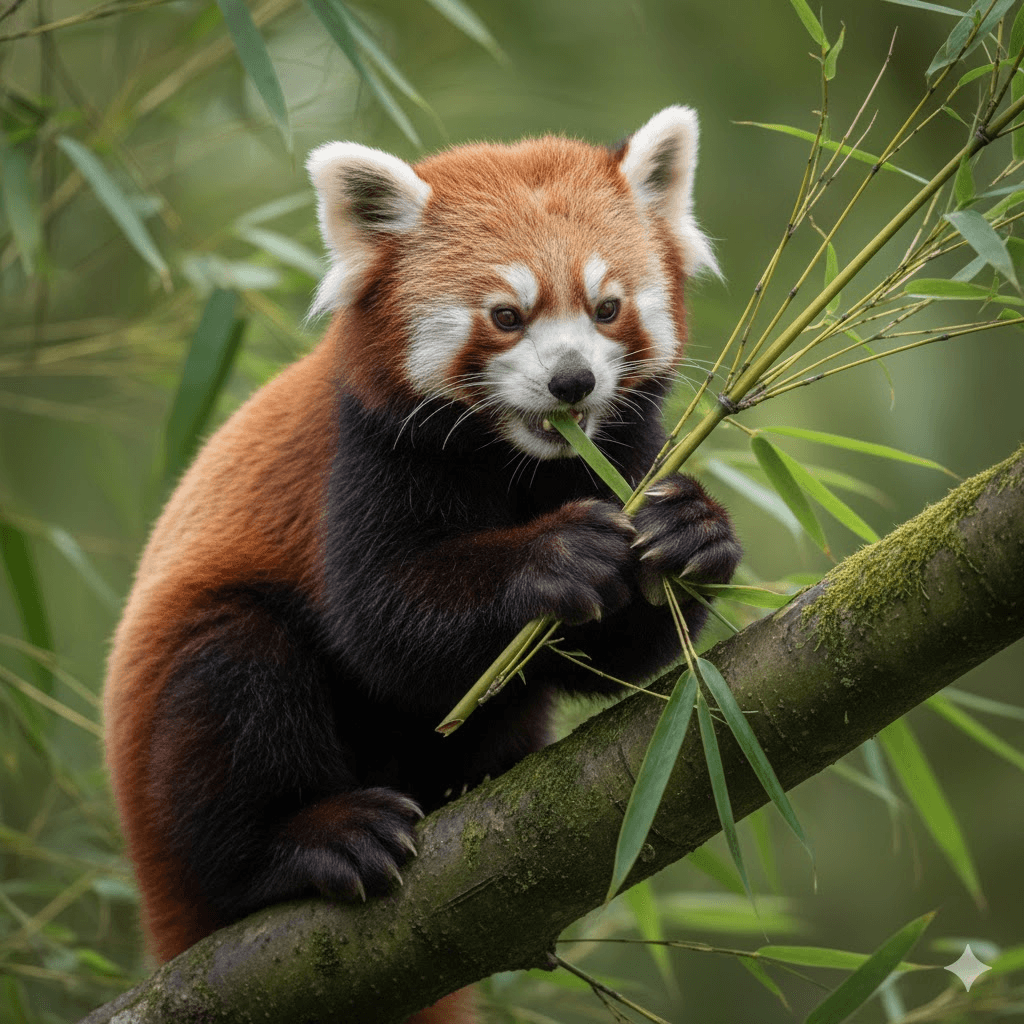
Generated with Artificial Intelligence
Red Panda (Ailurus fulgens)
Scientific Name(s) | Ailurus fulgens | ||||||||
|---|---|---|---|---|---|---|---|---|---|
Team(s) | Carnivora | ||||||||
Name(s) | Red Panda | ||||||||
Family | Ailuridae | ||||||||
Diet(s) | Omnivore | ||||||||
Habitat | Southwest China (montane forests) Eastern Himalayas | ||||||||
The red panda is a mammal slightly larger than a domestic cat, with a body structure resembling that of a bear. Its fur ranges between reddish-brown and black, and it has distinct white markings on the sides of its head, above its eyes, and along the edges of its ears. Its long, bushy tail aids in balance and helps prevent heat loss during winter. Its body structure has evolved to support arboreal movement, featuring semi-retractable claws and flexible ankle joints that enable it to move between branches and hang upside down.

Red Panda (Generated by Artificial Intelligence)
The red panda belongs to the family Ailuridae and is phylogenetically related to raccoons, weasels, and skunks. It shares a connection with the giant panda (Ursidae) only through similar feeding habits and a coincidental name; the two species are not closely related. The red panda, scientifically named Ailurus fulgens, was first described in 1825. Its Latin name means “fire-colored cat.” The giant panda was discovered in 1869, and both species share the name “panda” due to their bamboo diet.
Red pandas inhabit high-altitude, cool, and humid forests in Nepal, India, Bhutan, Myanmar, and China. Approximately half of their range lies within the Eastern Himalayas. The species prefers areas near water sources with dense bamboo cover and tree cover. Two subspecies are officially recognized: Ailurus fulgens fulgens, found in Nepal, India, Myanmar, and Bhutan; and Ailurus fulgens refulgens, primarily in China. Recent genetic studies suggest these subspecies may represent two distinct species.
Red pandas are solitary and nocturnal. They are most active during twilight and nighttime hours. During the day, they rest on the ground or sleep curled up or hanging from tree branches, depending on weather conditions. Their morphological adaptations for arboreal life enable them to evade predators and move efficiently within their habitat.

Red Panda and Cub (Generated by Artificial Intelligence)
Bamboo constitutes the primary component of the red panda’s diet. The opposable thumb-like extension on its paws, which aids in grasping bamboo stalks, serves a similar function to that of the giant panda but evolved primarily for gripping tree branches. The species also consumes fruit, roots, succulent grasses, acorn mast, lichen, and occasionally bird eggs, insects, and small mammals. Ecologically, red pandas help regulate bamboo populations and serve as a food source for predators such as snow leopards and jackals.
Females are fertile for only a few days each year. Gestation lasts approximately 130 days, resulting in one to four cubs. Cubs are cared for by their mother for about three months after birth, after which they begin independent life.
Red pandas are classified as Vulnerable by the IUCN. The wild population is estimated to be fewer than 10,000 individuals. Major threats include habitat loss, fragmentation, and degradation; poaching; and illegal pet trade. They are hunted in China and Myanmar for their fur and traditional uses. Additionally, climate change and natural disasters are forcing red panda populations to migrate to higher altitudes.
WWF and other organizations contribute to red panda conservation by monitoring populations in India, Nepal, and Bhutan. These efforts encompass habitat management, reintroduction programs, and community awareness initiatives. Collaborations with local communities have led to anti-poaching programs and the development of alternative income sources such as briquette production from yak dung and ecotourism, thereby reducing human impact on red panda habitats.
Red pandas play a vital role in ecosystem functions. They regulate bamboo populations and serve as a food source for natural predators. Additionally, they contribute to the balance of forest ecosystems, supporting the sustainability of other plant and animal species.

Red Panda – Feeding Process (Generated by Artificial Intelligence)
The red panda’s diet consists primarily of bamboo shoots and leaves. This feeding behavior helps control excessive bamboo growth, preserving forest structure. Excessive bamboo density can inhibit the growth of other plant species and reduce understory flora diversity. By consuming bamboo, red pandas maintain this ecological balance and thereby support the continuity of biological diversity.
In addition to bamboo, red pandas feed on fruits, acorn mast, and insects, dispersing the seeds of these plants through their feces to different areas. This promotes forest regeneration and the spread of plant species, enhancing the resilience of forest ecosystems.
Red pandas serve as a potential food source for predators such as leopards, snow leopards, and clouded leopards. Although not their primary prey, their populations contribute to the energy flow within ecosystems as part of the food chain for these large carnivores. This dynamic influences predator-prey relationships and broader ecosystem processes.
Red pandas are a key indicator of the overall health and biodiversity of their ecosystems. Declining populations typically signal environmental problems such as habitat destruction, illegal hunting, and climate change. Therefore, conserving red pandas also means protecting the fragile mountain forest ecosystems they inhabit and the thousands of other species that share these habitats.
Beyond their cultural symbolism for local communities, red pandas are a significant attraction for ecotourism. This generates economic benefits for local economies and provides financial support for conservation initiatives.
Gray, Betty Jean. "Care and Development of a Hand-reared Red Panda." *International Zoo Yearbook* 10, no. 1 (January 1970): 134–135. Accessed February 6, 2026. https://doi.org/10.1111/j.1748-1090.1970.tb01314.x
Kappelhof, J., and J. Weerman. "The Development of the Red Panda Ailurus fulgens EEP: From a Failing Captive Population to a Stable Population That Provides Effective Support to In Situ Conservation." International Zoo Yearbook 54, no. 1 (October 2020): 102–112. Accessed February 6, 2026. https://doi.org/10.1111/izy.12278.
National Geographic. "Red Pandas, Facts and Photos." nationalgeographic.com. Accessed February 6, 2026. https://www.nationalgeographic.com/animals/mammals/facts/red-panda.


Generated with Artificial Intelligence
Red Panda (Ailurus fulgens)
Scientific Name(s) | Ailurus fulgens | ||||||||
|---|---|---|---|---|---|---|---|---|---|
Team(s) | Carnivora | ||||||||
Name(s) | Red Panda | ||||||||
Family | Ailuridae | ||||||||
Diet(s) | Omnivore | ||||||||
Habitat | Southwest China (montane forests) Eastern Himalayas | ||||||||
No Discussion Added Yet
Start discussion for "Red Panda (Ailurus fulgens)" article
Taxonomy and Phylogenetic Position
Distribution and Habitat
Behavior and Activity Pattern
Diet
Reproduction
Conservation Status and Threats
Conservation Efforts and Human Interaction
Ecological and Biological Significance
Regulator of Bamboo Populations
Contribution to Seed Dispersal
Role in the Food Chain
Indicator of Biodiversity
Cultural and Bioeconomic Importance