


This article was automatically translated from the original Turkish version.
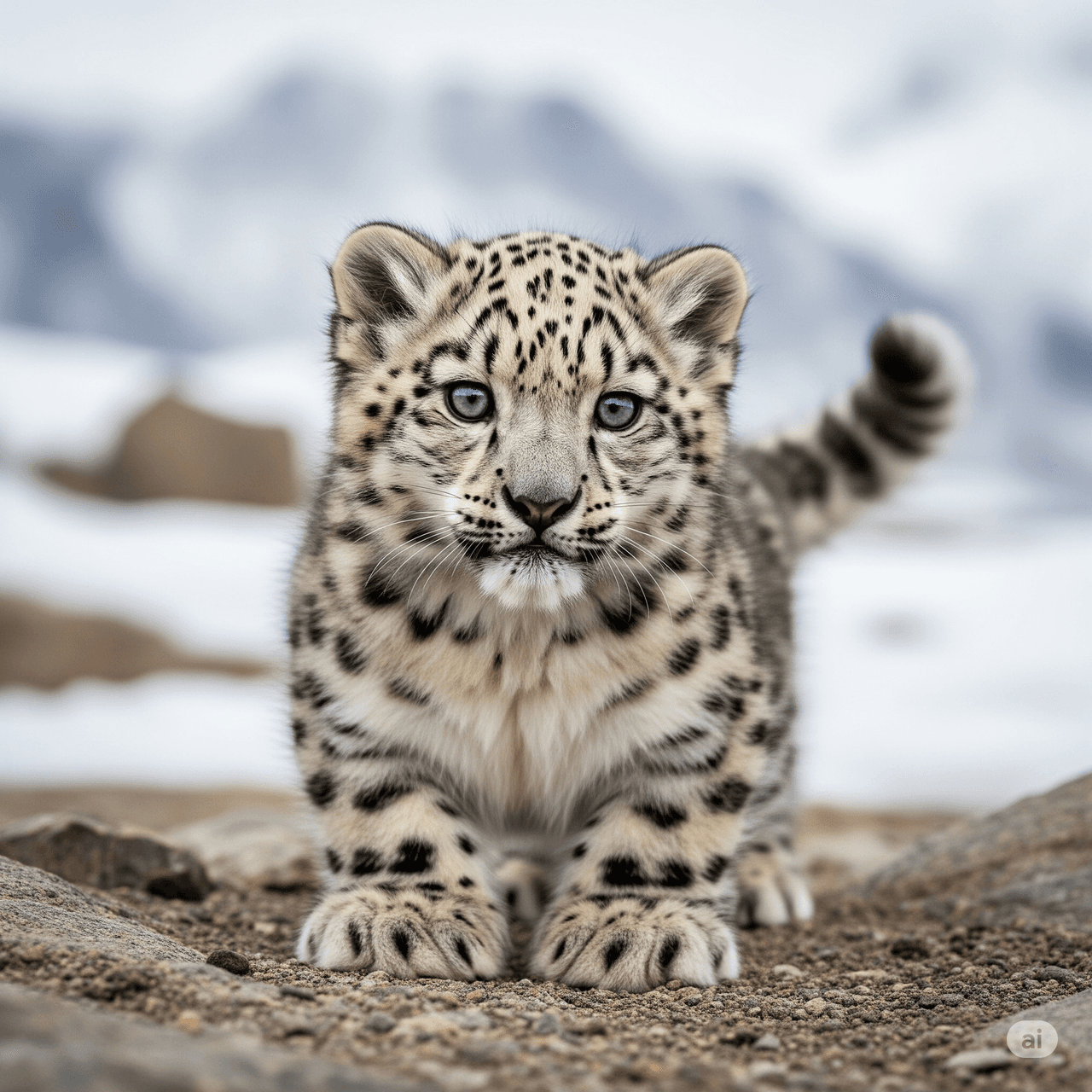
Leopard of the Snow
Genus | Panthera | ||||||||
|---|---|---|---|---|---|---|---|---|---|
Specie(s) | Uncia | ||||||||
Family | Felidae | ||||||||
Habitat | Mountain | ||||||||
Diet(s) | Carnivore | ||||||||
Status | Sensitive | ||||||||
Prey | Bharal | ||||||||
Distribution Range | Kunlun Mountains Karakoram Mountains Tibet Plateau Mountains Tien Shan Mountains Pamir Mountains Altai Mountains Himalaya Mountains Hindukush Mountains | ||||||||
Living Area | 2,000–6,000 m Elevation | ||||||||
Weight(s) | 22–55 kg | ||||||||
Length(s) | 90–115 cm | ||||||||
Number of Offspring | 2–3 | ||||||||
Conservation | GSLEP | ||||||||
The snow leopard (Panthera uncia) is a rare large cat species that dominates the high mountain belts of Central and South Asia and has evolved specialized adaptations to cold climates. Known as the “ghost” of rugged and fragmented terrains between 3,000 and 6,000 meters elevation, this species occupies the apex of the ecological pyramid in the Himalayas, Karakoram, Pamir, Tian Shan and Altai mountain ranges, helping to maintain the integrity of high-altitude ecosystems. Despite its symbolic status, low population density, extensive yet fragmented habitat, and human-induced pressures threaten the species’ current and future survival on a global scale.
The snow leopard is closely related to other members of the genus Panthera, including the lion (P. leo), tiger (P. tigris), jaguar (P. onca) and leopard (P. pardus); however, molecular clock analyses indicate that this lineage diverged approximately 3.9 million years ago in Central Asia. Recent studies based on mitochondrial genome sequences confirm that the snow leopard has remained a distinct evolutionary lineage, with gene flow within the species restricted by geographic barriers.
Its dense, long fur, reaching up to 55 mm in length, provides insulation that minimizes heat loss at temperatures as low as -40 °C. The base color of the fur ranges from smoky gray to yellow-cream; rosette markings, which provide terrestrial camouflage, measure 4–6 cm in diameter. Head-body length ranges from 100 to 130 cm, tail length from 80 to 105 cm, shoulder height averages 60 cm, and body mass varies between 22 and 55 kg. Thickening of the neck and tail reduces surface area for convective cooling, while the long tail aids in balance at high altitudes. Distinctive cranial features for species identification include an interfrontal depression, a prominent sagittal suture, and a sharply projecting frontal bone.
Corneal curvature and pupil dilation optimize vision under low-light conditions; a high rod-to-cone ratio in the retina enhances nocturnal hunting efficiency. A highly pneumatized skull facilitates warming of inhaled air. Hemoglobin’s high oxygen affinity maintains aerobic capacity in hypoxic environments; increased radial artery diameter supports oxygen delivery to peripheral tissues.

Sensory and Physiological Adaptations (Generated by Artificial Intelligence)
The total global range of the snow leopard is approximately 1.83 million km²; however, high topographic fragmentation limits only 28% of this area to “highly suitable” habitat. The highest population densities are recorded in the Karakoram and Hindu Kush subregions; new climate refugia are emerging in certain parts of Tibet and the Kunlun Mountains. Bioclimatic modeling predicts that suitable habitats will shift northward and to higher elevations by 2050.
Adult males establish home ranges averaging 200 km², while females occupy areas of about 120 km², forming asymmetrically overlapping territories. Satellite collar data reveal that 54% of daily activity occurs during crepuscular hours (civil twilight ±2 hours around sunrise and sunset), with increased nocturnal activity during winter months.
The primary prey portfolio includes blue sheep (Pseudois nayaur), Siberian ibex (Capra sibirica), Himalayan blue sheep (Bharal), argali (Ovis ammon), and Himalayan tahr; wild ungulates constitute 55–78% of the diet. During winter, declines in natural prey availability lead to increased predation on domestic goats and sheep, intensifying human-wildlife conflict. Scat DNA metabarcoding analyses have documented the inclusion of 14 different mammalian species in the snow leopard’s diet.

Hunting (Generated by Artificial Intelligence)
The most recent unified phase-meta-analysis estimates the global mature individual population at 4,080 (±620), with an annual population change rate of –1.2%. The genetic effective population size is only around 1,260, falling below IUCN critical thresholds and indicating that inbreeding-related losses of genetic diversity are likely to increase in the near term.
Byambasuren, C., Johansson, Ö., Alexander, J. S., Lkhagvajav, P., Samelius, G., & Sharma, K. (2024). Who’s the boss? Understanding the spatial relationship between snow leopard and Eurasian lynx in southern Mongolia. *Wildlife Biology*. https://doi.org/10.1002/wlb3.01323.
Li, J., Xue, Y., Hacker, C. E., Zhang, Y., Li, Y., Cong, W., Jin, L., Li, G., Wu, B., Li, D., & Zhang, Y. (2021). Projected impacts of climate change on snow leopard habitat in Qinghai Province, China. *Ecology and Evolution*, *11*(23), 17202–17218. https://doi.org/10.1002/ece3.8358.
ROȘU, P. M., BELU, C. R., TĂPĂLOAGĂ, D., GEORGESCU, B., MUSTĂȚEA, A. I., MIHAI, S. A., & University of Agronomic Sciences and Veterinary Medicine of Bucharest. (2024). MORPHOLOGICAL PARTICULARITIES OF THE SNOW LEOPARD SKULL - IRBIS (Panthera uncia - Schreber, 1775) - CASE STUDY. In *Scientific Papers. Series D. Animal Science: Vol. LXVII*. https://www.animalsciencejournal.usamv.ro/pdf/2024/issue_2/Art78.pdf.
Raina, P., Mungi, N. A., Kumar, U., Rathi, A. D., Khan, N. H., Patel, D. A., Bhasin, A., Bisht, S., Hiby, L., Pandav, B., Sultan, M. S., Takpa, J. J., & Jhala, Y. V. (2025). Comprehensive assessment of snow leopard distribution and population in the Indian Trans-Himalaya, Ladakh: Standardizing methods for evidence-based conservation. *PLoS ONE*, *20*(5), e0322136. https://doi.org/10.1371/journal.pone.0322136.
Sims, M. E. (2012). Cranial morphology of five felids: Acinonyx jubatus, Panthera onca, Panthera pardus, Puma concolor, Uncia uncia.InRUSSIAN JOURNAL of Theriology*, *Russian Journal of Theriology* (Vol. 11–2, pp. 157–170). https://kmkjournals.com/upload/PDF/RJT/11/ther11_2_157_170_Sims.pdf.
Trust, S. L. (2024, September 18). *Counting Ghosts of the Greater Himalayas: Pioneering Snow Leopard Survey released*. Snow Leopard Trust. https://snowleopard.org/counting-ghosts-of-the-greater-himalayas-pioneering-snow-leopard-survey-released/.

Leopard of the Snow
Genus | Panthera | ||||||||
|---|---|---|---|---|---|---|---|---|---|
Specie(s) | Uncia | ||||||||
Family | Felidae | ||||||||
Habitat | Mountain | ||||||||
Diet(s) | Carnivore | ||||||||
Status | Sensitive | ||||||||
Prey | Bharal | ||||||||
Distribution Range | Kunlun Mountains Karakoram Mountains Tibet Plateau Mountains Tien Shan Mountains Pamir Mountains Altai Mountains Himalaya Mountains Hindukush Mountains | ||||||||
Living Area | 2,000–6,000 m Elevation | ||||||||
Weight(s) | 22–55 kg | ||||||||
Length(s) | 90–115 cm | ||||||||
Number of Offspring | 2–3 | ||||||||
Conservation | GSLEP | ||||||||
Taxonomy, Morphology and Evolutionary Adaptations
Taxonomic Position and Phylogenetic Relationships
Physical Characteristics
Sensory and Physiological Adaptations
Ecology, Distribution and Population Dynamics
Geographic Range and Habitat Characteristics
Behavior and Spatial Patterns
Dietary Ecology
Population Size and Trends