


This article was automatically translated from the original Turkish version.
+2 More
In nuclear reactors, refueling—the planned removal of spent fuel assemblies from the reactor core and their replacement with fresh fuel, alongside the strategic rearrangement of remaining fuel assemblies—is a critical core management process that directly affects reactor reactivity control, power distribution, safety margins, and economic operation. In Pressurized Water Reactors (PWRs), periodic fuel replacement operations are essential for continuous and safe energy production. The fundamental principles, implementation methods, and strategic importance of fuel replacement and fuel shuffling in nuclear power generation will be examined.
In Pressurized Water Reactors, nuclear fuel is the primary component where fission reactions occur and is generally composed of uranium dioxide (UO₂) fuel material. UO₂ is widely preferred in PWR technology due to its high melting point and stability under radiation. This fuel is contained within a metallic cladding that encapsulates fission products and ensures safe reactor operation; the cladding is manufactured from zirconium-based alloys with low neutron absorption properties.
The fuel is loaded into cylindrical pellets within the cladding to form fuel rods. These fuel rods are arranged in a specific pattern within the reactor core to ensure mechanical integrity and efficient heat transfer. Groups of numerous fuel rods combine to form fuel assemblies. Fuel assemblies serve as modular building blocks within the core and include structural elements that maintain rod positioning and regulate coolant flow.
A PWR reactor core is constructed by arranging these fuel assemblies in a defined pattern. This hierarchical structure—pellet, fuel rod, and fuel assembly—represents the fundamental design approach that enables safe, controlled, and long-term fuel use in PWR reactors.
During reactor operation, fission reactions reduce the concentration of fissile isotopes within the fuel while fission products gradually accumulate. This physical process is generally referred to as fuel depletion and is a key concept describing how much energy the fuel has produced within the reactor. Fuel depletion is evaluated as a parameter that directly influences the neutronic and thermal behavior of the core throughout reactor operation. One of the primary effects of fuel depletion is reactivity loss. The reduction in fissile material and the buildup of fission products with neutron-absorbing properties diminish the core’s neutron multiplication capability, negatively impacting criticality. This situation underscores the importance of core management strategies for sustained and stable reactor operation.
Another significant consequence of fuel depletion is the gradual change in core power distribution. Fuel assemblies in different regions of the core deplete at varying rates depending on neutron flux and operational conditions. This leads to the distortion of initially balanced power distribution and the emergence of spatial power variations within the core. These effects necessitate careful planning of fuel placement and fuel replacement strategies.
Refueling is a fundamental core management process involving the planned removal of spent fuel assemblies from the reactor core during a scheduled shutdown and their replacement with fresh fuel assemblies. This process is performed periodically to restore reactor reactivity balance, optimize power distribution, and maintain safe operating conditions.
Reactor shutdown and cooling: In the first stage, the reactor is safely shut down and allowed to cool. This cooling period is critical for reducing the radioactivity of fission products.
Reactor vessel head removal: The reactor vessel head is opened. This operation is performed underwater, as water serves both as a radiation shield and a coolant.
Fuel handling operations: Specialized fuel handling machines are used to remove spent fuel assemblies from the reactor core and transfer them to the spent fuel pool.
New fuel loading: New fuel assemblies are loaded into the reactor core according to the planned configuration.
Reactor closure and restart: After all safety checks are completed, the reactor vessel head is sealed and the system is restarted.
Three primary fuel replacement strategies are used in PWR reactors:
Full core refueling: All fuel assemblies are replaced simultaneously. This strategy is rarely used and typically applied only during initial fuel loading or after major design modifications.
Partial core refueling: The most common strategy, in which approximately one-third of the core is renewed during each refueling cycle. For example, in a reactor with 193 fuel assemblies, about 64 assemblies are replaced per refueling.
Low-enrichment fuel strategy: Using fuel with lower enrichment levels through more frequent refueling. This approach offers advantages in terms of economics and proliferation resistance.
Shuffling is the strategic rearrangement of fuel assemblies that remain in the reactor core during refueling (i.e., those not replaced). This process is critical for optimizing power distribution and improving fuel utilization efficiency.
Commonly used shuffling patterns include:
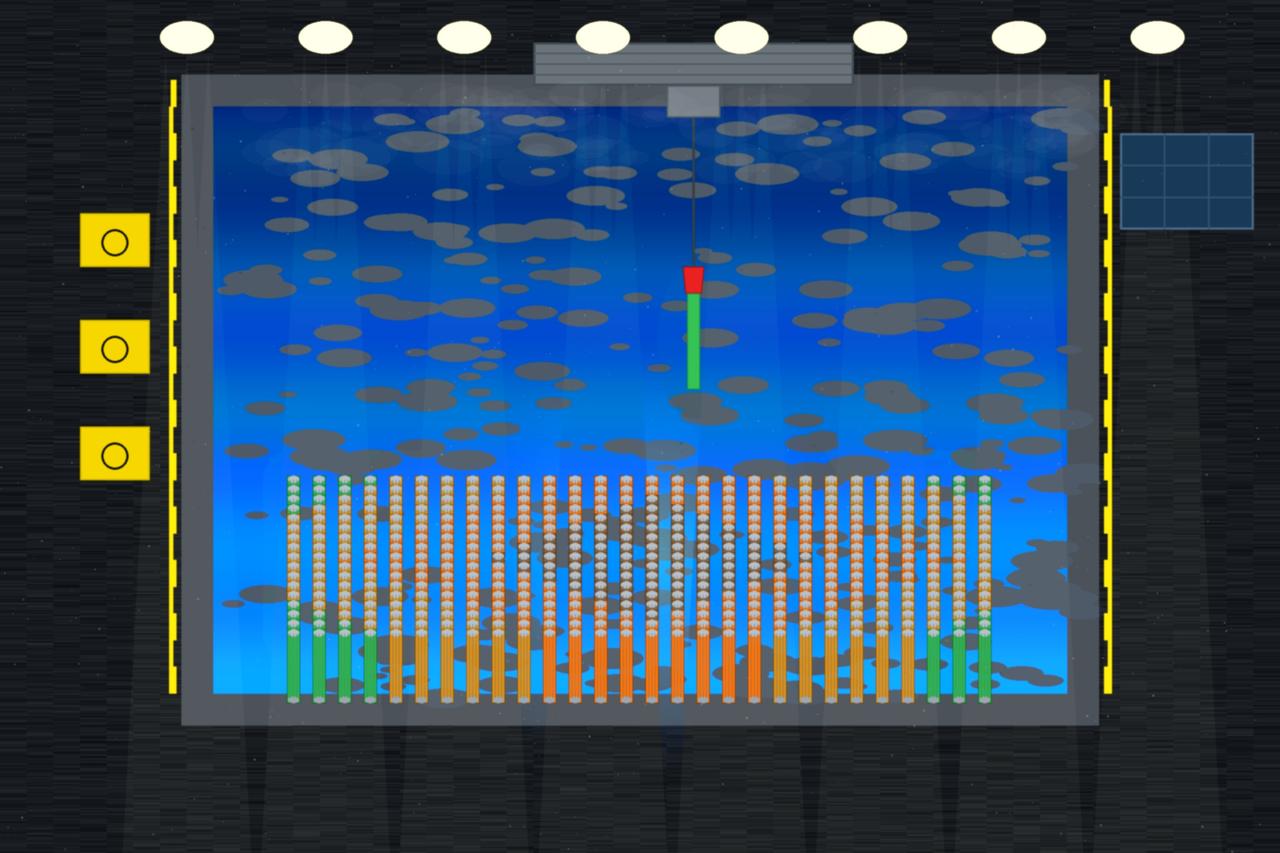
Instantaneous Image During Refueling (Generated by Artificial Intelligence)
Glasstone, Samuel, and Alexander Sesonske. Nuclear Reactor Engineering: Reactor Design Basics. 4th ed. New York: Chapman & Hall, 1994.
Knief, Ronald A. Nuclear Engineering: Theory and Technology of Commercial Nuclear Power. 2nd ed. La Grange Park, IL: American Nuclear Society, 2008.
Todreas, Neil E., and Mujid S. Kazimi. Nuclear Systems, Volume I: Thermal Hydraulic Fundamentals. 2nd ed. Boca Raton, FL: CRC Press, 2012.

No Discussion Added Yet
Start discussion for "Refueling Operation in Reactors" article
Fuel Structure in PWR Reactors
Fuel Depletion and the Need for Replacement
Refueling: The Fuel Replacement Process
Refueling Process
Fuel Replacement Strategies
Shuffling: The Fuel Rearrangement Process
Principles of Shuffling
Shuffling Patterns
Benefits of Refueling and Shuffling