


This article was automatically translated from the original Turkish version.
Reverse thrust is an aerodynamic braking method achieved by reversing the direction of engine thrust to slow down aircraft after landing. It is commonly used in jet-powered aircraft and aims to reduce speed by redirecting the engine’s thrust opposite to the direction of flight. This system is preferred particularly to reduce the load on landing gear braking systems and to enable safe landings on short runways.
Boeing C-17 Globemaster III Applying Reverse Thrust (AiirSource Military)
While early jet aircraft relied on bucket-type systems, modern aircraft with high-bypass-ratio engines use cascade systems that redirect the cold airflow. With the development of electric and hybrid-electric propulsion systems, lighter and simpler reverse thrust systems based on rotating components that reverse flow direction are expected to emerge in the future.
Reverse thrust is based on Newton’s third law of motion (“For every action, there is an equal and opposite reaction”). Normally, jet engines generate forward thrust by expelling air and combustion gases rearward. When this airflow is redirected forward, the resulting reaction force acts opposite to the aircraft’s forward motion, causing deceleration. However, due to aerodynamic and structural limitations, the airflow is typically deflected by approximately 135 degrees rather than a full 180 degrees.
Reverse thrust systems employ various mechanical devices to redirect the engine exhaust flow forward. The system is activated by pilot command after landing. Doors, vanes, or deflector panels located behind the engine open to redirect the exhaust or fan airflow toward the front.
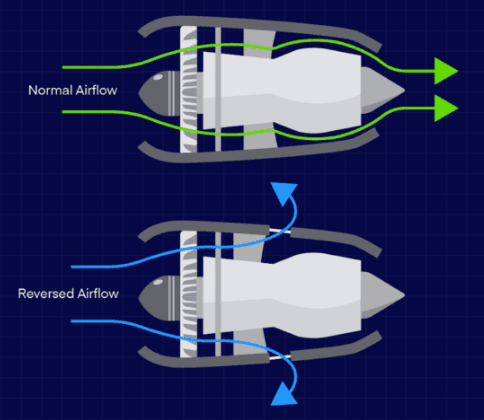
Operating Mechanism (Pilotinstitute)
Reverse thrust systems are subject to regular inspections and frequent maintenance procedures. Unforeseen malfunctions, such as the unintended deployment of the reverse thrust lock during flight, can lead to serious accidents; therefore, safety measures are a critical part of their design.
GlobeAir. "Thrust Reverser." GlobeAir, Accessed July 20, 2025. https://www.globeair.com/g/thrust-reverser
Pilot Institute. “Thrust Reversal.” Pilot Institute, Accessed July 20, 2025. https://pilotinstitute.com/thrust-reversal/
Purdue University. "Reverse Thrust." *Propulsion Basics – School of Aeronautics and Astronautics, Purdue University*, Accessed July 20, 2025. https://engineering.purdue.edu/~propulsi/propulsion/jets/basics/reverse.html
Skybrary. "Thrust Reversers: Flight Crew Guidance." *Skybrary Aviation Safety*, Accessed July 20, 2025. https://skybrary.aero/articles/thrust-reversers-flight-crew-guidance
TRT Haber. "Türkiye'nin İlk Milli Turbofan Uçak Motoru TEI-TF6000 Tanıtıldı." Accessed July 20, 2025. https://www.trthaber.com/haber/bilim-teknoloji/turkiyenin-ilk-milli-turbofan-ucak-motoru-tei-tf6000-tanitildi-845850.html
YouTube. “Thrust Reverser Mechanism – How It Works.” YouTube Video, Accessed July 20, 2025. https://www.youtube.com/watch?v=eV7YkWIqM0w

No Discussion Added Yet
Start discussion for "Reverse Thrust (Aviation)" article
Historical Development and Future Perspective
Basic Principle
Applications and Objectives
Operating Mechanism
Types of Reverse Thrust
Application Examples
Safety and Maintenance