


This article was automatically translated from the original Turkish version.
Riemann Hypothesis
Basic Subject | Distribution of prime numbers | ||||||||
|---|---|---|---|---|---|---|---|---|---|
Critical Region | Re(s) ∈ (0, 1) | ||||||||
Predicted Line | Re(s) = 1/2 | ||||||||
Definition Field | Complex plane | ||||||||
Function Type | Dirichlet series | ||||||||
Status of the Hypothesis | Still unproven | ||||||||
Award(s) | Clay Institute - 1 million dollars | ||||||||
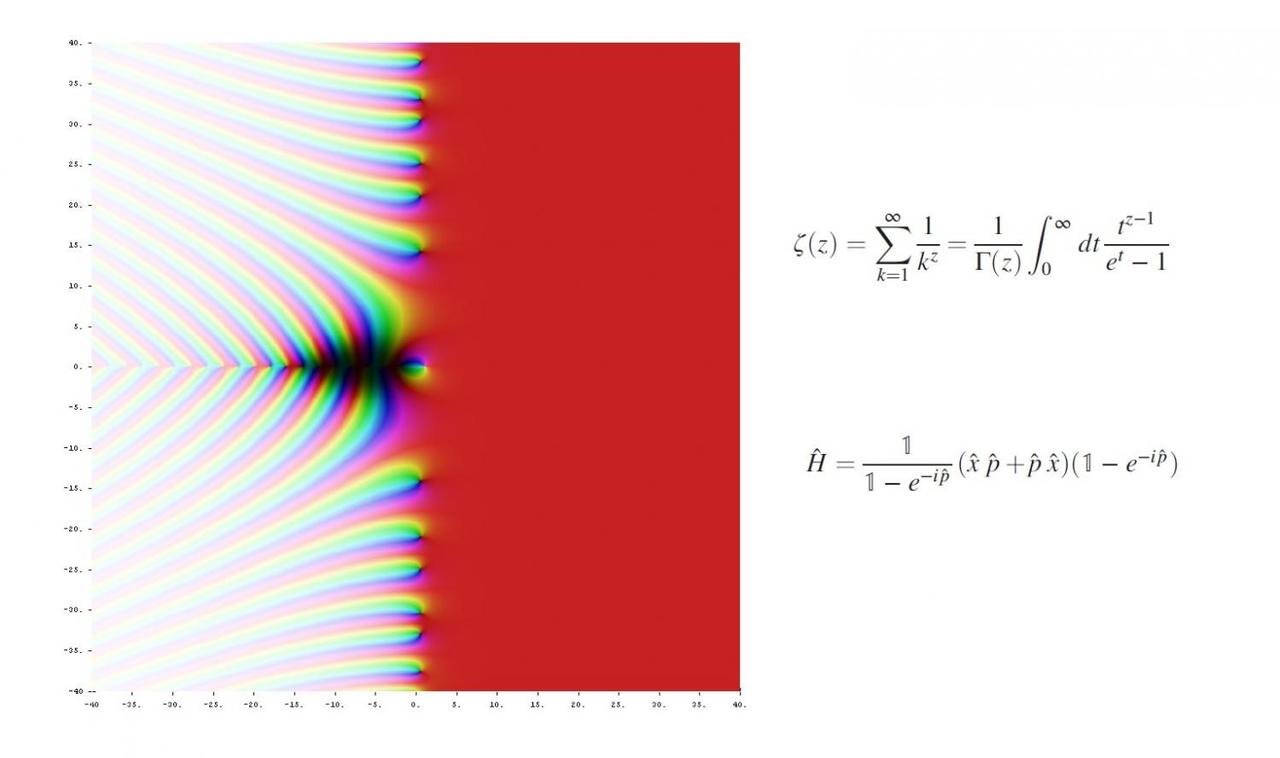
The Riemann Hypothesis is a conjecture at the heart of complex analysis and number theory, defining a fundamental problem concerning the distribution of prime numbers. According to the hypothesis, all nontrivial zeros of the Riemann zeta function lie on the line Re(s) = 1/2 in the complex plane. This line is called the critical line and constitutes the fundamental geometric structure governing the behavior of the zeta function in the complex plane.
The Riemann zeta function is initially defined as a Dirichlet series in the region Re(s) > 1, where it is expressed as:
zeta(s) = 1 / 1^s + 1 / 2^s + 1 / 3^s + 1 / 4^s + ... (continuing to infinity)
The influence of the zeta function’s zeros on the distribution of prime numbers is directly linked to the prime number theorem. The location of these zeros provides information about how regularly or irregularly primes are distributed. The truth of the zeros lying on the critical line enables more precise formulas for describing the density and frequency of prime distribution. That the zeta function’s zeros encode information about primes was revealed through Euler’s product expansion, establishing a direct bridge between prime numbers and the zeta function.
The zeta function becomes a meromorphic function defined over almost the entire complex plane through analytic continuation. It has a single pole at s = 1. The region Re(s) ∈ (0, 1), known as the critical strip, is where all nontrivial zeros are located. The symmetry property of the zeta function, guaranteed by its functional equation, ensures that the zeros are symmetrically distributed with respect to the critical line. This property allows information about all zeros to be inferred from the study of only half of them.
Large-scale numerical analyses using modern computational methods have observed that billions of nontrivial zeros of the zeta function lie on the critical line. These observations provide strong empirical support for the validity of the hypothesis. However, such verifications, which cover only a finite number of zeros, are insufficient to prove the hypothesis’s universal validity in a mathematical sense.
Computational methods, particularly those employing fast Fourier transforms and high-precision complex number analysis techniques, have enabled the generation of extensive lists of zeros. These approaches allow the behavior of the zeta function to be examined in various subregions and help better define the boundaries of the hypothesis’s validity.
The distribution of the zeta function’s zeros exhibits structural similarities to the energy levels of systems in statistical physics and quantum mechanics. In this context, formal parallels have been drawn between quantum chaos theory and the Riemann zeta function. Specifically, distribution patterns observed in statistical spectral analysis have made it possible to compare the spectral density of the zeta function’s zeros with energy levels in physical systems. These similarities underscore the importance of the hypothesis not only in mathematics but also from the perspective of physical systems.
Throughout history, numerous theories and methods have been proposed toward solving the hypothesis. These efforts are generally based on approaches rooted in complex analysis, functional analysis, and algebraic number theory. The relationship between the zeta function and Dirichlet series serves as a fundamental component in most of these methods. Additionally, various equivalent formulations of the hypothesis concerning the zeros have been developed. These range from conditional statements assuming no zeros lie outside the critical line to criteria concerning the average distribution of prime numbers.
The Riemann Hypothesis is regarded as one of the most important unsolved problems in mathematics in the 21st century. It lies at the center not only of theoretical mathematics but also of applied mathematics and information theory. Many fundamental results in number theory have been proven or strengthened under the assumption that the hypothesis is true. Consequently, if the hypothesis were false, it would lead to profound consequences requiring a fundamental reassessment of existing mathematical structures.
The problem is one of the seven Millennium Prize Problems announced by the Clay Mathematics Institute, with a one million US dollar prize offered for its solution. The hypothesis remains unproven; although strong numerical evidence supports its validity, no formal proof has yet been established.
Bischoff, Manon. “The Riemann Hypothesis: The Biggest Problem in Mathematics Is a Step Closer.” Scientific American, July 2024. Accessed May 9, 2025. https://www.scientificamerican.com/article/the-riemann-hypothesis-the-biggest-problem-in-mathematics-is-a-step-closer/.
Güneş, Egehan Eren. “Riemann Hipotezi Üzerine Kısa Bir İnceleme.” Academia.edu, August 9, 2024. Accessed May 9, 2025. https://www.academia.edu/122731263/Riemann_Hipotezi_%C3%9Czerine_K%C4%B1sa_Bir_%C4%B0nceleme.
Koca, Nazlı. Riemann Hipotezi Üzerine. Master's thesis, Pamukkale Üniversitesi, 2019. Accessed May 9, 2025. https://gcris.pau.edu.tr/handle/11499/35339.
“Riemann Hipotezine Yeni Bakış.” Fizikolog.net, 2023. Accessed May 9, 2025. https://fizikolog.net/yeni_gelismeler/fizik/riemann-hipotezine-yeni-bakis.html.

Riemann Hypothesis
Basic Subject | Distribution of prime numbers | ||||||||
|---|---|---|---|---|---|---|---|---|---|
Critical Region | Re(s) ∈ (0, 1) | ||||||||
Predicted Line | Re(s) = 1/2 | ||||||||
Definition Field | Complex plane | ||||||||
Function Type | Dirichlet series | ||||||||
Status of the Hypothesis | Still unproven | ||||||||
Award(s) | Clay Institute - 1 million dollars | ||||||||
Definition and Mathematical Foundation
Relationship with Prime Numbers
Analytic Structure and Behavior in the Complex Plane
Numerical Verification and Computational Investigations
Theoretical Similarities with Physical Systems
Theoretical Approaches to the Hypothesis
Mathematical Significance and Current Status