


This article was automatically translated from the original Turkish version.
+1 More
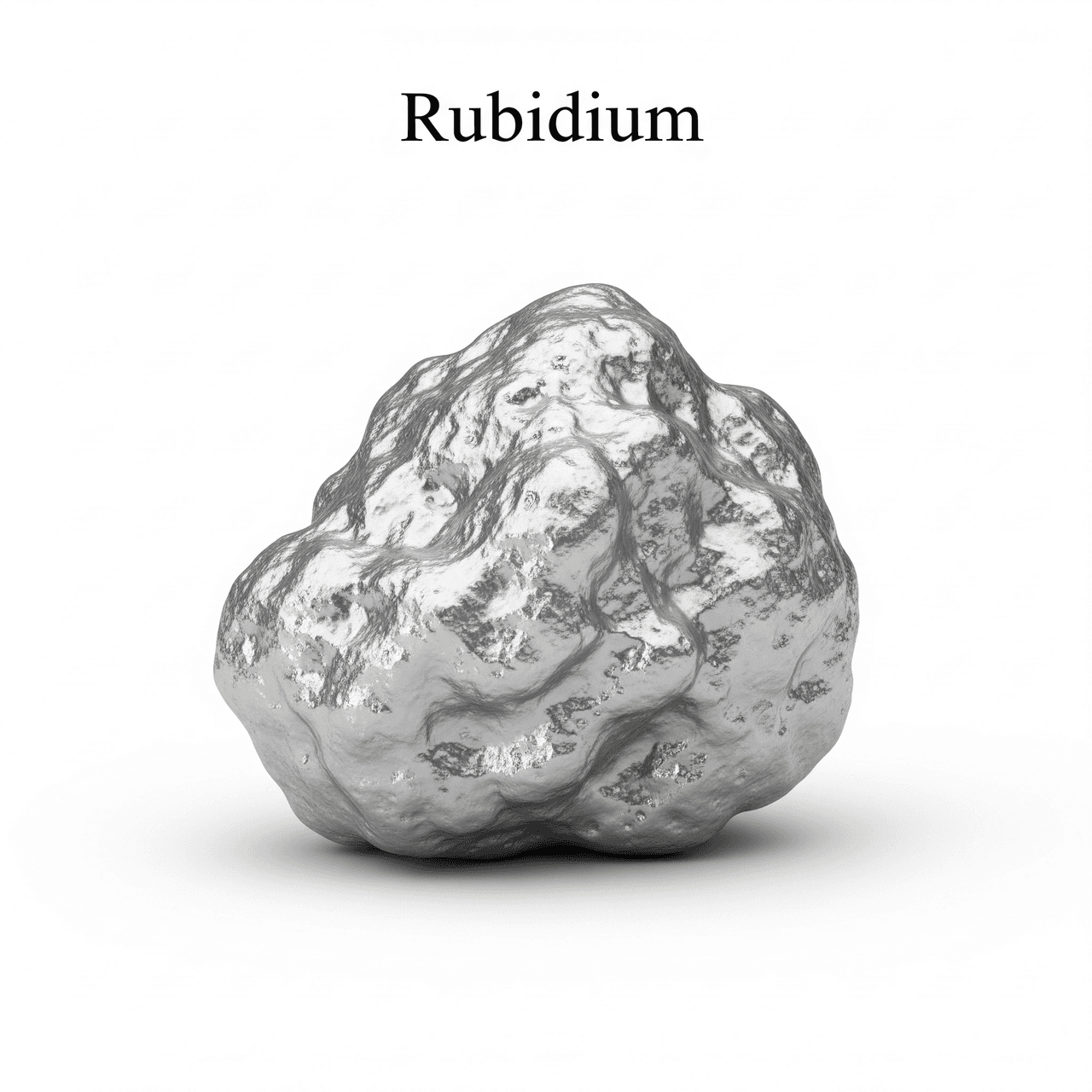
Rubidium (Rb)
Periodic Table | 5 | ||||||||
|---|---|---|---|---|---|---|---|---|---|
Chemical Symbol | Rb | ||||||||
Atomic Number | 37 | ||||||||
Group Number | 1 (Alkali Metal) | ||||||||
Electron Configuration | [Kr]5s¹ | ||||||||
Density | 1.53 g/cm³ | ||||||||
Melting Point | 39.30 °C | ||||||||
Boiling Point | 688 °C | ||||||||
Atomic Radius | 3.03 Å | ||||||||
Electron Affinity | 46.884 kJ/mol | ||||||||
Electronegativity | 0.82 (Pauling) | ||||||||
Appearance | Silvery-white metal | ||||||||
Year of Discovery(ies) | 1861 | ||||||||
Discoverer(s) | Robert Bunsen Gustav Kirchhoff | ||||||||
Rubidium (Rb) is a soft, silvery-white metallic element belonging to the alkali metals group, with an atomic number of 37 and the chemical symbol Rb. It is known for its high reactivity and is located in the fifth period and first group of the periodic table.
Rubidium is a member of the alkali metals group, also known as Group 1A elements in the periodic table. Its electron configuration is [Kr]5s¹, and the presence of a single valence electron in its outermost shell is the primary factor determining its chemical behavior and high reactivity. It tends to readily lose this single valence electron to form a +1 charged ion. This characteristic leads to its classification as an active metal and explains why its compounds typically form ionic bonds. Rubidium is solid at room temperature, and its low melting point (39.30 °C) is a typical feature of alkali metals.
The element rubidium was discovered in 1861 by German chemist Robert Bunsen and physicist Gustav Kirchhoff in Heidelberg. The discovery was made during the spectroscopic analysis of the mineral lepidolite (a type of mica). When Bunsen and Kirchhoff heated the mineral and examined the resulting spectrum, they observed two previously unrecorded prominent dark red lines. These lines indicated the presence of a new element.
The spectroscope, one of the scientific instruments of the time, enabled the separation of light emitted or absorbed by elements according to their wavelengths, producing a unique "fingerprint" (spectrum) for each element. It is well known that Bunsen and Kirchhoff also used this method to discover the element cesium. The discovery of rubidium was thus a product of this analytical technique.
Rubidium Element (Generated by Artificial Intelligence.)
The name rubidium was derived from the characteristic deep red lines observed in its spectrum during discovery. The Latin word "rubidius," meaning "deepest red," forms the origin of the element’s name. The discoverers named the new element "rubidium" due to these unique red spectral lines. The chemical symbol "Rb" is derived from this name.
Rubidium is a soft, malleable, silvery-white metal. Its physical properties are largely similar to those of other alkali metals.
Rubidium is chemically active. When exposed to air, it rapidly oxidizes and loses its luster. It reacts vigorously with water in an exothermic reaction, producing rubidium hydroxide (RbOH) and hydrogen gas (H₂). Although less violent than the reactions of potassium and cesium with water, this reaction is still hazardous. Rubidium also combines directly and strongly with halogens (fluorine, chlorine, bromine, iodine) to form rubidium halides.
Reaction with oxygen can produce various oxides, including rubidium oxide (Rb₂O), rubidium peroxide (Rb₂O₂), and rubidium superoxide (RbO₂).
Rubidium has two naturally occurring isotopes:
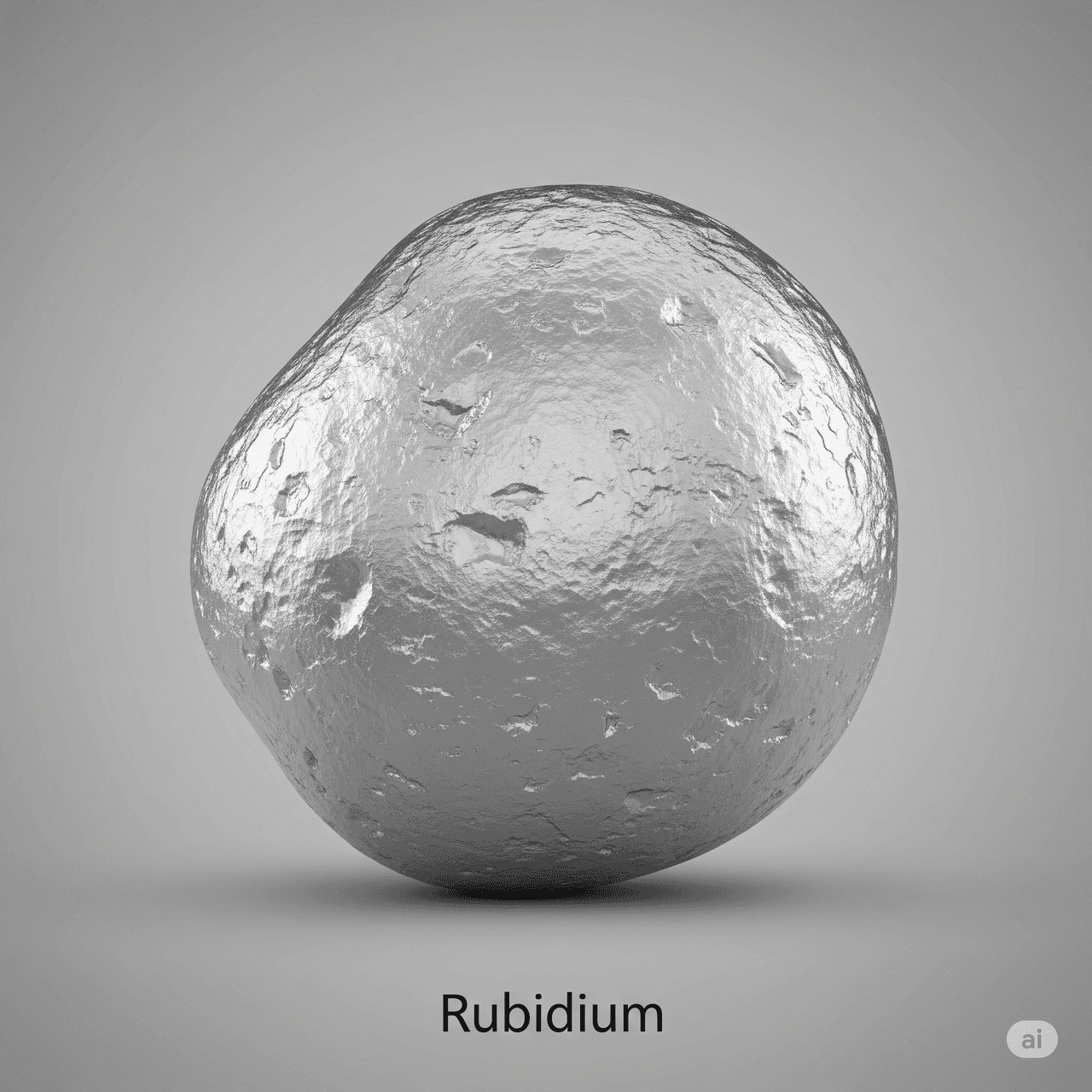
Rubidium (Generated by Artificial Intelligence.)
Although the commercial and scientific applications of rubidium and its compounds are limited, they are used in certain specialized fields:
Due to its ease of ionization, rubidium has been considered as a propellant for ion thrusters in spacecraft. However, cesium, which has been found to be more effective for this purpose, is generally preferred.
Chemistry Learner. "Rubidium." Chemistry Learner. Accessed May 20, 2025. https://www.chemistrylearner.com/rubidium.html
TÜBİTAK Bilim Genç. "Rubidyum." Bilim Genç. Accessed May 20, 2025. https://bilimgenc.tubitak.gov.tr/periyodik-tablo/rubidyum

Rubidium (Rb)
Periodic Table | 5 | ||||||||
|---|---|---|---|---|---|---|---|---|---|
Chemical Symbol | Rb | ||||||||
Atomic Number | 37 | ||||||||
Group Number | 1 (Alkali Metal) | ||||||||
Electron Configuration | [Kr]5s¹ | ||||||||
Density | 1.53 g/cm³ | ||||||||
Melting Point | 39.30 °C | ||||||||
Boiling Point | 688 °C | ||||||||
Atomic Radius | 3.03 Å | ||||||||
Electron Affinity | 46.884 kJ/mol | ||||||||
Electronegativity | 0.82 (Pauling) | ||||||||
Appearance | Silvery-white metal | ||||||||
Year of Discovery(ies) | 1861 | ||||||||
Discoverer(s) | Robert Bunsen Gustav Kirchhoff | ||||||||
Classification and Fundamental Properties
Discovery
Etimology
Physical and Chemical Properties
Isotopes
Applications