


This article was automatically translated from the original Turkish version.
+2 More
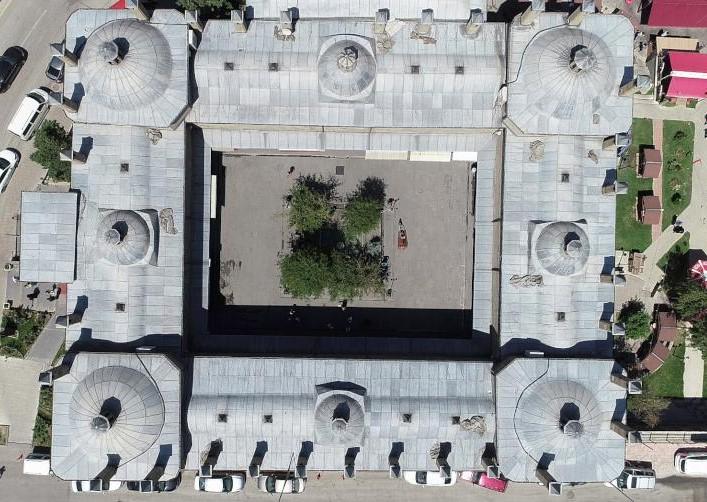
Rüstem Paşa Bedesteni (AA)
Construction Date(s) | 1561 | ||||||||
|---|---|---|---|---|---|---|---|---|---|
Location | Menderes Street (between Pervioğlu Mosque and Boyahane Hamam) Fevziye Neighborhood | ||||||||
Construction Material | Cut stone | ||||||||
Plan Schema | Rectangular courtyard, two-story, arcaded, 32 rooms | ||||||||
Important Repairs | 1965 (General Directorate of Foundations) | ||||||||
Known popularly as Taşhan, this monumental commercial structure was commissioned in 1561 by Grand Vizier Rüstem Paşa during the reign of Kanuni Sultan Süleyman, one of the most brilliant periods of the Ottoman Empire, and built in Erzurum. The building is recognized as an original and high-quality example of Ottoman caravanserai architecture, featuring a rectangular courtyard surrounded by arcades and a two-story layout.【1】
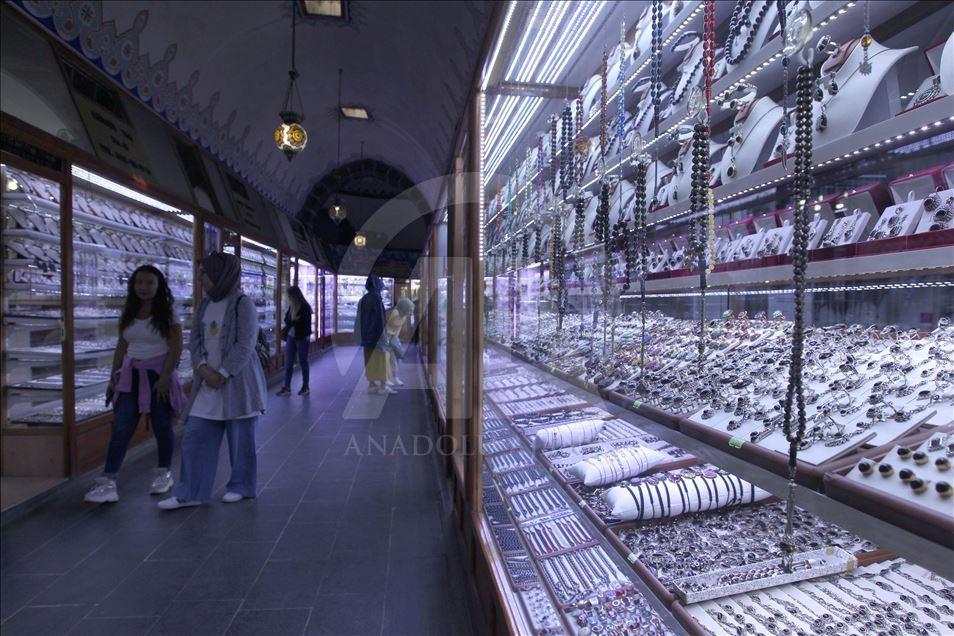
An interior view of Taşhan (AA)
Rüstem Paşa Bedesteni is located in the city center of Erzurum, in the Fevziye neighborhood on Menderes Street, between the Pervioğlu Camii and the Boyahane Hamam. Built in the 16th century, when Erzurum served as a "serhat şehri" (border town), the building’s function and nomenclature were directly influenced by its strategic location. An inscription above the barrel-vaulted entrance on the western façade identifies the structure as a "ribat." Ribats were forward outposts housing between 40 and 50 akıncı troops tasked with border security. However, as the Ottoman Empire expanded its borders to include Tbilisi and the Caspian Sea, the building gradually shed its military function and acquired a civilian character, being used as a residence, shelter, and commercial center.【2】
Situated at the intersection of the historic Silk and Spice Routes, the structure served for centuries to accommodate travelers’ needs for lodging, shelter, and trade, and today has become the central hub for the crafting and sale of Oltu stone, a culturally significant element of Erzurum’s heritage.
Throughout its history, the building housed facilities to meet all traveler needs, including an imaret, a mosque, resting areas, and merchant shops. Special sections were also designated for tethering the camels, donkeys, oxen, mules, and horses used by caravans, although a significant portion of these areas has not survived to the present day.
Constructed from cut stone, Rüstem Paşa Bedesteni reflects the classical Ottoman caravanserai architectural style through its layout centered around a rectangular courtyard.【3】 The building features a two-story arrangement with rooms arranged behind the arcades surrounding the courtyard. A total of 32 rooms encircle the courtyard. Access to the structure is provided through two separate entrances, one on the east and one on the west, both featuring pointed arches and barrel vaults.
On the upper floor, rooms with flat vaults are arranged around a corridor. The decorative elements visible on this level are not original to the building’s initial period but were added in later centuries. In 1965, the General Directorate of Foundations undertook a comprehensive restoration. During these works, the western façade of the caravanserai was slightly advanced through architectural intervention; a deep barrel-vaulted entrance space was created at the lower level, and a room for the caravanserai’s administrator was added above.

Various Oltu Stone Rosaries for sale in Taşhan (AA)
Having retained its commercial character throughout history, Taşhan now functions as a specialized market for the processing and sale of Oltu stone (black amber), a semi-precious mineral unique to Erzurum.【4】 In 1989, the Oltu Stone Association (OSA) brought together master artisans who had previously operated in scattered home workshops across the city, consolidating their activities within this historic structure and transforming Taşhan into a functional "work center." Production is not only carried out within the building by master craftsmen—including many female artisans—but sales also take place on-site.
Anadolu Ajansı. "Siyah altına turist ilgisi." Anadolu Ajansı Foto Galeri. Accessed January 28, 2026. https://www.aa.com.tr/tr/pg/foto-galeri/siyah-altina-turist-ilgisi/2
Hocaoğlu, Yunus. "Asırlardır ticaretin kalbinin attığı çarşı: Taşhan." Anadolu Ajansı, September 10, 2018. Accessed January 28, 2026. https://www.aa.com.tr/tr/turkiye/-asirlardir-ticaretin-kalbinin-attigi-carsi-tashan/1250929
Sezen, Işık, and Elif Akpınar Külekçi. "Kentsel Kimlik Bileşenleri ve Kış Turizmi İlişkisi: Erzurum Kenti Örneği." *Atatürk Üniversitesi Sosyal Bilimler Enstitüsü Dergisi* 24, no. 4 (2020): 1799-1810. Accessed January 28, 2026. https://dergipark.org.tr/en/download/article-file/869058
T.C. Erzurum Valiliği İl Kültür ve Turizm Müdürlüğü. *Erzurum Turizm Rehberi*. 2025. Accessed January 28, 2026. https://erzurum.ktb.gov.tr/Eklenti/137400,turizm-rehberipdf.pdf?0
T.C. Millî Eğitim Bakanlığı. *El Sanatları Teknolojisi: Oltu Taşı İşleme*. Ankara: MEGEP, 2010. Accessed January 28, 2026. https://megep.meb.gov.tr/mte_program_modul/moduller_pdf/Oltu%20Ta%C5%9F%C4%B1%20%20%C4%B0%C5%9Fleme.pdf
T.C.Yakutiye Kaymakamlığı Governorship. "Rüstem Paşa Bedesteni (Taşhan)." Accessed January 28, 2026. http://www.yakutiye.gov.tr/rustem-pasa-kervansarayi-tashan
Zaman, Mehmet, Cemal Sevindi, and Salih Birinci. "Tarihi Yolların Buluştuğu Erzurum Şehrindeki Beşeri Turistik Eserler." *Atatürk Üniversitesi Sosyal Bilimler Enstitüsü Dergisi* 22, Özel Sayı (2018): 581-601. Accessed January 28, 2026. https://dergipark.org.tr/tr/download/article-file/458045
[1]
T.C. Yakutiye Kaymakamlığı, "Rüstem Paşa Bedesteni (Taşhan)". Son Erişim:28 Ocak 2026 http://www.yakutiye.gov.tr/rustem-pasa-kervansarayi-tashan#
[2]
T.C. Yakutiye Kaymakamlığı, "Rüstem Paşa Bedesteni (Taşhan)". Son Erişim:28 Ocak 2026 http://www.yakutiye.gov.tr/rustem-pasa-kervansarayi-tashan#
[3]
Zaman, Mehmet, Cemal Sevindi and Salih Birinci. "Tarihi Yolların Buluştuğu Erzurum Şehrindeki Beşeri Turistik Eserler." Atatürk Üniversitesi Sosyal Bilimler Enstitüsü Dergisi 22, Özel Sayı (2018): 581-601. Erişim 28 Ocak 2026. https://dergipark.org.tr/tr/download/article-file/458045
[4]
Sezen, Işık and Elif Akpınar Külekçi. "Kentsel Kimlik Bileşenleri ve Kış Turizmi İlişkisi: Erzurum Kenti Örneği." Atatürk Üniversitesi Sosyal Bilimler Enstitüsü Dergisi 24, sy. 4 (2020): 1799-1810. Erişim 28 Ocak 2026.https://dergipark.org.tr/en/download/article-file/869058

Rüstem Paşa Bedesteni (AA)
Construction Date(s) | 1561 | ||||||||
|---|---|---|---|---|---|---|---|---|---|
Location | Menderes Street (between Pervioğlu Mosque and Boyahane Hamam) Fevziye Neighborhood | ||||||||
Construction Material | Cut stone | ||||||||
Plan Schema | Rectangular courtyard, two-story, arcaded, 32 rooms | ||||||||
Important Repairs | 1965 (General Directorate of Foundations) | ||||||||
No Discussion Added Yet
Start discussion for "Rüstem Paşa Bedesteni (Taşhan)" article
Historical Development and Functional Transformation
Architectural Features and Restorations
Current Status and Socioeconomic Structure