


This article was automatically translated from the original Turkish version.
+1 More
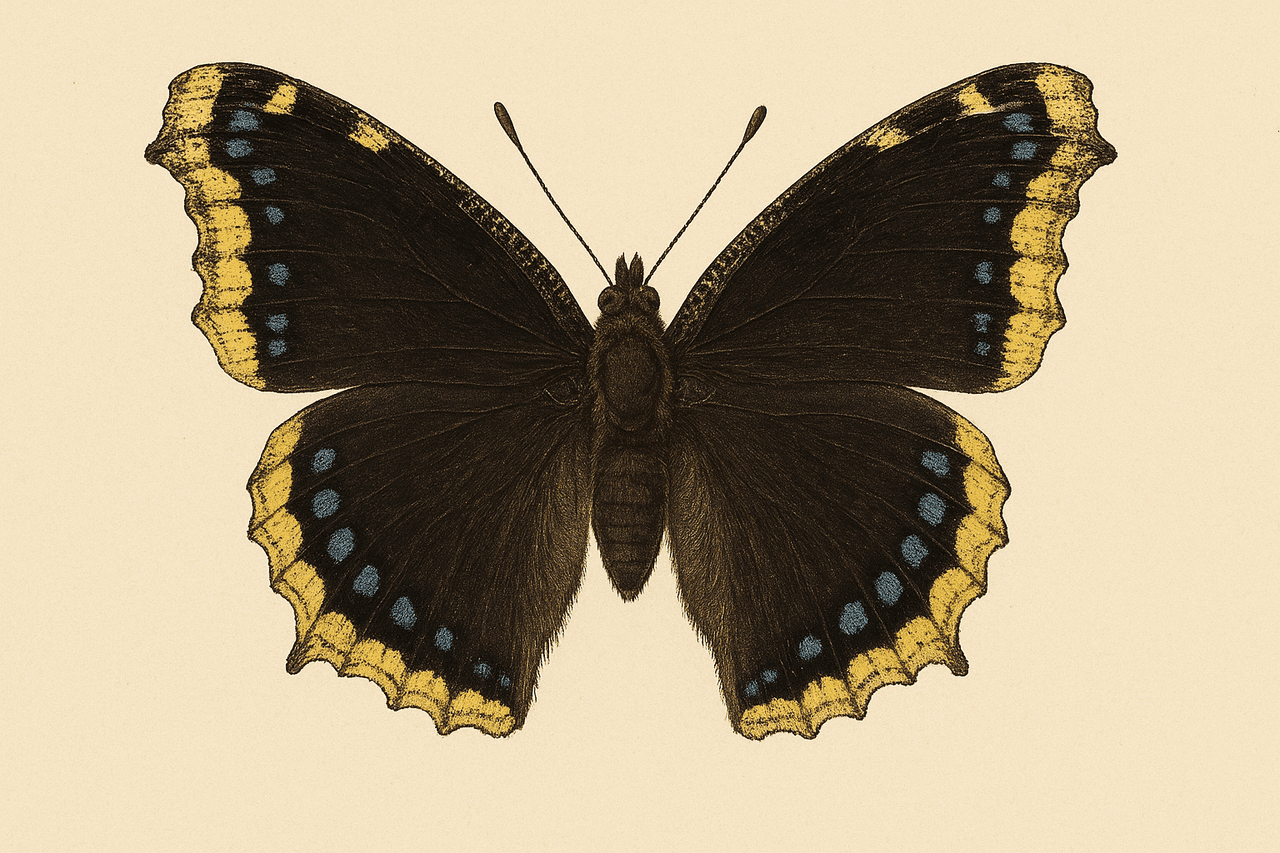
(Yapay zeka ile oluşturulmuştur)
The comma butterfly (Nymphalis antiopa) is one of the most well-known species in the Nymphalidae family. It is also known in English as the “camberwell beauty” or “mourning cloak.” It is a long-lived day-flying butterfly, with adult individuals capable of living up to 10–11 months—a duration significantly longer than that of many other butterfly species.
The wingspan typically ranges between 62–75 mm. The upper surface of the wings is dark brown to nearly black, with a broad yellowish-beige band running along the edges. Immediately inside this band are arranged a series of blue spots. The underside is more subdued, featuring gray-brown patterns that resemble tree bark, providing effective camouflage for the butterfly. The larvae are black, with spiny projections and white spots along their bodies. A distinctive orange dorsal stripe is also noticeable.
The comma butterfly is found across Europe, northern and central Asia, and North America. In Türkiye, it is more commonly observed in northern regions and high-altitude forested areas. It typically inhabits woodlands with birch (Betula), willow (Salix), and poplar (Populus) trees, as well as riverbanks, parks, and gardens.
This species generally produces one generation per year. It overwinters as an adult and becomes active again in spring, making it one of the earliest flying butterflies of the year. During hibernation, adults hide in tree cavities, under bark, and among leaf litter. In spring, mated females lay eggs in clusters on the leaves of willow and poplar trees. The caterpillars usually feed in groups. Adults primarily feed on tree sap and juices from ripe fruit; they rarely visit flowers for nectar.
The larvae feed on the leaves of willow, poplar, alder, and birch, forming a close ecological relationship with these tree species. Although adult butterflies contribute only marginally to pollination, their long lifespan gives them an important role in the ecosystem. Natural predators of the species include birds, parasitoid wasps, and insect predators.
Due to its wide geographic distribution, the comma butterfly is not considered threatened at the global level. However, habitat loss, deforestation, and climate change may negatively impact some local populations. Nevertheless, overall population balance is maintained.

(Yapay zeka ile oluşturulmuştur)
No Discussion Added Yet
Start discussion for "Sallow-Striped Velvet (Nymphalis antiopa)" article
Morphology
Distribution and Habitat
Life Cycle
Ecology
Conservation Status