

This article was automatically translated from the original Turkish version.
+1 More
Geographical Indication Type(s) | Mahreç Sign | ||||||||
|---|---|---|---|---|---|---|---|---|---|
Geographical Boundary | Türkiye (Samsun Province production center) | ||||||||
Raw Materials | Flour, Water, Salt, Yeast, Pekmez (grape, mulberry, apple, or pear pekmez), Sesame | ||||||||
Control | Organized regularly by relevant public institutions and university representatives under the coordination of the Samsun Chamber of Commerce and Industry. | ||||||||
Cultural Significance | A traditional product specific to the region and an indispensable part of breakfast and tea times. | ||||||||
Samsun Simidi is a traditional variety of simit unique to the city of Samsun in Türkiye’s Black Sea Region, produced using traditional methods. Its production and characteristics are protected by a geographical indication registration dated 20 March 2012 with number 176 issued by the Turkish Patent and Trademark Office. The geographical indication certificate defines the geographical boundary as Türkiye and mandates that production must take place within the province of Samsun.
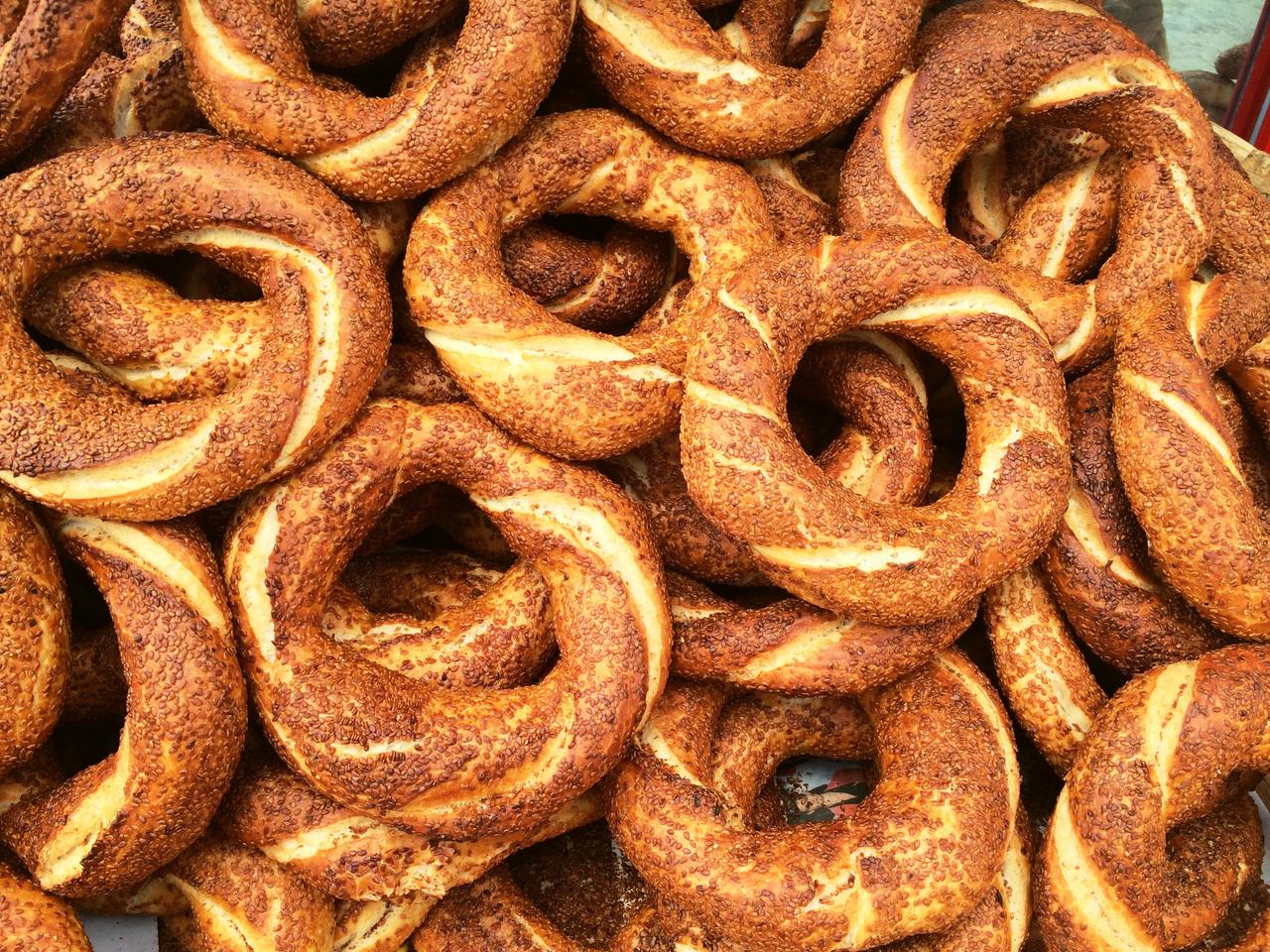
Samsun Simidi ( Turkish Patent and Trademark Office )
Samsun Simidi is prepared using a unique mixture of flour, water, salt, yeast, grape molasses (or molasses made from mulberry, apple, or pear), and sesame. The registered formulation specifies the use of 60 liters of water, 1.4 kilograms of salt, 1 kilogram of yeast, 6 kilograms of molasses, and 20 kilograms of sesame per 100 kilograms of flour. The dough has a dense and firm consistency with a short fermentation period. After kneading, the dough is rested for approximately 15 to 20 minutes.
The dough is cut into long thick rolls and divided into small pieces weighing approximately 50 to 80 grams. These pieces are shaped into rolls and rings. The shaped dough pieces are boiled for one to two minutes in copper cauldrons measuring 60 by 60 centimeters and containing molasses heated to boiling point. The boiling process ensures the dough surface is coated with molasses and develops its characteristic color.
After boiling, the dough pieces are removed using perforated strainers and thoroughly coated with sesame. One of the distinguishing features of Samsun Simidi is its dense sesame coating. The sesame-coated simits are baked for approximately six minutes in traditional charcoal-fired ovens previously heated to up to 270°C. The oven interior is lined with firebricks measuring 4 by 4 centimeters, and the simits are arranged inside using long wooden paddles made from gürgen wood.
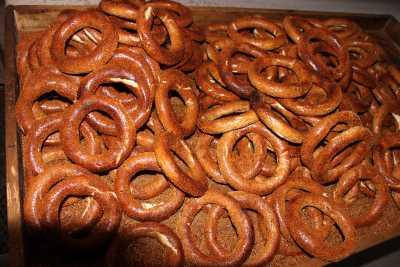
The diameter of Samsun Simidi typically ranges from 16 to 20 centimeters and its weight from 50 to 80 grams. Its outer surface is crisp and golden yellow due to the dense sesame coating. The interior has a semi-firm, porous, and elastic texture. The flavor profile, influenced by the short fermentation period and the use of molasses, exhibits a mild sweetness with dominant notes of molasses and sesame.
The geographical indication registration of Samsun Simidi ensures the preservation of its original production techniques and the sustainability of quality standards. Under this registration, production stages and ingredients are precisely defined, and inspections are regularly conducted by a commission composed of representatives from the Samsun Chamber of Commerce and Industry, relevant public institutions, and universities. These inspections cover the entire production process, from dough consistency and weight and shape control to molasses boiling, sesame coating, oven temperature, and baking duration.
Samsun Simidi is an important part of the region’s cultural heritage and is integrated into traditional consumption habits. Preferred during breakfast and tea times, it serves as a tangible symbol of regional gastronomic identity. Its protection under geographical indication holds strategic importance both for contributing to the regional economy and for maintaining production quality.
Culture Portal. "Samsun Simidi." Türkiye Kültür Portalı. Accessed July 10, 2025. https://www.kulturportali.gov.tr/turkiye/samsun/nealinir/samsun-simidi-1.
Turk Patent and Trademark Office. "Samsun Simidi Coğrafi İşaretTescil No," Registration No. 176. Accessed July 10, 2025. https://ci.turkpatent.gov.tr/Files/GeographicalSigns/176.pdf.
Turk Patent and Trademark Office. "Samsun Simidi Geographical Indication Information." Accessed July 10, 2025. https://ci.turkpatent.gov.tr/cografi-isaretler/detay/38061.

Geographical Indication Type(s) | Mahreç Sign | ||||||||
|---|---|---|---|---|---|---|---|---|---|
Geographical Boundary | Türkiye (Samsun Province production center) | ||||||||
Raw Materials | Flour, Water, Salt, Yeast, Pekmez (grape, mulberry, apple, or pear pekmez), Sesame | ||||||||
Control | Organized regularly by relevant public institutions and university representatives under the coordination of the Samsun Chamber of Commerce and Industry. | ||||||||
Cultural Significance | A traditional product specific to the region and an indispensable part of breakfast and tea times. | ||||||||
Production Process and Ingredients
Physical and Organoleptic Properties
Significance and Oversight of the Geographical Indication
Cultural and Regional Significance