

This article was automatically translated from the original Turkish version.
+1 More
Opening Date | 1926-09-19 | ||||||||
|---|---|---|---|---|---|---|---|---|---|
Official Name(s) | Stadio Giuseppe Meazza | ||||||||
Clubs Using İt | AC Milan, FC Internazionale Milano | ||||||||
UEFA Category | Category 4 | ||||||||
Current Capacity | 75,817 | ||||||||
Initial Capacity | 35,000 | ||||||||
Known Name | San Siro | ||||||||
Location | Italy Milan | ||||||||
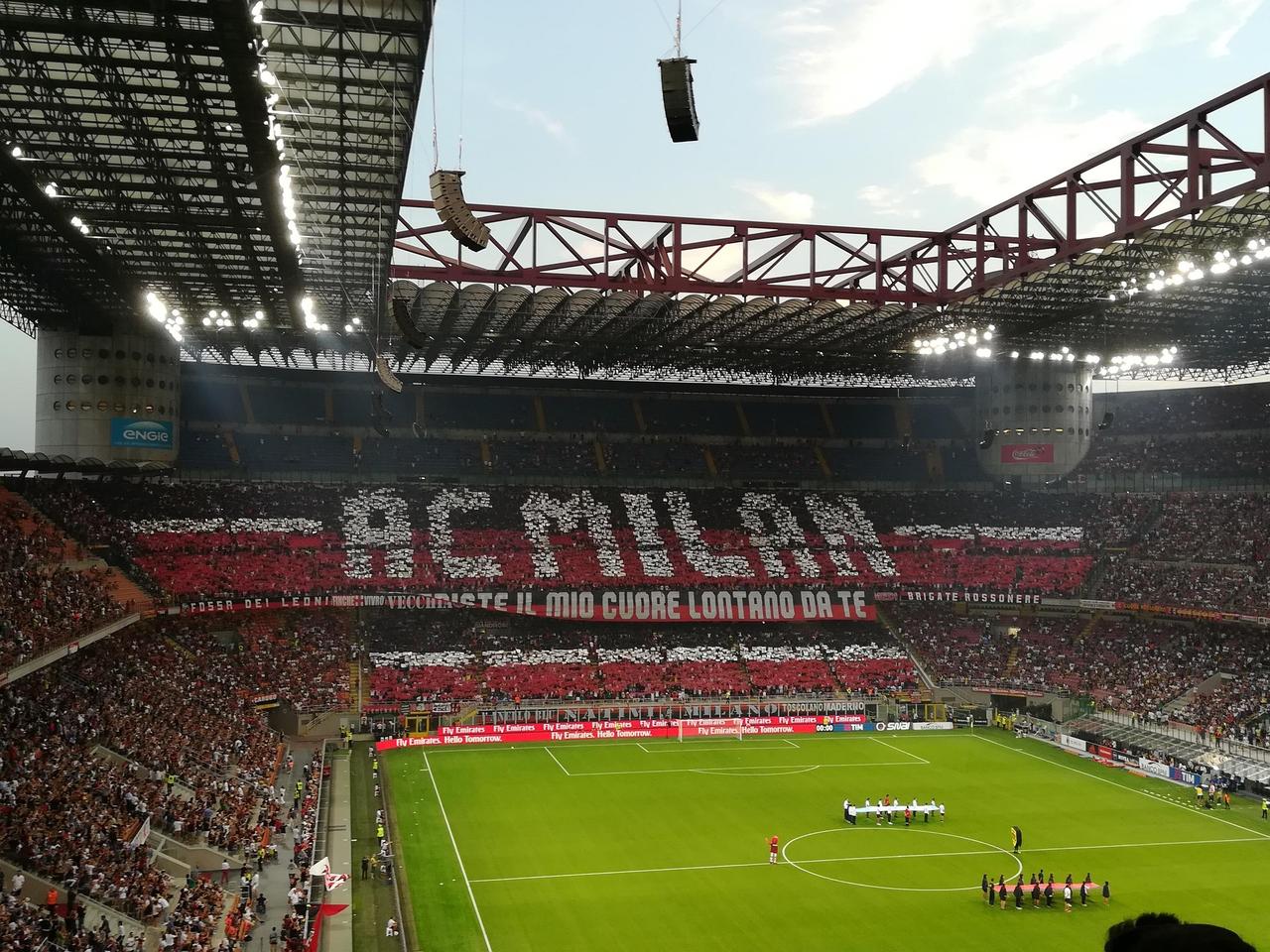
San Siro Stadium (officially Giuseppe Meazza Stadium) is a sports facility located in the San Siro district of Milan and regarded as Italy’s largest-capacity stadium. The venue hosts not only football matches but also concerts and major events, and has undergone a multi-layered development process spanning from the 20th century to the present, marked by architectural phases, capacity expansions, and changes in management models. Known by the nickname “La Scala del Calcio,” the stadium has become an integral part of the city’s identity and sporting culture.
San Siro Stadium / AC Milan, Italy - By drone [4K] (Drone Snap)
The construction of the stadium was initiated in 1925 by Piero Pirelli, then president of AC Milan. The structure was positioned around the Ippodromo del Trotto and designed with inspiration from British stadium architecture. Construction was completed in 13 months at a cost of approximately 5 million Italian lire. The original design featured four straight stands with a total capacity of 35,000 spectators.
The stadium opened on 19 September 1926 with the Milan–Inter derby. Initially built solely for Milan’s home matches, it began to be used by Inter as well starting from the 1947–1948 season.
In 1935, the Municipality of Milan purchased the stadium and launched its first expansion project. This intervention involved constructing four curved corners connecting the stands, increasing the capacity to 55,000.
During the 1950s, a new structural system was built to support the second tier of stands. This system rose above the existing stands and partially covered them. By the end of this phase, the capacity reached 85,000, with a seating arrangement of approximately 60,000 seats.
The architectural identity changed significantly during this period, with helical ramps added to provide access to the second ring. The lighting system was completed two years later, and an electronic scoreboard was installed roughly a decade after that.
In 1980, the stadium was renamed in honor of Giuseppe Meazza, who won the 1934 and 1938 FIFA World Cups with the Italian national team. Meazza played for both Inter and Milan and left a lasting legacy in Italian football through his on-field performances and personality. After his death in 1979, the stadium was officially named after him, formalizing its bond with the city.
A comprehensive renovation project was undertaken in preparation for the 1990 FIFA World Cup. As part of this project, a third tier of stands was added and a roof system was installed to cover all 85,700 seats. The renovation gave the stadium an architectural form recognized among Europe’s most modern sports venues. The renovated stadium was officially inaugurated on 25 April 1990.
The third ring was supported by eleven cylindrical reinforced concrete towers, which also served to support the roof. The roof system was designed with transparent materials and arranged to cover all stands outside the playing field. Capacity had reached 100,000 in 1955 but was later reduced to 85,000 for safety reasons.

San Siro Stadium (Unsplash)
The stadium consists of stands supported by prestressed concrete beams carried by four corner towers and seven intermediate towers. The corner towers rise above the stand level and extend to the roof.
The total capacity is listed at 75,817 seats, and the stadium holds UEFA Category 4 status, representing the highest classification for stadiums in Europe. The total amount of metal structure is recorded at 13,400 tons, and the reinforced concrete reinforcement steel at 6,000 tons.
The stadium has hosted numerous international tournaments and landmark matches. These include the 1934 World Cup semi-final between Italy and Austria on 3 June, the 1965 European Cup final between Inter and Benfica on 27 May, the 1990 World Cup opening match between Argentina and Cameroon on 8 June, and the 2003 UEFA Champions League semi-final between Inter and Milan on 13 May.
The stadium’s operations are managed by M-I Stadio S.r.l., a joint venture between F.C. Internazionale Milano S.p.A. and A.C. Milan S.p.A. The company oversees facility activities on behalf of both clubs.
The board of directors is chaired by Francesco Perrini, while the CEO roles are held by Massimiliano Catanese and Stefano Cocirio. Oversight and supervisory boards are organized as separate entities.
Services offered at the stadium are categorized into three main groups: facility-related services, event-related services, and person-related services. Structural services fall directly under MI-Stadio’s authority; entertainment and football-related activities are managed by the clubs; and food and beverage services are delegated to companies operating in the sector according to specific criteria.
Facility management is carried out within the framework of planning, organization, implementation, and control functions. Numerous technical subsystems—including HVAC systems, energy systems, lighting, security, data networks, waste management, and pitch maintenance—are operated in a coordinated manner.
The stadium features a natural grass surface. The installation and maintenance of the natural grass areas are linked to soil composition, drainage systems, aeration, and maintenance programs. The root zone, infiltration and percolation rates, aeration, and topsoil applications are key determinants of pitch quality.

San Siro Stadium (Unsplash)
The stadium is not only used for football matches but has also hosted concerts by national and international artists since 1980. It is open to visitors through museum exhibits and guided tours, and serves as a venue for corporate and private events.
AC Milan. "The History of San Siro Stadium." Accessed February 22, 2026. https://www.acmilan.com/en/club/venues/san-siro.
Anadolu Ajansı. "Milano Belediyesi, San Siro Stadı'nın Milan ve Inter kulüplerine satışına onay verdi." September 30, 2025. Accessed February 22, 2026. https://www.aa.com.tr/tr/futbol/milano-belediyesi-san-siro-stadinin-milan-ve-inter-kuluplerine-satisina-onay-verdi/3703207.
Arkitectureonweb. "San Siro 2.0 - Monument for Life Transforms the Stadium into a Memorial for COVID-19 Victims." September 6, 2023. Accessed February 22, 2026. https://www.arkitectureonweb.com/en/-/projects/san-siro-2.0.
Cigada, A., G. Moschioni, M. Vanali, and A. Caprioli. "The Measurement Network of the San Siro Meazza Stadium in Milan: Origin and Implementation of a New Data Acquisition Strategy for Structural Health Monitoring." 2010. https://doi.org/10.1111/j.1747-1567.2009.00536.x.
FIFA.com. "History Written in the San Siro." September 16, 2019. Accessed February 22, 2026. https://inside.fifa.com/news/history-written-in-the-san-siro.
Inter.it. "Stadio ‘Giuseppe Meazza’." Accessed February 22, 2026. https://www.inter.it/it/club/stadio-giuseppe-meazza.
Lower Block. "San Siro Stadium | A Historic Marvel of Football, Architecture & Culture." November 7, 2025. Accessed February 22, 2026. https://lowerblock.com/articles/san-siro-stadium-a-historic-marvel-of-football-architecture-culture/?srsltid=AfmBOoqwI5hslLq5FDNekcuxxJ6HznENPXypLcs1MnHAMTgzMP85LzTh.
San Siro Stadium. "The Stadium." Accessed February 22, 2026. https://sansirostadium.com/the-stadium/?lang=en.
Terenzi, Alessandra. "Stranieri a San Siro: L'abitare tra marginalità e riscossa." 2022. https://www.francoangeli.it/riviste/SchedaRivista.aspx?doi=10.3280/SUR2022-129007.
Webuild Group. "San Siro Stadium, Milan." Accessed February 22, 2026. https://www.webuildgroup.com/en/projects/stadiums/giuseppe-meazza-stadium-milan/.

Opening Date | 1926-09-19 | ||||||||
|---|---|---|---|---|---|---|---|---|---|
Official Name(s) | Stadio Giuseppe Meazza | ||||||||
Clubs Using İt | AC Milan, FC Internazionale Milano | ||||||||
UEFA Category | Category 4 | ||||||||
Current Capacity | 75,817 | ||||||||
Initial Capacity | 35,000 | ||||||||
Known Name | San Siro | ||||||||
Location | Italy Milan | ||||||||
Foundation and Initial Construction (1925–1935)
Structural Expansion and the Second Ring (1950s)
Naming after Giuseppe Meazza (1980)
1990 FIFA World Cup and the Third Ring
Architectural and Technical Features
Historical Matches
Operations and Management Structure
Service Structure and Facility Management
Pitch and Field Management
Multi-Purpose Use