

This article was automatically translated from the original Turkish version.
Type of Geographical Indication | Mahreç Sign | ||||||||
|---|---|---|---|---|---|---|---|---|---|
Registration Number | 470 | ||||||||
Registration Date | 12.11.2019 | ||||||||
Product / Product Group(s) | Rugs and kilims | ||||||||
Province(s) | Sivas | ||||||||
Applicant/Registrant(s) | Şarkışla District Governorship | ||||||||
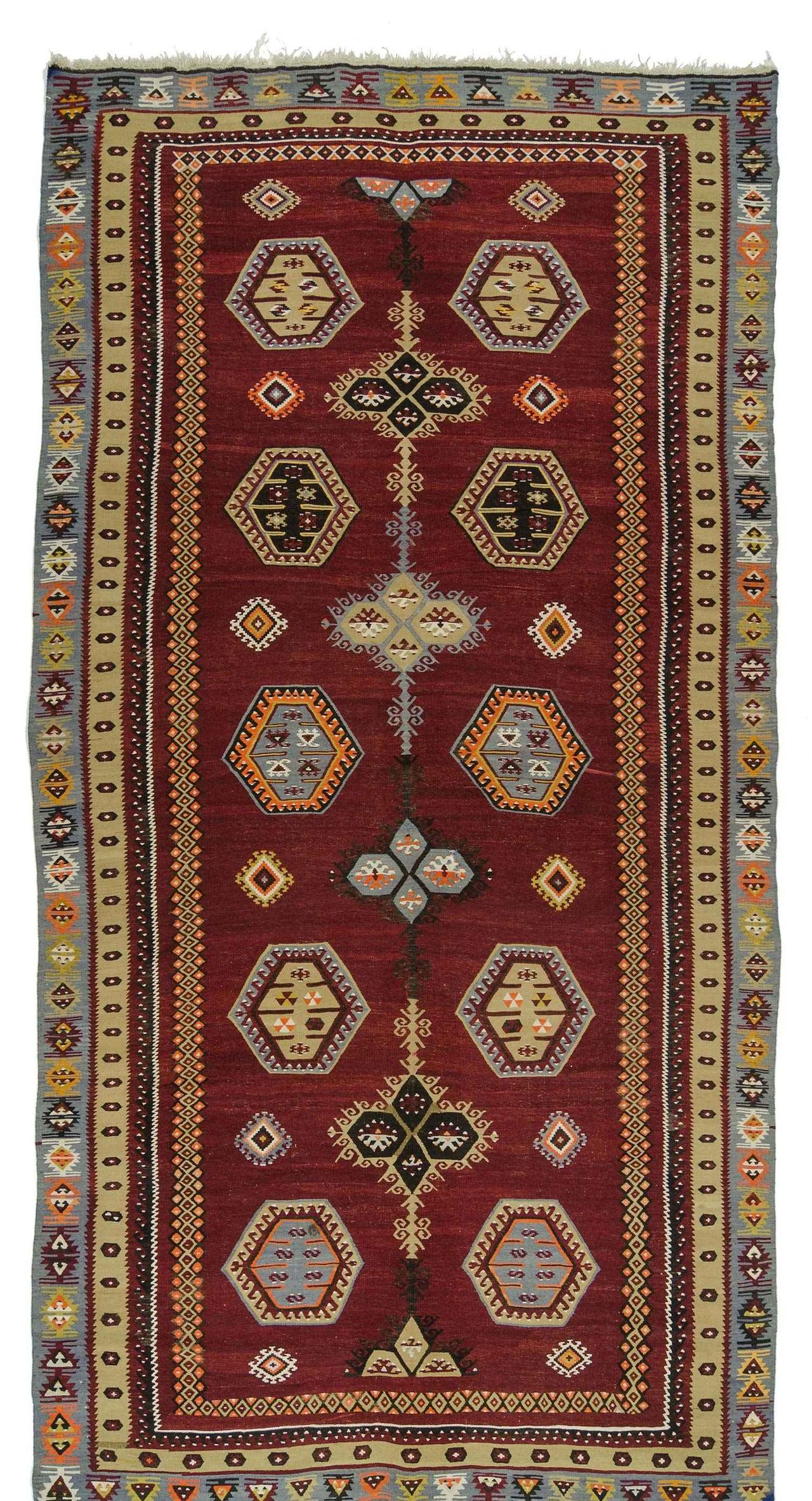
Şarkışla kilim is a registered handicraft product woven on handlooms in the Şarkışla district of Sivas Province using wool yarn. These kilims are typically rectangular or rhombus-shaped and feature dense geometric patterns arranged symmetrically. They stand out as a regional folkloric product due to their traditional production methods and rich repertoire of motifs.
The primary material of the Şarkışla kilim is fine wool yarn used for both warp and weft. The surface of the kilim contains rectangular or rhombus-shaped motifs incorporating plant and animal symbols. These motifs are interwoven to form a symmetrical design. The dominant colors are red, blue, green, black, and orange. The patterns are typically woven on a background following the principle of 1/4 symmetry.
Some of the traditional motifs used in the kilim and their meanings are as follows:
The Şarkışla kilim is woven using two distinct techniques: flat weave and cicim. The entire production process is carried out entirely by hand on wooden or metal looms using only a shuttle. The production stages include:
The geographical boundary of the Şarkışla kilim is defined as the Şarkışla district of Sivas Province. Because this folkloric product is renowned for its motif richness and weaving technique, which require high craftsmanship, all stages of production must occur within this geographical boundary.
The monitoring of the geographical indication for the product is carried out by a monitoring body established under the coordination of the Şarkışla District Governorate. This body consists of one handicrafts teacher and one master kilim instructor assigned to the Şarkışla District Community Education Center. Inspections are conducted annually on a regular basis, as well as upon complaint or when deemed necessary. The monitoring body may consult expert individuals or legal entities or procure services during inspections.
The criteria used during inspections are as follows:
Turk Patent and Trademark Office. "Şarkışla KilimiCoğrafi İşaretler Sicil Belgesi." *Geographical Indications Portal.* Accessed October 25, 2025. https://ci.turkpatent.gov.tr/Files/GeographicalSigns/87435864-0172-441d-b696-880078f19eb3.pdf.
Turkish Patent and Trademark Office. "Şarkışla Kilimi." *Geographical Indications Portal.* Accessed October 25, 2025. https://ci.turkpatent.gov.tr/cografi-isaretler/detay/38445.

Type of Geographical Indication | Mahreç Sign | ||||||||
|---|---|---|---|---|---|---|---|---|---|
Registration Number | 470 | ||||||||
Registration Date | 12.11.2019 | ||||||||
Product / Product Group(s) | Rugs and kilims | ||||||||
Province(s) | Sivas | ||||||||
Applicant/Registrant(s) | Şarkışla District Governorship | ||||||||
Product Characteristics
Production Method
Geographical Boundary
Monitoring