

This article was automatically translated from the original Turkish version.
+1 More
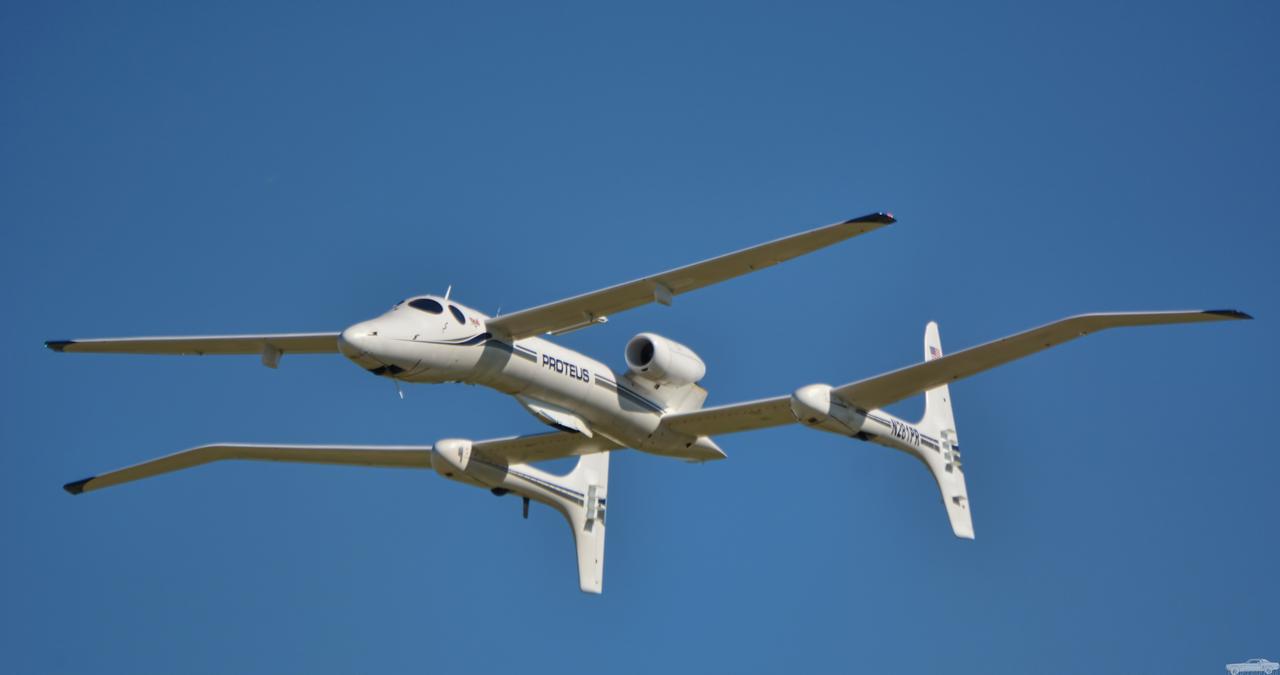
Scaled Composites Proteus is a multi-purpose research aircraft designed by aerospace designer Burt Rutan and developed by Scaled Composites. It features a twin-engine tandem wing configuration and is capable of high-altitude long-endurance (HALE) flight.
The Scaled Composites Model 281 Proteus was developed in the mid-1990s by aerospace designer Burt Rutan to meet the need for a multi-purpose airborne platform capable of extended missions at stratospheric altitudes. The aircraft’s design philosophy diverges from conventional fixed-wing aircraft by emphasizing modularity and high aerodynamic efficiency. The development process focused on creating a fuselage architecture capable of stable flight under the low air density of high altitudes while carrying heavy scientific payloads. The project was initially funded by commercial entities such as Angel Technologies to fulfill requirements for high-altitude telecommunications relay stations and later continued under NASA’s Environmental Research Aircraft and Sensor Technology (ERAST) program.
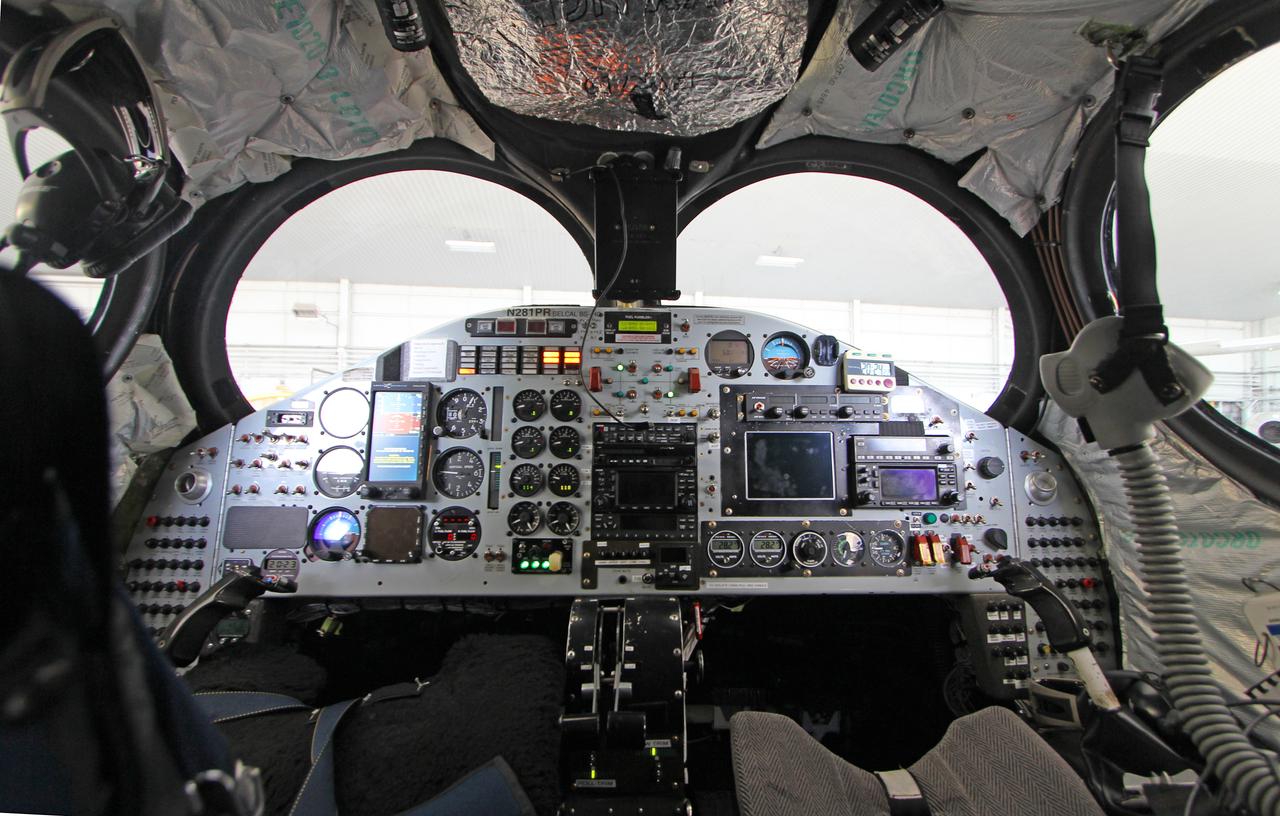
Scaled Composites Proteus cockpit (Christoper Ebdon)
The structural design of the aircraft is constructed entirely from carbon fiber-epoxy composite materials to minimize total weight and maintain structural integrity despite extreme temperature variations in the stratosphere. The Proteus features a distinctive tandem wing configuration; two sets of main wings positioned at the front and rear of the fuselage allow the aircraft to maintain stability despite shifts in its center of gravity. This architectural design enables the aircraft to retain balance even when carrying heavy sensor pods mounted beneath the nose or fuselage. Additionally the wingtips are modular; the wingspan can be physically adjusted between 23.6 meters and 28 meters depending on the altitude and range requirements of the mission.【1】
During the technical development phase the engine placement and propulsion system were strategically critical. Two Williams International FJ44-2E turbofan engines mounted on the upper rear section of the fuselage were positioned to avoid disrupting airflow over the sensor-equipped nose region and to prevent parasitic thermal effects from exhaust heat on scientific instrumentation. The Proteus made its first flight on 26 July 1998 at Mojave Air and Space Port. During testing it demonstrated not only its capability as a manned flight platform but also laid the foundation for the development of unmanned aerial vehicle technologies through the integration of autonomous flight algorithms controllable from ground stations.
The Scaled Composites Proteus is optimized with aerodynamic and technical parameters for extended flight at stratospheric altitudes (18,000 meters and above). The aircraft has an empty weight of approximately 2,658 kilograms and a maximum takeoff weight of up to 5,670 kilograms. This payload capacity allows the aircraft to carry more than half its own weight in useful load and fuel. With a fuselage length of 17.17 meters the aircraft generates high lift even at low speeds thanks to its tandem wing structure enabling stable gliding performance in thin atmospheric layers.
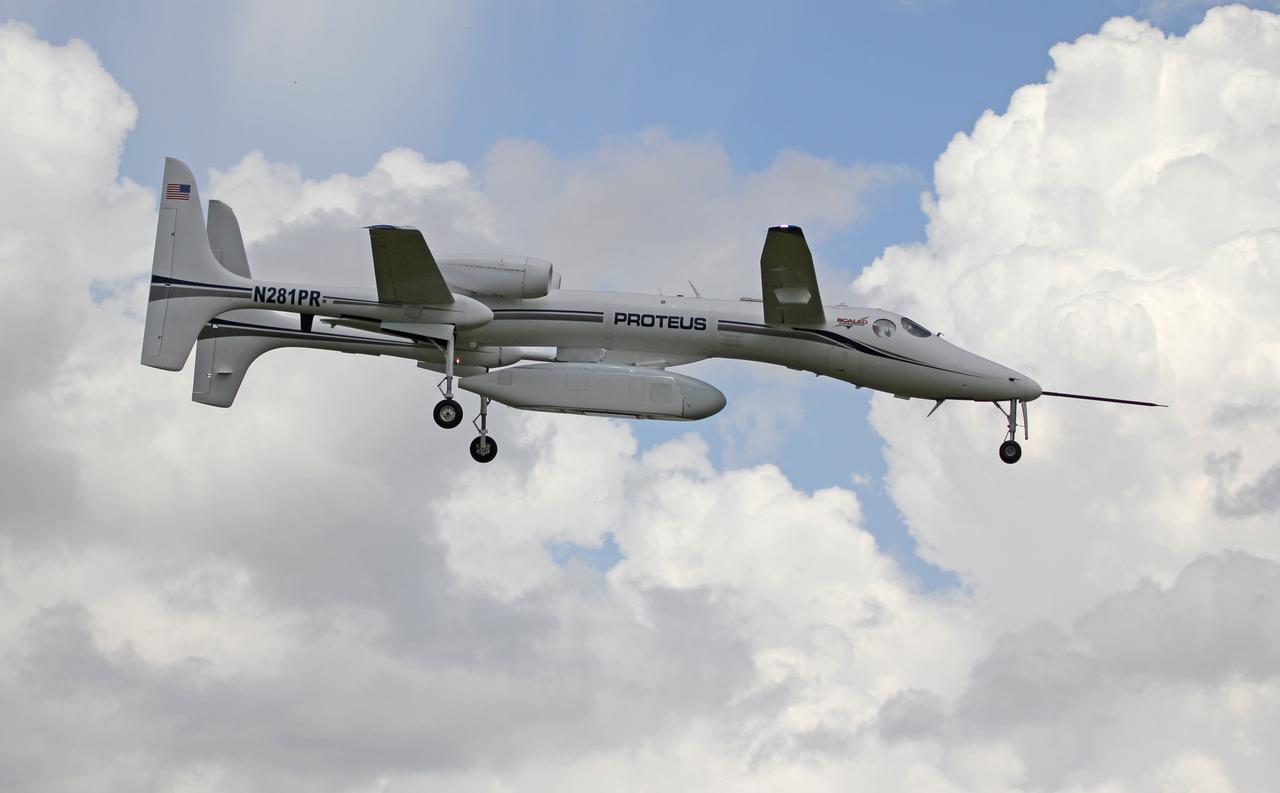
Scaled Composites Proteus (Christoper Ebdon)
The propulsion system consists of two Williams International FJ44-2E turbofan engines mounted on the upper rear section of the fuselage. Each engine produces approximately 2,300 lbf (10.2 kN) of thrust at sea level. This engine placement was designed to prevent sensitive optical and radar sensors mounted in the nose and under the fuselage from being affected by exhaust gases or heat radiation. Powered by these engines the Proteus achieves a service ceiling exceeding 19,800 meters (65,000 feet) and can remain airborne for 14 to 18 hours depending on mission requirements.
In terms of performance the Proteus is a platform that holds world records in its weight class. Under records certified by the Fédération Aéronautique Internationale (FAI) the aircraft completed horizontal flight above 17,000 meters with a 1,000-kilogram payload and reached a maximum altitude of 19,277 meters resetting altitude records. Its cruise speed is optimized at approximately 350 km/h (190 knots) depending on altitude and mission configuration; this speed enables the aircraft to maintain prolonged "loiter" over target areas for wide-area surveillance and telecommunications relay missions.【2】
Since its first flight the Scaled Composites Proteus has served as the primary platform in numerous high-altitude research and technology demonstration programs conducted by institutions including NASA NOAA and the United States Department of Defense. One of its most significant operational phases was under NASA’s ERAST (Environmental Research Aircraft and Sensor Technology) program. In this context the Proteus conducted missions involving stratospheric cloud physics measurements greenhouse gas monitoring and atmospheric data collection providing foundational data for climate research. Additionally it served as an "unmanned aerial vehicle prototype" during the development of autonomous flight systems and was used in flight tests to validate detect-and-avoid systems capable of identifying other aircraft from ground control stations.
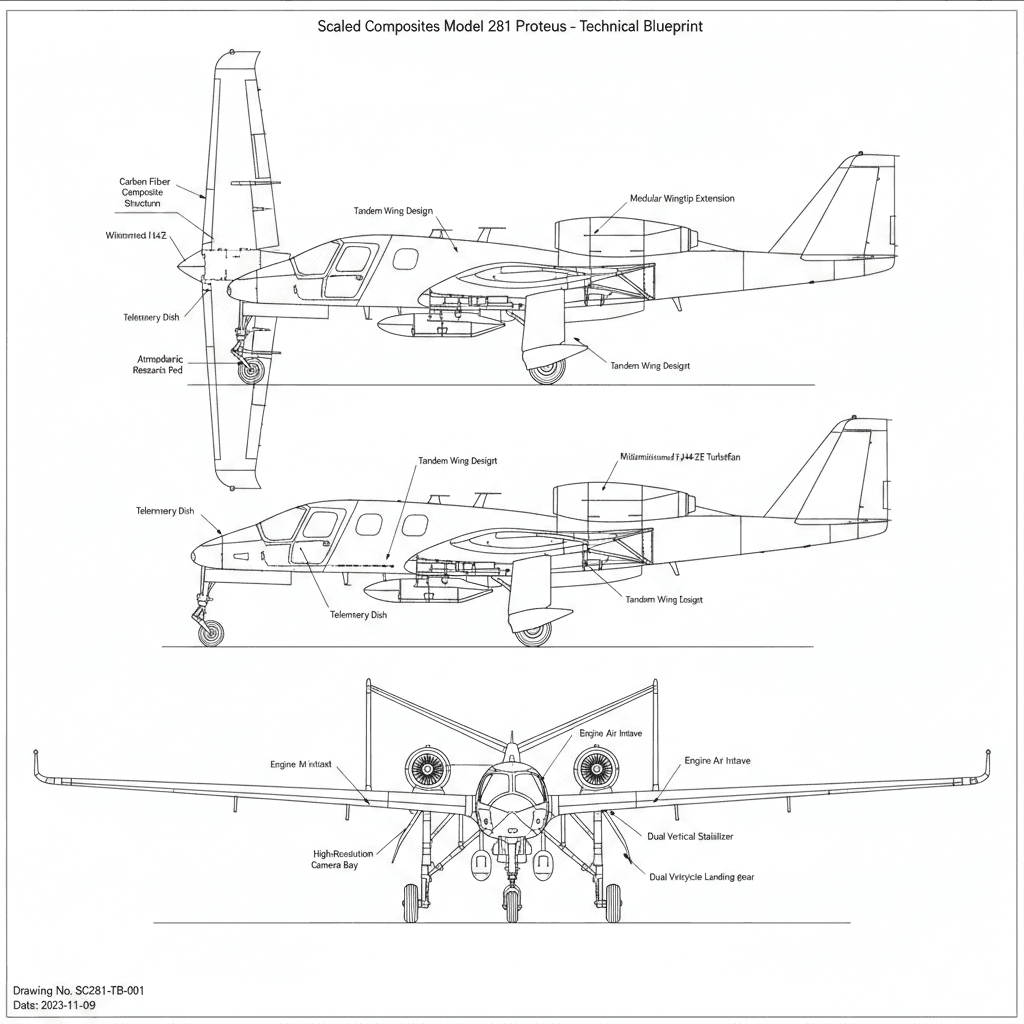
Scaled Composites Proteus Technical Drawing (Generated by Artificial Intelligence)
In the commercial domain the aircraft was tested as a telecommunications relay platform under Angel Technologies’ HALO (High Altitude Long Endurance Operations) project. During these operations the Proteus flew circular patterns over designated areas transmitting broadband internet and communication signals to ground users from altitudes above 15,000 meters. These missions demonstrated the aircraft’s ability to maintain stable flight for over 14 hours while preserving fuel efficiency even in the stratosphere’s extremely low air density.【3】
In the early 2000s the Proteus officially certified its operational capabilities through world records. In flights approved by the Fédération Aéronautique Internationale (FAI) the aircraft set a record by reaching an altitude of 19,277 meters in its weight class. Throughout its operational life it has not only served as a scientific observation platform but also functioned as a testbed for radar systems missile defense sensors and high-resolution imaging devices for defense industry organizations such as Northrop Grumman. Today the Proteus remains actively engaged in various private and official projects and continues to be one of the rare aircraft capable of integrating next-generation sensor technologies thanks to its modular design.
Scaled Composites Proteus Flight (Scaled Composites)
The Scaled Composites Proteus is recognized as one of the pioneering examples of a low-cost high-efficiency multi-purpose stratospheric flight concept. Burt Rutan’s innovative tandem wing design and fully composite fuselage structure enabled the aircraft to operate at altitudes unreachable by conventional jet aircraft at a fraction of the operating cost of specialized spy planes. The success of the Proteus directly contributed to the development of modern unmanned aerial vehicles (UAVs) and played a vital role as a technology testbed particularly in the areas of autonomous flight control systems and satellite communication integration.
The ability to physically alter the wingspan according to mission needs and to modify the fuselage to carry different sensor pods has inspired modern modular aircraft designs. Through the altitude records it broke and the scientific flights conducted under NASA the Proteus successfully bridged the gap between atmospheric research and telecommunications technologies.
AOPA (Aircraft Owners and Pilots Association). “Rutan’s Proteus Marks Milestone.” June 22, 2017. Accessed February 20, 2026. https://www.aopa.org/news-and-media/all-news/2017/june/22/rutans-proteus-marks-milestone
Bolton, Willard. “Operational Experience with UAV Payloads for Climate Research Applications.” 2nd AIAA “Unmanned Unlimited” Conf. and Workshop & Exhibit [San Diego, California], 2003. Accessed February 20, 2026. https://doi.org/10.2514/6.2003-6620
Brown, David. “Flight Test of the New Global Hawk Radar Using the Proteus Manned High Altitude Aircraft.” 10th AIAA Aviation Technology, Integration, and Operations (ATIO) Conference [Fort Worth, Texas], 2010. Accessed February 20, 2026. https://doi.org/10.2514/6.2010-9118
Ebdon, Christopher. *1998 Scaled Composites Inc. Model 281 Proteus S/N:001 - N281PR, Scaled Composites*. Flickr, August 23, 2014. Accessed February 20, 2026. https://www.flickr.com/photos/av8pix/15010455121/
Ebdon, Christopher. *1998 Scaled Composites Inc. Model 281 Proteus S/N:001 - N281PR, Scaled Composites*. Flickr, August 23, 2014. Accessed February 20, 2026. https://www.flickr.com/photos/av8pix/15013235862/
Horwedel, Chad. *Proteus*. Flickr, July 29, 2017. Accessed February 20, 2026. https://www.flickr.com/photos/chorwedel/36606710675/
Larar, Allen M., et al. “Ground Testing and Campaign Intercomparisons with the NAST-I Airborne FTS.” *Sensors, Systems, and Next-Generation Satellites XVIII*, vol. 9241 (October 2014): 924118. Accessed February 20, 2026. https://doi.org/10.1117/12.2068268
NASA Airborne Science Program. “Proteus." NASA. Accessed February 20, 2026. https://airbornescience.nasa.gov/aircraft/Proteus
NASA IMPACT. "Proteus." CASEI: Catalog of Archival Data for Earth Science Investigations. NASA. Accessed February 20, 2026. https://impact.earthdata.nasa.gov/casei/platform/Proteus/
Scaled Composites. “Scaled Composites Proteus - 25 Years of Flight.” YouTube, July 26, 2023. Accessed February 20, 2026. https://www.youtube.com/watch?v=ymBE9Hzdags
Space Science and Engineering Center, University of Wisconsin-Madison. "Proteus Visits for CLAMS." Accessed February 20, 2026. https://www.ssec.wisc.edu/news/articles/4772.
[1]
Scaled Composites. "Proteus".Scaled Composites. Access date: 20 February 2026. https://scaled.com/portfolio/proteus/.
[2]
Scaled Composites. "Proteus".Scaled Composites. Access date: 20 February 2026. https://scaled.com/portfolio/proteus/.
[3]
NASA Airborne Science Program. "Proteus".NASA. Access date: 20 February 2026. https://airbornescience.nasa.gov/aircraft/Proteus.

No Discussion Added Yet
Start discussion for "Scaled Composites Proteus" article
Design and Development
Technical Specifications and Performance
Operational History and Missions
Place in Aviation History and Legacy