

This article was automatically translated from the original Turkish version.
Scarlet sage, scientifically known as Salvia splendens, is a popular seasonal flower with widespread recognition as an ornamental plant around the world. It belongs to the genus Salvia and is a member of the Lamiaceae (mint) family.
Scarlet sage is an upright, shrub-like or herbaceous perennial plant that can grow between 30 and 50 cm in height depending on cultivation conditions. Its stem is angular and green. The leaves are oval-shaped with toothed margins and pointed tips.
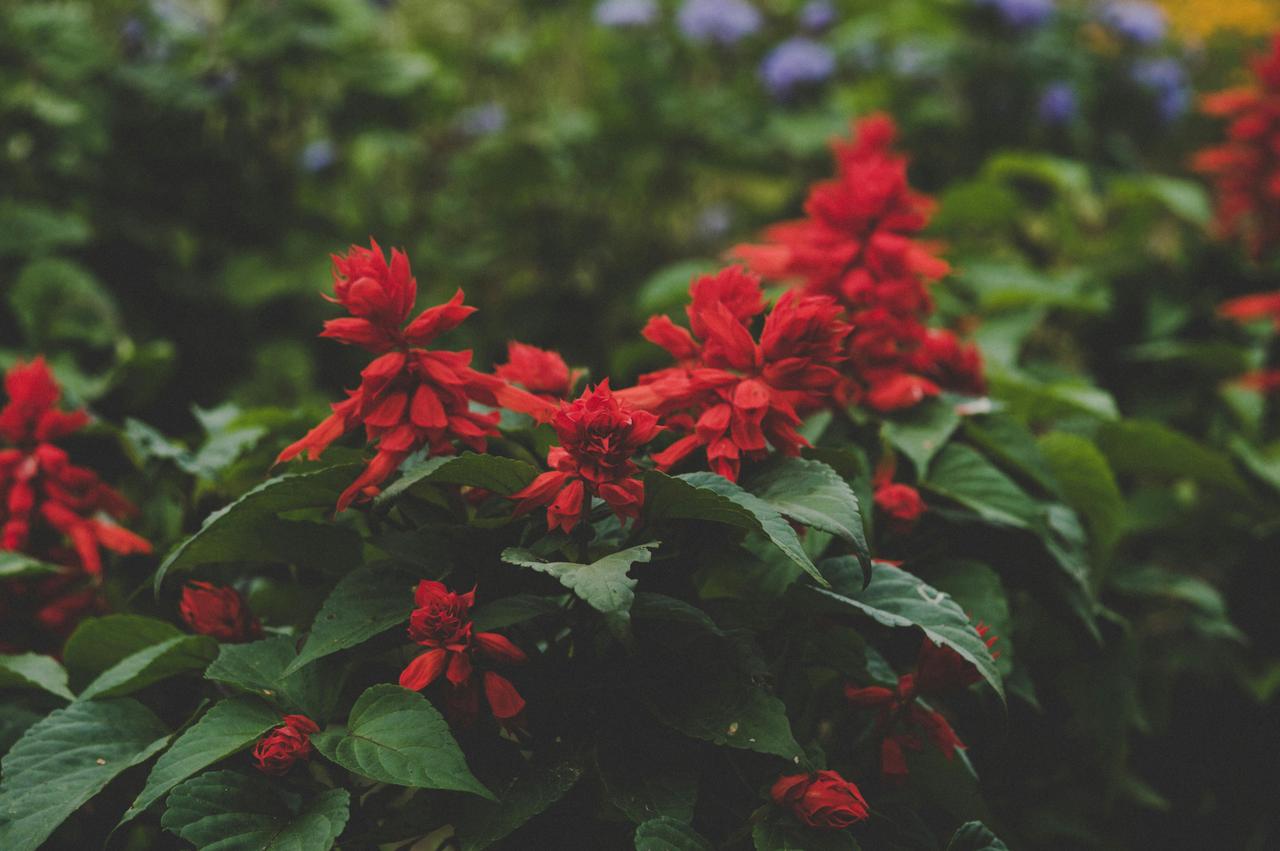
The most distinctive feature of the plant is its bright red, tubular flowers that bloom continuously from early summer through autumn. These flowers form large, spike-like or raceme-like clusters.
Scarlet sage thrives in full sun. It develops healthily under direct sunlight throughout the day. Insufficient sunlight may cause the plant to develop leggy, sparse branches and an unkempt appearance.
However, in regions where summer temperatures become excessively high, it is recommended to plant scarlet sage in partially shaded areas such as east-facing locations that receive morning sun or under trees that provide dappled shade. It is not well suited to very dry areas with low humidity; it prefers moist climates influenced by sea air.
Although not overly selective about soil type, scarlet sage prefers rich, moist, and well-drained (permeable) garden soil. Extremely acidic or highly calcareous soils should be avoided.
For container cultivation, deep pots are recommended to allow roots to move freely and support continued growth (plastic pots are not suitable). For potting soil, a good compost mix can be enhanced with approximately one-quarter perlite or pumice stone to improve drainage.
Scarlet sage can be easily propagated by seed or by stem cuttings.
Propagation by cuttings is very straightforward. Stems, whether fresh or mature, can be directly planted into soil. These cuttings can root within up to three weeks and generally do not require protection from direct sunlight during this period.
The main diseases affecting Salvia splendens are wilting, powdery mildew, and rust. Common pests that can damage the plant include nematodes, red spider mites, and whiteflies. An effective cultivation and maintenance program helps minimize these issues.
Atatürk Orman Çiftliği. "Ateş Çiçeği." aoc.gov.tr. Accessed October 19, 2025. https://www.aoc.gov.tr/Portal/BitkiselUretimler/ates-cicegi/103
Perevoshchikov, Danila. "Kırmızı yapraklı çiçeklerin seçmeli odak fotoğrafı JPG." Pexels. Accessed October 19, 2025. https://www.pexels.com/tr-tr/fotograf/kirmizi-yaprakli-ciceklerin-secmeli-odak-fotografi-768890/
Yapmış, Ezgi. “Ateş Çiçeği.” Ankara Büyükşehir Belediyesi Tarımsal Hizmetler Daire Başkanlığı Yayını. Accessed October 19, 2025. https://www.ankara.bel.tr/files/6515/9107/9868/67-ATE_E.pdf

No Discussion Added Yet
Start discussion for "Scarlet Sage (Salvia splendens)" article
General Characteristics and Morphology
Light and Position Requirements
Soil Requirements
Propagation
Propagation by Seed
Propagation by Cuttings (Vegetative Propagation)
Diseases and Pests