This article was automatically translated from the original Turkish version.
+2 More
Place(s) | Ani Archaeological Site Türkiye Kars | ||||||||
|---|---|---|---|---|---|---|---|---|---|
Date(s) | Second half of the 11th century – 12th century | ||||||||
Period(s) | Great Seljuk Empire | ||||||||
The Selçuklu Çarşı Mescidi is located along the Selçuklu-period trade axis of the Ani Archaeological Site. The structure is situated on the eastern side of the market street, which extends between the Ebu’l Muammeran Camii to the north and the Ebu’l Menuçehr Camii to the south. This axis served as the focal point of the city’s commercial and social life during the Selçuklu era. The mosque’s position indicates its function as a place of worship easily accessible to merchants and customers of the market.
Ani was an important center of trade and culture throughout the Middle Ages due to its strategic location. After the city was conquered by the Selçuklu forces in 1064, the market district was reorganized according to Selçuklu architectural principles, during which religious structures such as mosques were added.
In the mid-11th century, while under Byzantine administration, Ani experienced a period of political, social, and economic stagnation. The city was captured in 1064 by the Selçuklu army under Sultan Alparslan, becoming the first major city in Anatolia to come under Selçuklu control. Following the conquest, the city walls were repaired, and new mosques, smaller prayer halls, tombs, baths, and market structures were constructed.
During the Selçuklu period, the market functioned as both a commercial and social hub. Mosques within the market were planned to allow merchants to perform prayers at different times of the day. The Selçuklu Çarşı Mescidi is a reflection of this concept in Ani, forming a central focal point within the market due to its location.
Although no inscription survives on the mosque itself, its architectural features and plan type indicate a construction date between the second half of the 11th century and the middle of the 12th century. Two separate mosque inscriptions previously recorded in Ani, while not directly belonging to this structure, may be associated with it:
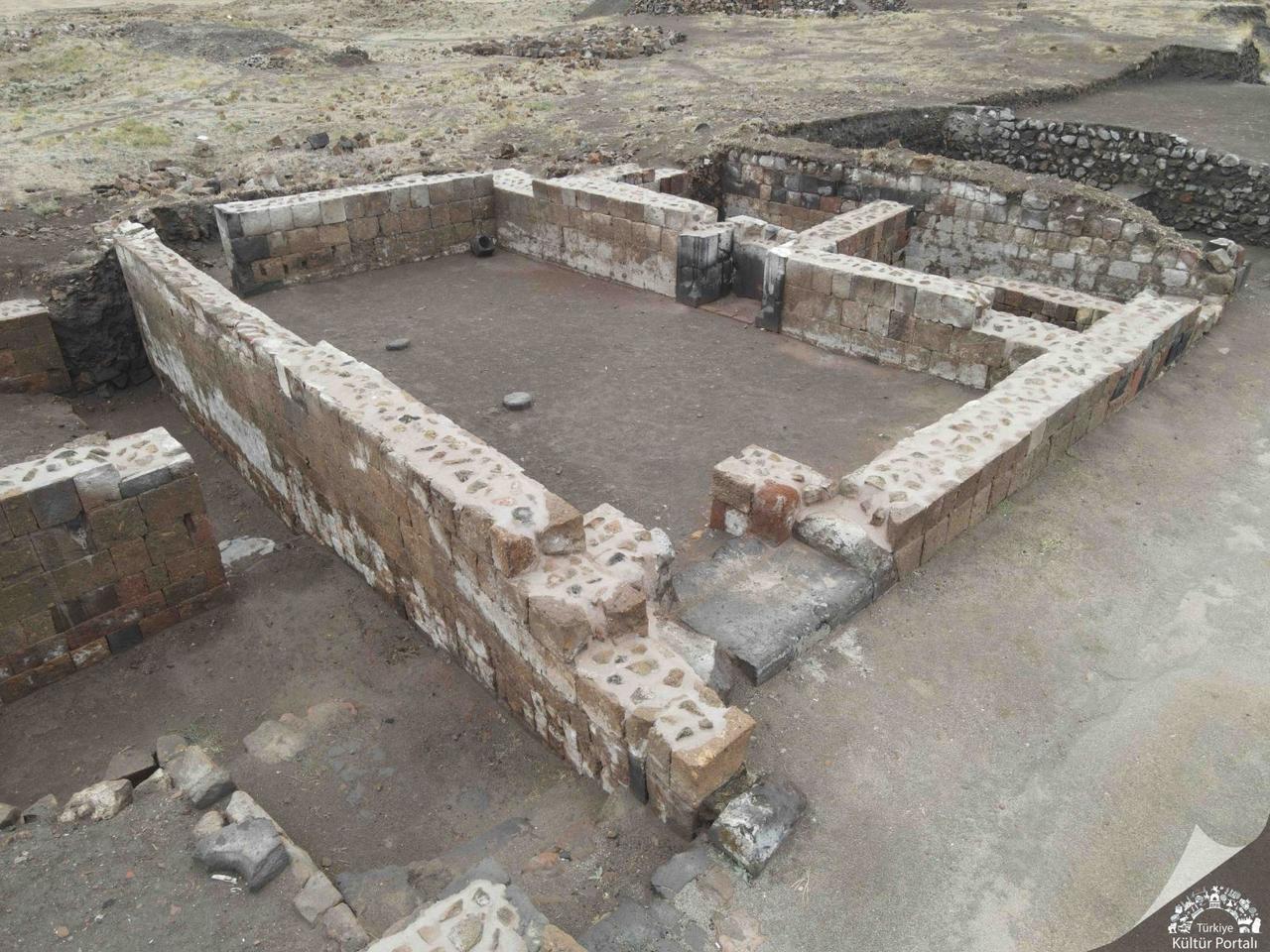
The structure has a rectangular plan oriented east-west, measuring 9.75 × 5.75 meters. Wall thickness is 0.65 meters. The plan reflects the simple and functional layout typical of small-scale Selçuklu mosques.
There is one entrance on each of the east and west facades:
The prayer hall is covered by a wooden ceiling supported by two wooden columns rising from octagonal stone bases located in the center. The exterior roof is presumed to have been a flat earthen surface.
The mihrab niche, located at the center of the southern wall, has a rectangular section defined by concave, convex, and flat profiles. The minbar has not survived. The current niche is 1.10 meters wide and 0.65 meters deep.
During excavations in 2020, the mosque was uncovered after removing a 1.50-meter-thick layer of soil. A stone-lined feature resembling a basin was identified in front of the northern wall of the prayer hall. This area, accessible via a narrow corridor measuring 3.30 × 0.90 meters, opened into a compartment measuring 2.10 × 1.05 meters. This installation suggests the building was used as a workshop in the post-Selçuklu period.
In the 2021 season, this installation was removed, revealing the original column bases of the mosque. The eastern base is broken, while the western base remains intact.
The primary objective of the conservation process was to preserve the original state of the existing walls. Based on analyses conducted at the Erzurum Restoration and Conservation Regional Laboratory, a specialized mortar mix was developed, composed of one part lime and three parts aggregate.
Local materials were used: river sand from the Bostanlar Stream and perlite from Esenkent Village. The upper surfaces of the walls were covered with a cap mortar, and small stone fragments were inserted into the joints to avoid a uniform, plastered appearance.
The Selçuklu Çarşı Mescidi is an important component of Ani’s Selçuklu-period urban fabric. Its location, architecture, and excavation findings confirm that the structure was built between the 11th and 12th centuries and served the market traders. This mosque, unearthed in Ani, serves as a reminder of other Selçuklu structures still buried beneath the ground.
The Selçuklu Çarşı Mescidi is a significant structure that sheds light on the social and religious life of Ani during the Selçuklu period. The 2020–2021 excavation and conservation efforts have revealed its architectural characteristics and ensured its preservation for future generations. This mosque is one of the small-scale yet functional examples illustrating Ani’s rapid post-conquest urban development.
Arslan, Muhammet. “Ani Kazısında Bulunan Selçuklu Çarşı Mescidi.” *Palmet Dergisi* 1 (March 28, 2022): 1–13. Accessed August 16, 2025. https://dergipark.org.tr/tr/download/article-file/2586109.
Selçuklu Çarşı Mescidi – Kars.” Kültür Portalı (T.C. Kültür ve Turizm Bakanlığı). Accessed August 16, 2025. https://www.kulturportali.gov.tr/turkiye/kars/gezilecekyer/selcuklu-carsi-mescidi-.
Place(s) | Ani Archaeological Site Türkiye Kars | ||||||||
|---|---|---|---|---|---|---|---|---|---|
Date(s) | Second half of the 11th century – 12th century | ||||||||
Period(s) | Great Seljuk Empire | ||||||||
No Discussion Added Yet
Start discussion for "Selçuklu Çarşı Mescidi" article
Historical Background
Ani’s Transition to Selçuklu Rule
The Role of the Market and Mosques
Construction Date and Inscriptions
Architectural Features
Plan and Dimensions
Entrances
Structural System
Mihrab
Excavation Process (2020–2021)
Conservation Works
Assessment and Significance