


This article was automatically translated from the original Turkish version.
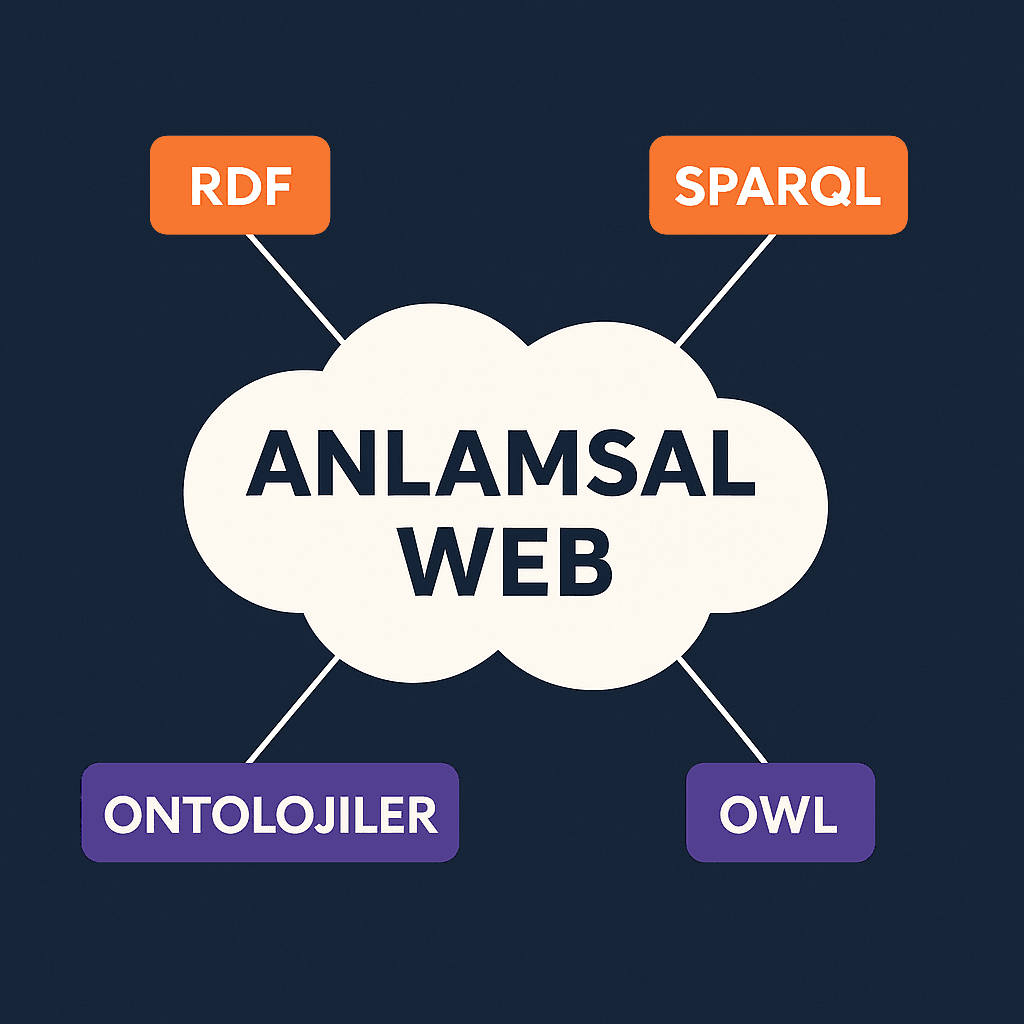
Semantic Web
Original Name(s) | Semantic Web | ||||||||
|---|---|---|---|---|---|---|---|---|---|
Type(s) | Technological Concept / Web Paradigm | ||||||||
Definition(s) | It is a vision aimed at making the Internet understandable to machines as well. | ||||||||
Core Technologies | SWRL Ontologies SPARQL OWL RDF | ||||||||
Application Area(s) | big data analytics natural language processing access control information management personalized recommendation systems e-government Health informatics | ||||||||
Enterprise Developer | World Wide Web Consortium (W3C) | ||||||||
The Semantic Web emerged as a paradigm aiming to make the current internet smarter, meaning-based, and machine-understandable. This vision was first proposed by Tim Berners-Lee in 2001 as an effort to address the limitations of the World Wide Web (WWW). Berners-Lee’s vision was for the web to become not only a medium for document sharing but also an environment capable of processing information and performing reasoning.
While the current Web (Web 2.0) enables users to generate and share content, the meaning of this content remains inaccessible to machines. This limitation makes it difficult to efficiently analyze and utilize the vast amounts of data available on the internet. The Semantic Web aims to overcome this problem by making data interpretable not only for humans but also for machines.
The concept of Web 3.0 extends beyond the Semantic Web to represent an integrated structure incorporating technologies such as artificial intelligence, blockchain, big data, and the Internet of Things. Nevertheless, at its core, Web 3.0 embraces the fundamental principles of the Semantic Web. Web 3.0 does not merely store information but seeks to foreground intelligent systems capable of performing meaningful operations on that information.
In this context, the goal of the Semantic Web is to define content within contextual relationships, model them through ontologies, and enable machines to derive meaning from these relationships. Thus, machines can be empowered to perform complex tasks, deliver more accurate search results, and provide advanced information services.
The World Wide Web Consortium (W3C) has developed numerous standards to advance the Semantic Web. These include RDF (Resource Description Framework), OWL (Web Ontology Language), and SPARQL (SPARQL Protocol and RDF Query Language). These technologies are recognized as fundamental tools for structuring data and enabling machine processing.
The architecture of the Semantic Web is built upon technological building blocks that enable data on the internet to become more meaningful and interconnected. These components play an active role in processes such as modeling, defining, sharing, and querying data.
1. RDF (Resource Description Framework): A foundational model that expresses data as triplets (subject, predicate, object). Through RDF, any resource on the internet can be defined by identifying what it is (subject), what it does (predicate), and what it relates to (object). This triplet structure enables machines to establish logical relationships between data.
2. OWL (Web Ontology Language): Used for creating and defining ontologies. OWL allows for more complex definitions of relationships between concepts and provides advanced information representation for the Semantic Web. Ontologies developed with OWL generate rich content based on classes, individuals, and properties.
3. SPARQL (SPARQL Protocol and RDF Query Language): A specialized language for querying data expressed in RDF. It operates similarly to database query languages but is designed specifically around RDF’s triplet structure. This enables data queries based on relationships rather than tables as in relational databases.
When combined, these technologies form the technical infrastructure of the Semantic Web. RDF defines how data is described, OWL determines how data is organized, and SPARQL specifies how access to data is achieved.
Thanks to these systems, information systems do not merely store data but also gain the ability to reason over it. For example, on an e-commerce platform, products can be defined using RDF, categorized using OWL, and personalized recommendations can be generated using SPARQL based on user preferences.
Another significant feature of these technologies is their ability to ensure interoperability across different platforms and systems. This allows data collected from diverse sources to be meaningfully processed under a unified framework.
Moreover, these technologies are supported by tools accessible not only to technical experts but also to domain specialists. Ontology editors (such as Protégé), RDF visualizers, and SPARQL endpoint tools facilitate this process. In particular, the application of these technologies in public, healthcare, and education sectors strengthens evidence-based decision-making and enhances the effectiveness of information systems.
One of the foundational elements of the Semantic Web, ontologies enable not only the structuring of data but also its interpretation at a semantic level. An ontology is a formal and consistent framework for defining concepts within a specific domain and the relationships between them.
Within the Semantic Web, ontologies serve as essential tools that allow machines to assign meaning to information. They make it possible to translate conceptual connections naturally established by the human mind into formats that machines can process. Thus, a system can understand not only terms such as “patient” and “treatment” but also the causal, hierarchical, and procedural relationships between them.
Developing an ontology begins with defining the fundamental concepts of the relevant knowledge domain. Subsequently, the relationships among these concepts are structured into a theoretical and logical framework. Concepts are typically represented as classes, properties, and individuals. These relationships are expressed in structures such as “a doctor treats a patient.”
The purpose of ontologies is not merely to classify data but also to enable logical inference from it. Therefore, ontologies include structures such as inheritance, restriction, and relation among classes. Thanks to these logical structures, information systems do not just store data but also process it.
Among the widely used ontology definition languages in the Semantic Web is OWL (Web Ontology Language). OWL has the capacity to formalize numerous details, from subclass-superclass relationships to the types of properties individuals can possess. This detailed definitional power enables information systems to generate more reliable results.
Ontologies are typically developed through collaboration between domain experts and knowledge engineers. In information-intensive fields such as healthcare, law, bioinformatics, and education, the ontology development process plays a crucial role in digitizing domain knowledge. A laboratory test ontology developed in healthcare provides a concrete example of this structure.
Another advantage of ontologies is their reusability and extensibility. An ontology developed for one domain can be linked to other domains or enriched over time with new concepts. This establishes a shared semantic foundation across systems, enabling interoperability.
One important application of ontologies in information systems is access control. In handling sensitive data, ontologies can define which roles are permitted to access which data. This provides a significant advantage in terms of both security and data management.
Ontologies are also used in natural language processing, information extraction, and decision support systems. These systems rely on ontological knowledge to interpret user inputs and generate the most appropriate responses, thereby delivering more personalized and context-aware services.
One of the most important components enhancing the functionality of the Semantic Web is its logical inference mechanisms. These mechanisms allow systems to generate new knowledge from existing data. A key structure serving this purpose is SWRL, or the Semantic Web Rule Language.
SWRL adds rule-based inference capabilities to ontologies defined in OWL. These rules enable logical conclusions to be drawn when specific conditions are met. The fundamental logic of SWRL is based on an “if–then” structure, allowing for a wide range of contextual inferences.
SWRL rules can be defined based on attributes, relationships, and numerical data associated with class individuals. For example, if a patient’s cholesterol level exceeds 240 and they smoke, the system can label the patient as being at risk for heart disease. Such a rule enables the information system to generate new knowledge not only from existing data but also from the connections between that data.
This inferential capability is one of the most fundamental features distinguishing the Semantic Web from traditional databases. While classical systems rely solely on existing data, inference engines like SWRL produce predictive analyses, evaluations, and decision-support services.
SWRL is widely used in fields such as health informatics, defense systems, financial analysis, and large-scale information management. In these areas, modeling complex relationships and evaluating multiple conditions simultaneously is of critical importance.
Rules written in SWRL do not merely perform truth-based inferences; they also enable evaluation in scenarios involving uncertainty. Advanced SWRL engines can be used in conjunction with extensions based on fuzzy logic.
With this structure, decision support systems can perform predictive analyses not only based on past data but also on rules derived from that data. For instance, the simultaneous observation of certain symptoms can allow the system to infer which diseases a patient may be associated with.
When integrated into system architecture, SWRL enables information systems to become not merely “queried” but also “learning” structures. Thus, the knowledge base continuously evolves and enriches itself.
Defining correct rules is as critical to system performance as structuring ontologies. Consequently, the concept of rule engineering has become a specialized field within Semantic Web projects.
Although SWRL has not been directly standardized by the W3C, it is supported by numerous tools and platforms that work with OWL. Open-source tools such as Protégé provide a powerful development environment for both ontology and rule definitions.
Semantic Web technologies are transforming not only individual user experiences but also institutional and sectoral levels of information management. Integrating, combining meaningfully, and making reusable data from diverse sources is one of the greatest needs of the 21st-century data era.
In traditional data integration methods, data often cannot be effectively merged due to structural incompatibilities, differing data formats, and missing semantic mappings. The Semantic Web aims to overcome these challenges through RDF and ontology-based models. As a result, information retrieved from different databases, websites, and content management systems can be unified under a common semantic foundation.
One of the most important tools in this process, ontologies, create an integrated information environment by defining conceptual relationships between data. The conceptual maps provided by ontologies present data meaning in a machine-understandable form, accompanied by explanatory metadata.
Data integration is not merely a technical requirement but also a critical process for institutional efficiency and decision support systems. In information-intensive sectors such as healthcare, law, finance, and education, the accurate and meaningful management of data flows is vital.
In this context, applications such as DICON (Domain-Independent Consent Management) offer examples of how personal data protection and data sharing processes can be managed through ontology-based systems. The DICON structure enables different data providers to operate on a common framework, ensuring data privacy and security.
Data sharing, with the Semantic Web, can be grounded not only at the technical level but also in ethical and legal frameworks. Semantically supported data labeling processes define which data can be accessed by whom, for what purpose, and under what conditions.
Another dimension of data integration is its ability to facilitate information sharing in multilingual and culturally diverse environments. Through ontologies, specific concepts can be mapped to their equivalents in different languages, establishing a universal network of meaning.
In structures such as the European Union, which involve multinational data networks, Semantic Web technologies ensure the standardization of information sharing. This accelerates cross-project data transfer, collaboration, and joint decision-making processes.
Additionally, query languages such as SPARQL enable RDF data from diverse sources to be queried within a unified structure. This allows information systems to execute more efficient queries and enhance data analytics.
Web 3.0 is not merely a technological innovation but a digital renewal that triggers social, cultural, and economic transformations. This next-generation internet, centered on the Semantic Web, touches every aspect of digital life by enabling information to be organized more accurately, meaningfully, and usefully.
The Semantic Web does not merely make access to information easier; it fundamentally changes how information is accessed. Users can now retrieve information not only through keyword searches but also through context-aware queries. This enables search engines to deliver more accurate results, personal assistants to generate more precise recommendations, and databases to be scanned with greater precision.
This technological advancement provides users with more personalized internet experiences. Across domains ranging from shopping to education and from healthcare to entertainment, users can access content better suited to their needs. This may also enhance equality in information access and reduce the digital divide.
However, the societal impacts of Web 3.0 extend beyond the individual level. At the institutional level, enterprises significantly restructure their data management, customer relations, and strategic planning processes. With semantic data, organizations can make faster decisions, optimize marketing efforts, and gain competitive advantages.
At the societal level, the effects of the Semantic Web are closely linked to concepts such as information justice, preservation of cultural content, and freedom of expression. The increasing prevalence of data-driven decision-making can contribute to a society composed of more participatory and informed individuals.
Nevertheless, the widespread adoption of the Semantic Web also brings certain risks. Issues such as data privacy, algorithmic bias, and digital surveillance bring ethical dimensions of Web 3.0 to the forefront. Therefore, normative regulations must evolve at the same pace as technological advancements.
Altay, Orhan, and Mustafa Ulaş. “Anlamsal Web Kullanılarak İlaç Ontolojisi Çıkarılması.” *Fırat Üniversitesi Mühendislik Bilimleri Dergisi* 30, no. 1 (2018): 169–174. Accessed May 23, 2025. https://dergipark.org.tr/tr/pub/fumbd/issue/35837/400437.
Dursun, Şemseddin, and Cahit Taşdemir. “Is Metaphysics Hyper-Physics or Over Physics? Evaluating It with Mathematical Paradigms.” *Journal of Theoretical Educational Science* 9, no. 1 (2016): 130–145. Accessed May 23, 2025. https://dergipark.org.tr/en/pub/akukeg/issue/29360/314161.
Olca, Emre, and Özgü Can. “DICON: A Domain-Independent Consent Management for Personal Data Protection.” *IEEE Access* 10 (2022): 95479–95497. Accessed May 23, 2025. https://ieeexplore.ieee.org/abstract/document/9881506.
Sezer, Emine, Can Özgü, Bursa Okan, and Ünalır, Murat Osman. “Sağlık Bilgi Sistemlerinde Ontoloji Tabanlı Bir Yaklaşım: Kan Testi Ontolojisi Örneği.” *Pamukkale Üniversitesi Mühendislik Bilimleri Dergisi* 22, no. 5 (2016): 367–375. Accessed May 23, 2025. https://dergipark.org.tr/tr/pub/pajes/issue/24961/263447.
Yang, Seang, and Max Li. “Web3.0 Data Infrastructure: Challenges and Opportunities.” *IEEE Network* 37, no. 1 (2023): 4–5. Accessed May 23, 2025. https://ieeexplore.ieee.org/abstract/document/10110018.
Çavdırlı, Aytuğ. *Ontoloji Tabanlı Veri Erişimini Temel AlanBir Erişim Denetim Yaklaşımı / An Access Control Approach Based on Ontology-Based Data Access.* Master's thesis, Ege Üniversitesi, 2024. Accessed May 23, 2025. https://tez.yok.gov.tr/UlusalTezMerkezi/TezGoster?key=KMB79M3N7zK1UR2WYeRgQvDZ-0EURbWt-1eJK8lK2j5BhNyyITMDNK1cnbZF-diB.

Semantic Web
Original Name(s) | Semantic Web | ||||||||
|---|---|---|---|---|---|---|---|---|---|
Type(s) | Technological Concept / Web Paradigm | ||||||||
Definition(s) | It is a vision aimed at making the Internet understandable to machines as well. | ||||||||
Core Technologies | SWRL Ontologies SPARQL OWL RDF | ||||||||
Application Area(s) | big data analytics natural language processing access control information management personalized recommendation systems e-government Health informatics | ||||||||
Enterprise Developer | World Wide Web Consortium (W3C) | ||||||||
The Purpose of the Semantic Web
Core Components and Technologies of the Semantic Web
Ontologies: Structural Representation of Knowledge
The Semantic Web and Reasoning: Information Inference with SWRL
The Role of the Semantic Web in Data Integration and Information Sharing
The Future of Web 3.0 and the Societal Impacts of Semantic Networks