


This article was automatically translated from the original Turkish version.
+1 More
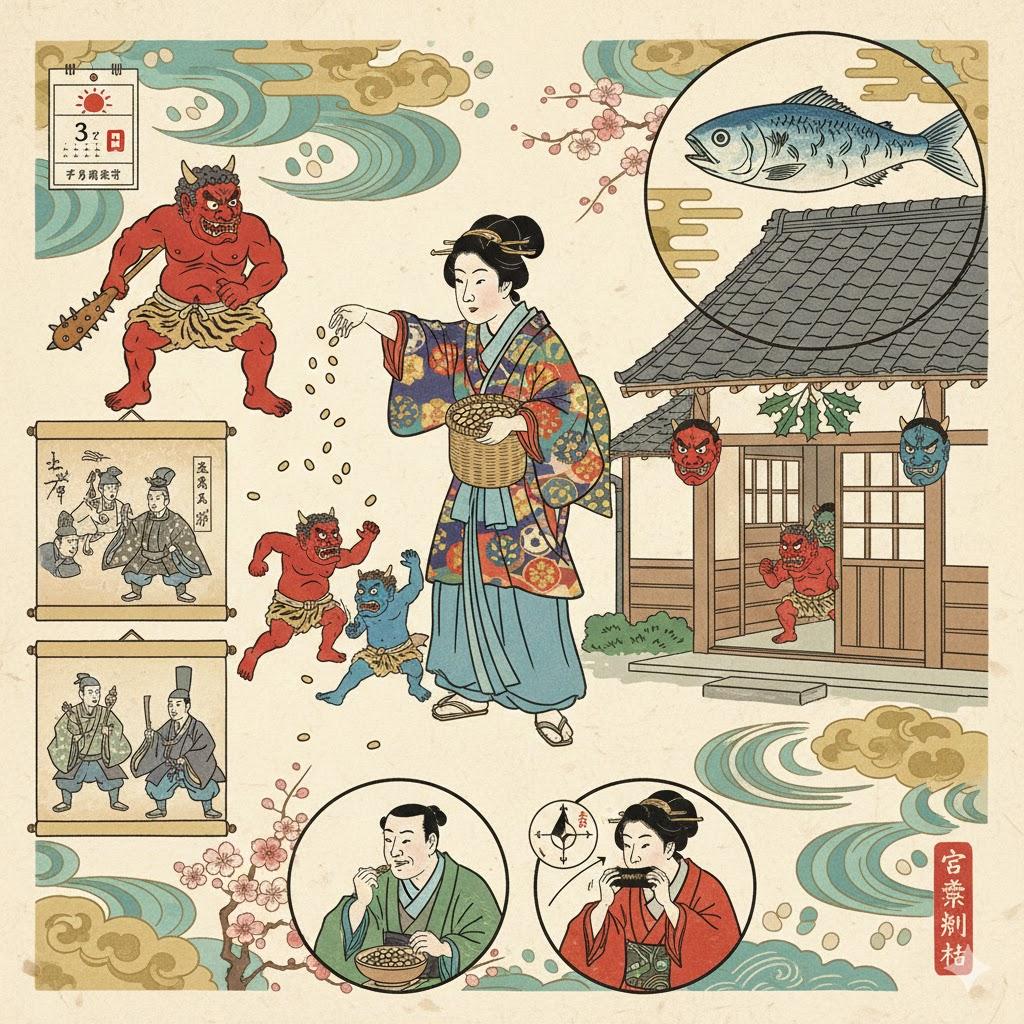
Setsubun Festival (Generated with Artificial Intelligence)
Original Name(s) | Setsubun | ||||||||
|---|---|---|---|---|---|---|---|---|---|
Origin(s) | Ancient China – Tsuina rituals | ||||||||
Symbolic Figures | Daikoku and Ebisu (gods of fortune) Oni (demons) | ||||||||
Main Ritual | Mamemaki (bean throwing) | ||||||||
Transition Represented | Winter → Spring | ||||||||
Calendar Type | Traditional Japanese lunar calendar | ||||||||
Meaning(s) | Division of seasons seasonal transition | ||||||||
Setsubun is a longstanding cultural observance in Japan based on the traditional calendar system, marking the seasonal transition. Today it is observed on the day before Risshun, which according to the Japanese lunar calendar typically falls around February 3 and is considered the beginning of spring. The festival symbolizes the end of winter and the transition to spring, and is shaped by rituals aimed at purifying oneself from the negative influences believed to accompany this shift.
The term “Setsubun” is composed of two Japanese kanji. “Setsu” (節) means season, while “Bun” (分) means to divide or separate. Together, Setsubun literally translates to “the division of seasons” or “seasonal transition point”.【1】 Historically, this term was used four times a year in the Japanese calendar system to denote the day before each seasonal change. Over time, its usage narrowed and became exclusively associated with the transition from winter to spring.
The origins of Setsubun lie in ancient Chinese rituals known as Tsuina, which were designed to expel evil spirits. These practices were transmitted to Japan through cultural exchange and gradually integrated with local beliefs. During the Heian period, Setsubun became a formal ceremony held at the imperial court, where rituals were performed to drive away malevolent spirits and enter the new season in a purified state. By the Edo period, these customs spread beyond the court and became widespread in temples and everyday life, evolving into a social tradition. Although the exact origin date of Setsubun cannot be documented, its distinctive rituals have been part of Japanese culture for over a thousand years.【2】

Warding Off Evil Spirits, Colorful Woodblock Print - Tsukioka Kôgyo (The Art Institute of Chicago)
The primary purpose of Setsubun is to expel evil spirits (oni) and the misfortune, illness, and negativity associated with them during seasonal transitions. According to traditional belief, the period from winter to spring is considered a time when the boundary between the spirit world and the human world weakens. Thus, Setsubun represents not only a calendrical transition but also a spiritual and spatial purification process. The rituals performed during the festival aim to safeguard individual health, family well-being, and communal prosperity.
The central ritual of Setsubun is mamemaki, the throwing of roasted soybeans. This practice is carried out both in homes and at temples. As the beans are thrown, participants traditionally chant “Oni wa soto, fuku wa uchi”, meaning “Out with demons, in with fortune.” The use of soybeans stems from the belief that cereal grains possess purifying properties. Additionally, the Japanese word for bean, “mame”, sounds similar to phrases meaning “to destroy evil.” As a complementary practice, after the bean-throwing, individuals eat a number of beans equal to their age, or sometimes one more, as it is believed this ensures health and protection for the coming year.【3】

Beans Thrown During the Demon-Expelling Ceremony - Kubo Shunman (The Met)
Another custom observed during Setsubun is the consumption of eho-maki, uncut long sushi rolls. The sushi is eaten in silence, facing the lucky compass direction of the year, and without being broken. Silence symbolizes undivided focus and preservation of intent, while eating the roll whole reflects the belief that fortune should not be divided. Although this tradition became widespread primarily in modern times, it has now become an established part of contemporary Setsubun observances.
Hiiragi iwashi is a traditional talisman consisting of a grilled sardine head impaled on a holly branch, hung at the entrance of homes during Setsubun. This practice is based on two beliefs: first, that the sharp odor of the sardine repels demons; second, that the sharp, pointed leaves of the holly branch act as a deterrent to evil spirits. This custom is performed to protect homes and create a purified atmosphere at the beginning of spring.

Hiiragi Iwashi Practice (Generated by Artificial Intelligence)
During Setsubun, the oni figure is one of the most prominent symbols. Oni are regarded as personifications of illness, misfortune, and evil, often depicted with red or blue masks. A common household ritual involves one person wearing an oni mask and being playfully chased by others. In some temple ceremonies, deities representing prosperity and good fortune, such as Daikoku and Ebisu, are also honored. Throughout the festival, temples sell objects associated with luck, including daruma dolls, bamboo rakes, and various amulets.
While Setsubun follows a common framework across Japan, it exhibits regional variations. The Kanda Myojin Shrine in Tokyo, with a history of approximately 1,300 years, is one of the most important centers for Setsubun celebrations. Its ceremonies include traditional processions, symbolic archery rituals performed by participants dressed in ancient warrior attire, and large-scale mamemaki events.【4】 Similar temple-centered observances take place in regions such as Kofu, Dazaifu, and Nara. The Setsubun Mantoro ceremony at Kasuga Taisha Shrine in Nara, featuring hundreds of lanterns lit in procession, exemplifies the long-standing historical continuity of this tradition.【5】
Although Setsubun is a uniquely Japanese tradition, it is observed in regions with Japanese communities and promoted through cultural outreach initiatives abroad. In particular, Japanese cultural centers in Hawaii organize educational events featuring Setsubun rituals, including mamemaki and eho-maki. Additionally, Japan’s diplomatic missions overseas present Setsubun as part of its cultural heritage through informative content and public events.
Dazaifu Tenmangu. "Setsubun Festival." Accessed January 15, 2026. https://www.dazaifutenmangu.or.jp/en/art-and-events/events/setsubun-festival/
Go Tokyo. "Setsubun Festival Bean-Tossing Ceremony." *Go Tokyo The Official Tokyo Travel Guide.* Accessed January 15, 2026. https://www.gotokyo.org/en/spot/ev176/index.html
Japan Travel. "Setsubun Mantoro." *Japan Endless Discovery.* Accessed January 15, 2026. https://www.japan.travel/en/spot/51/
Japanese Cultural Center of Hawai’i. "Japanese Traditions: Setsunun." jcchawaii.org. Accessed January 15, 2026.
Japanese Embassy, Türkiye. "Setsubun." *tr.emb-japan.go.jp.* Accessed January 15, 2026. https://www.tr.emb-japan.go.jp/itpr_ja/11_000001_00374.html
Kōgyo, Tsukioka. "Setsubun (Kyogen), from the series 'Pictures of No Performances (Nogaku Zue).'" Art Institute of Chicago. Accessed January 19, 2026. https://www.artic.edu/artworks/154942/setsubun-kyogen-from-the-series-pictures-of-no-performances-nogaku-zue
National Diet Library, Japan. "Setsubun and Jakibarai (Warding off evil spirits)." National Diet Library, Japan. Accessed January 15, 2026. https://www.ndl.go.jp/en/imagebank/column/setsubun
Shunman, Kubo. "Beans for Tossing During Setsubun Exorcism Ceremony,” from the series Ise Calendars for the Asakusa Group (Asakusa-gawa Ise goyomi) From the Spring Rain Collection (Harusame shū), vol. 2." The Metropolitan Museum of Art. Accessed January 19, 2026.
Visit Kofu. "Daijingu Setsubun Festival." Official Tourism Website for Kofu City. Accessed January 15, 2026. https://kofu-tourism.com/en/see-and-do/74
Web Japan. "Setsubun and Bean-Throwing." Ministry of Foreign Affairs of Japan. Accessed January 15, 2026. https://web-japan.org/kidsweb/explore/calendar/february/setsubun.html
[1]
National Diet Library, Japan, "Setsubun and Jakibarai (Warding off evil spirits)," National Diet Library, Japan, Erişim Tarihi: 15 Ocak 2026, https://www.ndl.go.jp/en/imagebank/column/setsubun
[2]
National Diet Library, Japan, "Setsubun and Jakibarai (Warding off evil spirits)," National Diet Library, Japan, Erişim Tarihi: 15 Ocak 2026, https://www.ndl.go.jp/en/imagebank/column/setsubun
[3]
Japonya Büyükelçiliği, Türkiye, "Setsubun," tr.emb-japan.go.jp, Erişim Tarihi: 15 Ocak 2026, https://www.tr.emb-japan.go.jp/itpr_ja/11_000001_00374.html
[4]
Web Japan, "Setsubun and Bean-Throwing," Ministry of Foreign Affairs of Japan, Erişim Tarihi: 15 Ocak 2026, https://web-japan.org/kidsweb/explore/calendar/february/setsubun.html
[5]
Web Japan, "Setsubun and Bean-Throwing," Ministry of Foreign Affairs of Japan, Erişim Tarihi: 15 Ocak 2026, https://web-japan.org/kidsweb/explore/calendar/february/setsubun.html

Setsubun Festival (Generated with Artificial Intelligence)
Original Name(s) | Setsubun | ||||||||
|---|---|---|---|---|---|---|---|---|---|
Origin(s) | Ancient China – Tsuina rituals | ||||||||
Symbolic Figures | Daikoku and Ebisu (gods of fortune) Oni (demons) | ||||||||
Main Ritual | Mamemaki (bean throwing) | ||||||||
Transition Represented | Winter → Spring | ||||||||
Calendar Type | Traditional Japanese lunar calendar | ||||||||
Meaning(s) | Division of seasons seasonal transition | ||||||||
Meaning and Conceptual Framework
Historical Origins and Development
Purpose and Belief System
The Mamemaki Ritual
The Eho-maki Tradition
The Hiiragi Iwashi Practice
Symbolic Figures and Ritual Representations
Regional and Institutional Practices
Practices Outside Japan