


This article was automatically translated from the original Turkish version.
+1 More
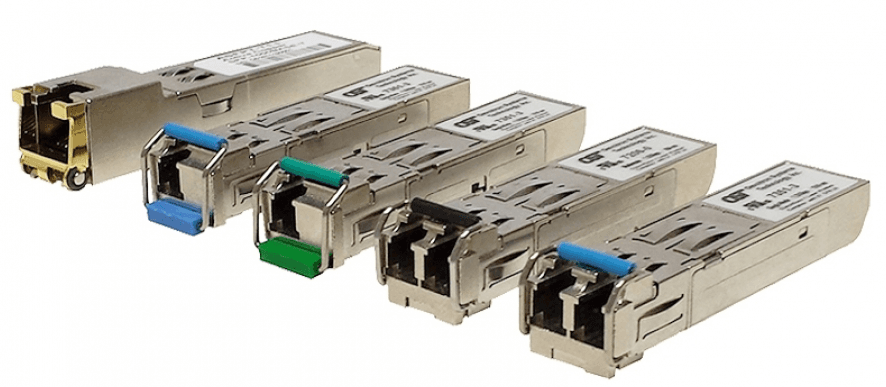
SFP Module (Small Form-factor Pluggable)
Definition(s) | A module used in devices such as switch routers with small form-factor pluggable (SFP) interfaces. | ||||||||
|---|---|---|---|---|---|---|---|---|---|
Expansion | Small Form-Factor Pluggable | ||||||||
Basic Features | Hot-swappable, supported by fiber or copper, typically 1 Gbps, compact design | ||||||||
Connection Types | RJ-45 (copper), LC/SC (fiber optic) | ||||||||
Application Area(s) | Data centers modular network architectures fiber-copper transitions campus networks | ||||||||
Advanced Types | SFP+: 10 Gbps, QSFP: Much higher speeds | ||||||||
SFP (Small Form-factor Pluggable) is a hot-swappable interface module used in network hardware. It is commonly employed to establish a physical connection between a network device and either fiber optic or copper network cabling. Thanks to its compact size and replaceable design, SFP modules provide network flexibility and scalability. SFP supports the “hot-swappable” feature, allowing modules to be inserted or removed without powering down the device. This characteristic minimizes system downtime and simplifies maintenance procedures.

SFP module (generated by artificial intelligence)
The primary purpose of SFP modules is to enable seamless transitions between different network types and transmission media. These modules are typically inserted into SFP slots on devices such as switches, routers, firewalls, or media converters. When a single device needs to support multiple transmission speeds or cabling types, configuration can be easily updated by simply replacing the SFP module. Common use cases include:

Fiber Cables Terminated with SFP Modules (unsplash)
SFP modules come in various types designed for both fiber optic (single-mode and multi-mode) and copper (such as Ethernet over RJ-45) connections. The most commonly supported speeds are 1 Gbps (SFP) and 10 Gbps (SFP+). Some advanced variants support higher speeds such as 25 Gbps (SFP28), 40 Gbps (QSFP+), and 100 Gbps (QSFP28). Modules typically include the following key components:
In addition, SFP modules can operate at different wavelengths (850 nm, 1310 nm, 1550 nm), enabling solutions ranging from short to long distances. Typical transmission distances vary from a few meters up to 80 km.
SFP modules offer numerous advantages for network management:
Although SFP modules offer many advantages, they also come with certain limitations. In environments with numerous ports and diverse connection types, the following drawbacks should be considered:
In summary, SFP modules are widely used in modern network infrastructures to provide connection flexibility and support high data transmission capacities. With a variety of speed and connection type options, SFP technology is a fundamental component that enhances the scalability and functionality of network architectures. Its adoption across diverse environments—from data centers and campus networks to industrial systems and ISP infrastructures—is a direct result of the performance, compatibility, and ease of maintenance it offers.
Ichino, M., S. Yoshikawa, Hirotaka Oomori, Y. Maeda, N. Nishiyama, T. Takayama, T. Mizue, I. Tounai, and Mitsuaki Nishie. “Small Form Factor Pluggable Optical Transceiver Module with Extremely Low Power Consumption for Dense Wavelength Division Multiplexing Applications.” *IEEE Journal of Selected Topics in Quantum Electronics* 16, no. 5 (2010): 1359–1366. Accessed May 21, 2025. https://www.researchgate.net/publication/224614978_Small_form_factor_pluggable_optical_transceiver_module_with_extremely_low_power_consumption_for_dense_wavelength_division_multiplexing_applications.
Techslang. "What Is an SFP?" Techslang.com. Accessed https://www.techslang.com/definition/what-is-an-sfp/.

SFP Module (Small Form-factor Pluggable)
Definition(s) | A module used in devices such as switch routers with small form-factor pluggable (SFP) interfaces. | ||||||||
|---|---|---|---|---|---|---|---|---|---|
Expansion | Small Form-Factor Pluggable | ||||||||
Basic Features | Hot-swappable, supported by fiber or copper, typically 1 Gbps, compact design | ||||||||
Connection Types | RJ-45 (copper), LC/SC (fiber optic) | ||||||||
Application Area(s) | Data centers modular network architectures fiber-copper transitions campus networks | ||||||||
Advanced Types | SFP+: 10 Gbps, QSFP: Much higher speeds | ||||||||
No Discussion Added Yet
Start discussion for "SFP Module (Small Form-factor Pluggable)" article
Purpose and Application Areas
Technical Specifications
Advantages
Limitations