


This article was automatically translated from the original Turkish version.
+2 More
Coaxial cable is a signal transmission cable consisting of a single central conductor surrounded by an insulating dielectric material and an outer metallic shield, either braided or spiral, which serves as an outer layer. This structure is completed by an outer plastic insulating sheath. The central conductor is typically made of copper and serves as the primary component for signal transmission. The insulating layer electrically isolates the central conductor from the protective outer shield while ensuring controlled signal propagation. The shielding layer prevents electromagnetic interference from affecting the signal and simultaneously protects other transmission media from internal signals. The outer plastic sheath provides physical durability and protection against environmental factors.
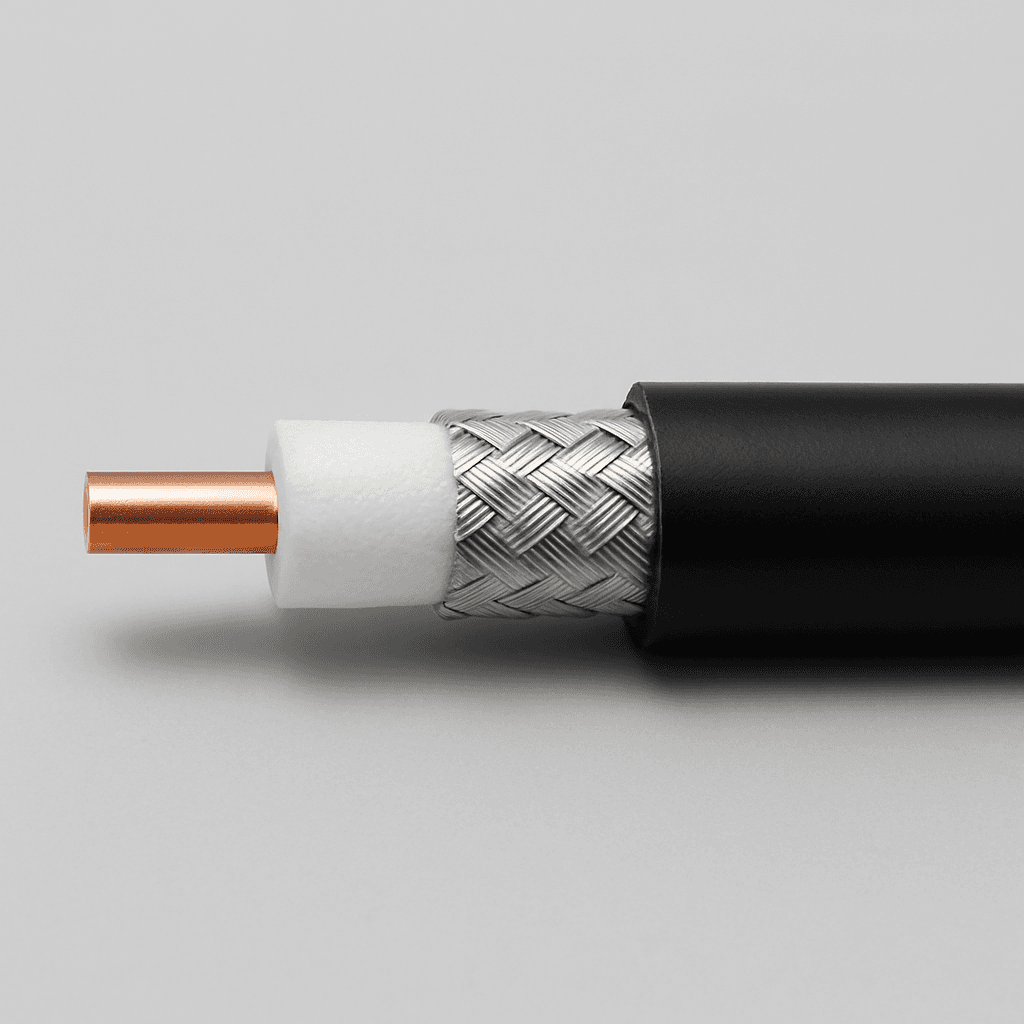
Coaxial Cable Image (Generated by Artificial Intelligence)
Coaxial cables provide high protection against electromagnetic interference. This characteristic is related to both the material of the central conductor and the type of shielding used. The shielding layer is typically made of aluminum foil or braided metal wire. In addition to providing protection against electromagnetic interference, coaxial cables are designed to minimize signal attenuation. Electrical parameters such as characteristic impedance, propagation velocity, and attenuation level have been standardized. Common impedance values are 50 ohms and 75 ohms, varying according to application. For example, 75 ohm coaxial cables are preferred in television and video systems while 50 ohm cables are used in data communication and radio transmission applications.
Attenuation refers to the power loss experienced by the signal as it travels along the cable. This loss varies depending on the cable length and material quality. Return loss defines the portion of the signal reflected back toward the source due to impedance mismatches during transmission. Propagation velocity indicates the speed at which the signal travels through the cable and is usually expressed as a percentage of the speed of light. These electrical properties are fundamental in determining the suitability of a coaxial cable for a given application.
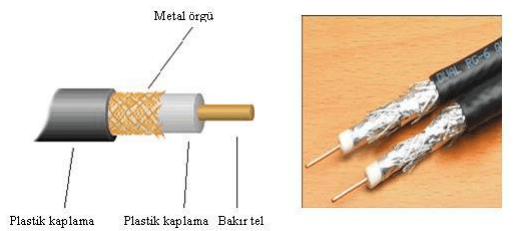
Visual Representing the Structure of a Coaxial Cable (megep)
Coaxial cables are generally classified using “RG” (Radio Guide) codes. This classification is based on the cable’s physical structure, impedance, shielding method, and signal carrying capacity. Common types include RG-6, RG-11, RG-59, and RG-58. RG-6 is typically used in television systems; RG-11, which is thicker and suited for longer distances; RG-59 in closed-circuit camera systems; and RG-58 in Ethernet networks.
Coaxial cables are manufactured in two main forms: thick and thin. Thick coaxial cable (Thicknet or 10Base5) has a diameter of approximately 1 cm and is usually encased in a yellow outer sheath. It is used for baseband data transmission and can carry data at 10 Mbps over distances up to 500 meters. Thin coaxial cable (Thinnet or 10Base2) has a more flexible structure with a diameter of 0.64 cm and can transmit data at 10 Mbps over distances up to approximately 185 meters. Both cable types were used in Ethernet networks with bus topology, but their use has since been replaced by twisted pair cables and fiber optic systems.
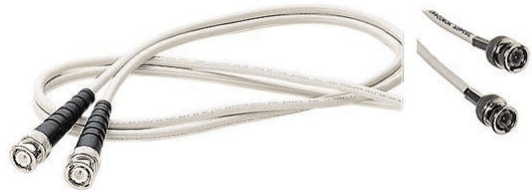
RG-58 Coaxial Cable (Ministry of National Education)
Coaxial cables are capable of transmitting various analog and digital signals, resulting in a wide range of applications from television broadcast systems to data transmission networks, security camera systems to satellite communications. Although widely used in long-distance telephone networks since the 1950s, they have since been largely replaced by fiber optic systems. Today, their most common applications include cable television systems (CATV), building-wide television distribution (MATV), closed-circuit television systems (CCTV), radio antennas, digital video recording systems, and low-frequency data transmission applications.
Types used for data transmission have 75 ohm impedance for analog signals and 50 ohm impedance for digital signals. The latter is preferred in digital signal transmission due to lower signal distortion and greater resistance to interference. In particular, coaxial cables are widely used in industrial areas with high electromagnetic fields because they effectively reduce parasitic effects.
Special connectors are required to integrate coaxial cables into systems. These connectors vary depending on the cable type. Thick coaxial cables use AUI (DIX or DB15) and N-type connectors, while thin coaxial cables use BNC connectors. During installation of BNC connectors, the cable end is carefully stripped and connected to the connector either with or without soldering. In network configurations, particularly those using bus topology, both ends of the cable must be terminated with a 50 ohm terminator. Without a terminator, the network will not function properly or data transmission will be disrupted due to signal reflections.
BNC connectors come in several types. These include the “BNC cable connector” that attaches directly to the cable, the “BNC T connector” used to connect to a computer network card, and the “BNC barrel connector” used to join two coaxial cables. Maintaining the physical integrity of the cable during installation requires attention to bending radius and ensuring the shielding layer remains undamaged, both of which are critical for sustaining signal quality.
In coaxial cable applications, key considerations include preventing signal loss, ensuring proper impedance termination, maintaining uninterrupted shielding, and securing reliable connections. Cable bending angles should be kept as wide as possible, avoiding sharp turns. In building installations, it is recommended to route the cable away from magnetic fields and power lines. As cable length increases, signal attenuation also increases; therefore, signal amplifiers or repeaters may be used when necessary. Although coaxial cable is inherently flexible and durable, it must be selected in a type suitable for environmental conditions such as temperature, humidity, and UV exposure.
Coaxial cable was first developed at the end of the 19th century as a medium for transmitting electromagnetic signals. Practical applications were pioneered in the 1930s by American engineers Lloyd Espenschied and Herman Affel, and by the 1940s, telephone companies began using it for long-distance voice transmission. From the 1950s onward, it found widespread use in television broadcasting and became common in military communication systems and public infrastructure. Particularly in the 1980s, its adoption in computer networks was formalized with the Ethernet standards 10Base5 and 10Base2. However, from the late 1990s onward, its use in network systems declined due to the rise of more flexible and higher-bandwidth twisted pair and fiber optic cables, although it retained its importance in television, CCTV, and radio systems.
Significant differences exist between coaxial and fiber optic cables in terms of structure, performance, and application. Coaxial cable transmits signals electrically, whereas fiber optic cable transmits information as pulses of light. This fundamental difference directly affects data transmission speed and immunity to interference. Fiber optic cables offer much higher bandwidth, are immune to electromagnetic interference, and can transmit data over much longer distances. In contrast, coaxial cables provide adequate performance for short- and medium-distance applications at a lower cost.
In terms of installation, coaxial cable is easier and less expensive than fiber optic cable. Cutting, splicing, and terminating fiber optic cables require specialized equipment, while coaxial cable installation is simpler. Therefore, fiber optic systems are generally preferred for backbone connections, while coaxial cables continue to be used in building distribution systems.
Coaxial cables were primarily used in network topologies with bus configuration. In bus topology, all devices are connected to a single main line, with terminators placed at both ends. While this structure is cost-effective, a fault on the main line can disrupt the entire network. Additionally, because each device transmits signals, access methods such as CSMA/CD were employed to prevent collisions. In modern systems, coaxial cable is still used in distribution systems and in the analog-to-digital transition phase of IP-based security systems.
Coaxial cables must be manufactured in compliance with national and international standards. To ensure consistent electrical and mechanical properties, production must adhere to criteria established by organizations such as TS (Turkish Standard), VDE (German Standard), and IEC (International Electrotechnical Commission). Coaxial cables are used in television systems (CATV), centralized satellite systems (SMATV), analog security camera systems (CCTV), radio communication, legacy Ethernet segments of computer networks, and certain specialized communication protocols.
For many years, coaxial cable served as the primary medium for audio, video, and data transmission. Although it has lost ground in some areas to fiber optic and high-performance twisted pair cables, it continues to be used in television broadcasting, security systems, and short-distance data transmission applications. Due to its low cost, protection against electromagnetic interference, and compatibility with diverse systems, it remains a functional component in technical infrastructures.
If desired, I can also add sections such as image descriptions of the materials, example RG cable tables, or key considerations for application projects.
Ministry of National Education. "Haberleşme ve Bildirim Tesisatları." Ankara: General Directorate of Vocational and Technical Education, 2011. Accessed July 18, 2025.
Ministry of National Education. "Temel Bilgisayar Ağları - 1." Ankara: Strengthening Vocational Education and Training System Project (MEGEP), 2008. Accessed July 18, 2025.
Ministry of National Education. "Temel Elektrik Malzemeleri." Ankara: General Directorate of Vocational and Technical Education, 2011. Accessed July 18, 2025.
Ministry of National Education. "Yerel Ağ Sistemleri." Ankara: Strengthening Vocational Education and Training System Project (MEGEP), 2008. Accessed July 18, 2025.

Properties and Technical Specifications
Types and Standards
Applications
Connectors and Installation
Application Notes
History of Coaxial Cable
Comparison with Fiber Optic Cable
Topology and System Integration
Compliance with Standards and Application Areas