This article was automatically translated from the original Turkish version.
Sia Ancient City
Location | Türkiye Burdur Bucak | ||||||||
|---|---|---|---|---|---|---|---|---|---|
Elevation(s) | 1050 m | ||||||||
Region(s) | Ancient Pisidia | ||||||||
Founding Period | Hellenistic Period | ||||||||
Initial Works | 1892 | ||||||||
Sia Ancient City is an ancient settlement located at an elevation of 1,050 meters within the boundaries of the Bucak district of Burdur Province, between the neighborhoods of Köletaşı and Kozağacı of Karaot Village. Known locally as "Taş-tandam," the city is situated in a mountainous and steep terrain. Due to its remote location from modern settlements and the absence of a regular transportation route, it stands out as one of the best-preserved ancient cities in Anatolia.

Sia Ancient City (müzeler.org)
Sia is located within the ancient region of Pisidia, between small-scale settlements such as Kremna, Selge, Pednelissos, Hyia, and Keraitai. Its rugged and mountainous topography granted the city a strategic position, reinforced by surrounding walls and tower structures. This geographical configuration enhanced the city’s resilience against historical events and natural influences.
Sia Ancient City is believed to have been established during the Hellenistic period. It continued to function as a socio-economic center through the 3rd and 4th centuries AD during the Roman era and retained its urban identity until the early Byzantine period.

Sia Ancient City (Culture Portal)
The first scientific studies at the site were initiated in 1892 by Edward V. Berard and William M. Ramsay. Subsequent surface surveys and epigraphic analyses were conducted by specialists including George Bean in 1957, Mehmet Özsait in 1974, Stephen Mitchell in 1995 and 1996, and Hüseyin Metin in 2017. However, due to its forested environmental setting, no official archaeological excavation has yet been carried out. Although the city’s exact ancient name remains unknown, scholarly research has uncovered a wealth of data.
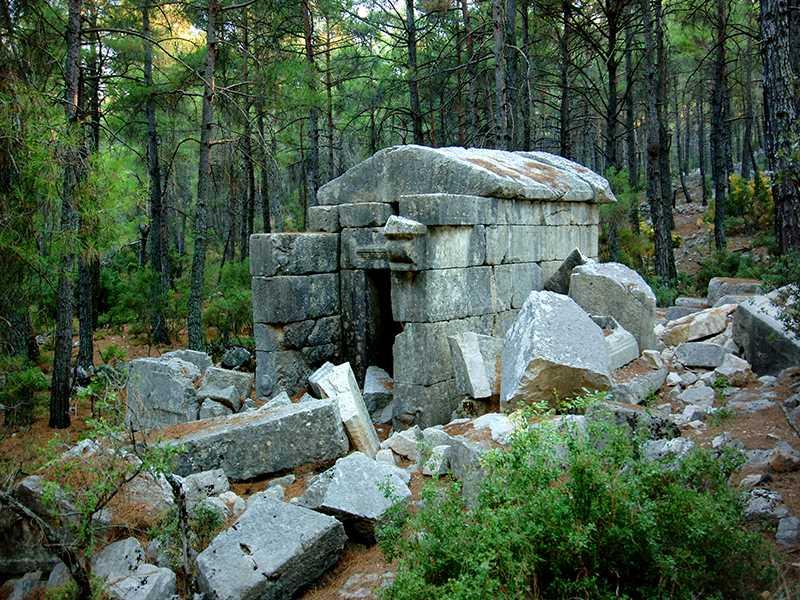
In addition to defensive walls and towers, Sia Ancient City contains a bath (estimated to date from the 3rd century), a bouleuterion (council house—the only structure predating the Roman period), an agora (marketplace), a Doric stoa (open-air covered public space), a palaestra (sports school or gymnasium), a cistern, a necropolis (cemetery), a temple, and a church. The monumental tombs in the necropolis are particularly striking. The city’s walls, two-story tower, and entrance gate are among the most significant surviving remains. Remains of residential structures have been found both inside and outside the city walls.

Sia Ancient City (Culture Portal)
Sia Ancient City possesses significant potential for alternative tourism due to its historical, urban, and environmental characteristics. Its elevation of 1,050 meters and rugged topography provide an ideal setting for mountain sports and hiking activities. Rural footpaths and goat trails offer adrenaline-filled routes for cycling groups.
The rich flora and fauna surrounding the site—including dense stands of pine, black pine, European beech, hornbeam, fir, cedar, mulberry, linden, goat’s horn, oak, cypress, wild fig, and olive trees—offer scenic landscapes for nature lovers and photographers.
Bucak Belediyesi. "Sia Antik City." bucak.bel.tr. Accessed June 19, 2025. https://www.bucak.bel.tr/bucak/Gezi-Rehberi/Sia-Antik-Kenti/19.
Kültür Portalı. "Sia Ören Yeri / Taşandam." Last Updated December 13, 2021. First Published February 21, 2013. Accessed June 19, 2025. https://www.kulturportali.gov.tr/turkiye/burdur/gezilecekyer/sia-tasdandam.
Sia Antik City. Accessed June 19, 2025. https://muzeler.org/sia-antik-kenti--434723.
Soslu, Salih. "Sia Antik Kenti." Türkiye Turizm Ansiklopedisi, 2020. Accessed June 19, 2025. https://turkiyeturizmansiklopedisi.com/sia-antik-kenti.

Sia Ancient City
Location | Türkiye Burdur Bucak | ||||||||
|---|---|---|---|---|---|---|---|---|---|
Elevation(s) | 1050 m | ||||||||
Region(s) | Ancient Pisidia | ||||||||
Founding Period | Hellenistic Period | ||||||||
Initial Works | 1892 | ||||||||
Geographical and Strategic Location
Historical Development
Research and Excavations
Architectural Structures
Alternative Tourism Potential