


This article was automatically translated from the original Turkish version.
+2 More
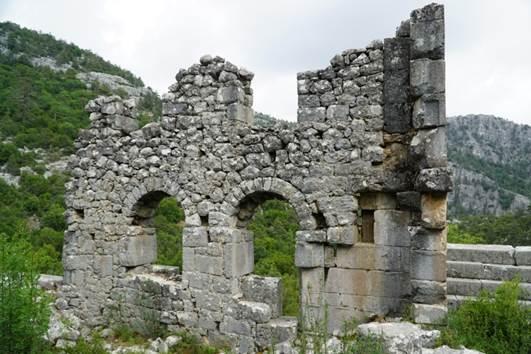
Ancient City of Adada (SDÜ)
Location | Sütçüler Türkiye Isparta | ||||||||
|---|---|---|---|---|---|---|---|---|---|
Elevation(s) | Approximately 1200 m | ||||||||
Establishment | 3rd century BC | ||||||||
Region(s) | Pisidia–Pamphylia Transit Route | ||||||||
The Ancient City of Adada is an ancient Pisidian settlement located at an elevation of approximately 1200 meters at the foot of the Taurus Mountains near Sağrak village in the Sütçüler district of Isparta. The city lies along an ancient road network that follows the western shore of Lake Caralis (Beyşehir) and connects Perge to Antiokheia via Pednelissos Timbiriada and Neapolis. Due to its strategic position it served as an important transit point between the regions of Pisidia and Pamphylia.
The city first appeared in historical records in the 3rd century BCE and reached its peak during the Roman Imperial period. Under Roman rule extensive building activities were carried out during which monumental structures such as temples a forum a basilica and a theatre were constructed. It is known that Saint Paul (St. Paulos) visited Adada on his route from Perge to Antiokheia which underscores the city’s significance in the early history of Christianity.
During the Eastern Roman (Byzantine) period Adada became an important Christian center like other Pisidian cities. Parts of pagan temples were converted into churches and new churches were built. Evidence suggests that urban life in the city continued until the 9th century.

Remains of the Ancient City of Adada (SDÜ)
The Ancient City of Adada is situated at the foot of the Taurus Mountains and features a distinctive urban layout shaped by both natural topography and deliberate planning. The southern part of the city borders a valley while its western and northern sides are bordered by gently sloping hills and its eastern side by a flat ridge.
Among Adada’s most important structures are the Roman Imperial period Temple of Trajan the Imperial Cult Temple the Temple of the Emperors and Zeus Megistos–Serapis and the Temple of the Emperors and Aphrodite.
Located in the northeastern part of the city and built in the 160s CE the Temple of Zeus Megistos–Serapis is a tetrastylos prostylos structure raised on a podium. Its architectural decorations feature palmette and Ionic kymation moldings dated to the Antonine period (150–175 CE). Inscriptions found at the temple reveal the significant contributions of the families of Tlamoas and Antiokhos to its construction. Surrounding the temple are stoas an ergasterion and an altar structure.
During the Byzantine period new churches were built in the city and some pagan temples were converted into churches. The largest church located on the western side of the valley was constructed during the Byzantine period using the terraces and interior walls of an earlier building.
The city contains public structures such as a forum a basilica a monumental fountain an administrative building an open-air assembly area and cisterns. The forum measures approximately 32 by 45 meters and is paved with regular stone slabs with a large cistern at its center. On either side of the forum are stoas and to the north lies a basilica oriented east-west.
The acropolis of Adada is situated on the rocky section between the city’s plateau and the valley and was constructed for defensive purposes. The acropolis was fortified with walls and towers which reinforced the city’s strategic position at higher elevations and provided protection against external threats. On the western part of the acropolis is an open-air assembly area with a capacity of approximately 1000 people. This space served both social and political functions. In later periods the forum and basilica the city’s commercial and administrative center were constructed in front of this assembly area.
The theatre of Adada is located on the slope of a hill to the west of the city. The stage building and orchestra area remain largely buried under earth. The seating area (cavea) has been uncovered through rescue excavations conducted by the museum. With a capacity of approximately 500 the theatre is typical of a medium-sized ancient city.
The houses of Adada were built on terraces along the southern slope of the valley to the southwest of the agora. The terraces were supported by retaining walls and the houses were arranged in multiple stories. Structures were built using double-skin wall technique and small cut stone blocks indicating continuous occupation from the Hellenistic period through to the Late Antique period. In the Late Antique period some houses acquired new functions for example House GVK009 was converted into a church in the 6th century. Aristocratic residences emphasized the wealth and social status of their owners through their architectural arrangements.
Documentary on the Ancient City of Adada (TRT2)
The Ancient City of Adada was first observed by A. Schönborn in 1841 and later examined by J. R. S. Sterrett in 1884. In the late 19th century G. Hirschfeld and W. M. Ramsay confirmed the city’s name through inscriptions. The first scientific excavations were carried out in 2004 through a collaboration between the Isparta Museum and Pamukkale University. Today architectural documentation and surface surveys are conducted by Süleyman Demirel University and various research teams.
Altınışık, Fatih, and Ahmet Mörel. "Geç Antik Dönem'de Adada Konutları: Sosyo-ekonomik Değişimlerin Mimari Temsilleri." *Mehmet Akif Ersoy Üniversitesi Sosyal Bilimler Dergisi* 41 (2025): 279–299. https://dergipark.org.tr/en/pub/makusobed/issue/92125/1670178
Aylan, Serkan. "Adada Antik Kenti." Türkiye Turizm Ansiklopedisi. 2019. Accessed September 25, 2025. https://turkiyeturizmansiklopedisi.com/adada-antik-kenti
Mörel, Ahmet, and Okan Özdemir. "Adada Antik Kenti Tanrı İmparatorlar ve Zeus Megistos Serapis Tapınağı Ön Değerlendirmeler." 39. Araştırma Sonuçları Toplantısı, Volume 1 (2024): 75-88. https://www.academia.edu/120858300/_Preliminary_Remarks_on_Temple_of_God_Emperors_and_Zeus_Megistos_Serapis_in_Adada_Adada_Antik_Kenti_Tanr%C4%B1_%C4%B0mparatorlar_ve_Zeus_Megistos_Serapis_Tap%C4%B1na%C4%9F%C4%B1_%C3%96n_De%C4%9Ferlendirmeler_
Mörel, Ahmet. "Adada Antik Kenti Yüzey Araştırmaları." Süleyman Demirel Üniversitesi Arkeoloji. Accessed September 25, 2025. https://insantoplum.sdu.edu.tr/arkeoloji/tr/yuzey-arastirmalari/adada-antik-kenti-yuzey-arastirmalari-13783s.html
TRT2. "Anadolu Arkeolojisi | Adada Antik Kenti | 10. Bölüm." YouTube Video, 27:19. Accessed September 25, 2025. https://www.youtube.com/watch?v=w54tCF6_4io&t=1s
Türkiye Kültür Portalı. "Adada Antik Kenti - Isparta." Accessed September 25, 2025. https://www.kulturportali.gov.tr/turkiye/isparta/gezilecekyer/adada-antik-kenti

Ancient City of Adada (SDÜ)
Location | Sütçüler Türkiye Isparta | ||||||||
|---|---|---|---|---|---|---|---|---|---|
Elevation(s) | Approximately 1200 m | ||||||||
Establishment | 3rd century BC | ||||||||
Region(s) | Pisidia–Pamphylia Transit Route | ||||||||
No Discussion Added Yet
Start discussion for "Ancient City of Adada" article
History
Urban Structure and Architecture
Religious Structures
Temple of Zeus Megistos–Serapis
Christian Period Structures
Civic Spaces
Defensive Structures
Theatre
Residential Area
Research