


This article was automatically translated from the original Turkish version.
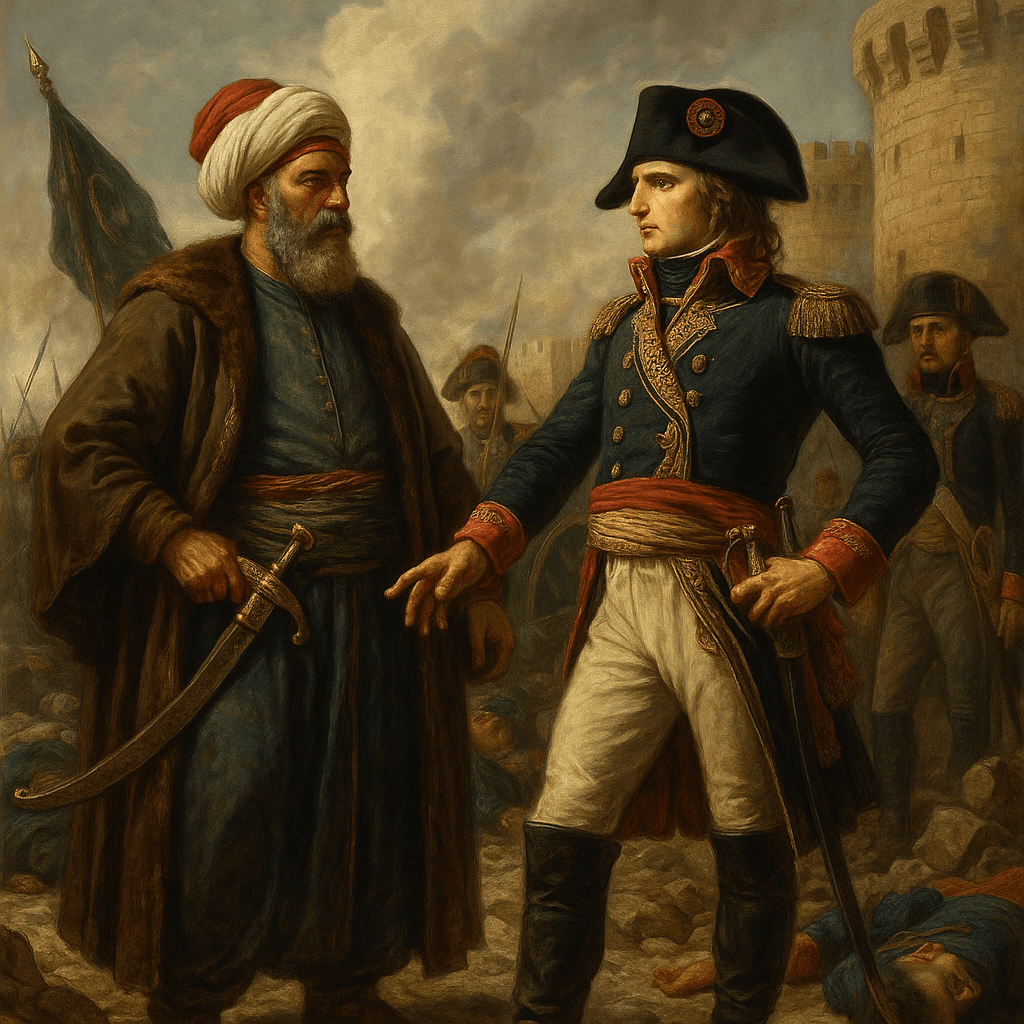
The Siege of Acre, a siege battle that took place in May 1799 between the Ottoman Empire and France, ended in a decisive Ottoman victory. This victory halted the advance of French general Napoleon Bonaparte in the Eastern Mediterranean and secured the continuation of Ottoman dominance in the Levant. One of the principal figures of the victory, Cezzar Ahmed Pasha, gained prominence through his successful defensive strategy and secured an important place in Ottoman military history.
In the late 18th century, the political and military upheavals following the French Revolution rapidly spread across Europe and affected the Mediterranean and the Middle East. In 1798, Napoleon Bonaparte invaded Egypt to sever Britain’s trade routes to its colony in India and weaken its global position. This move threatened the Ottoman Empire’s sovereignty in the region and drew Britain’s attention. In response, the Ottoman Empire drew closer to Britain and began taking military and diplomatic measures against France.
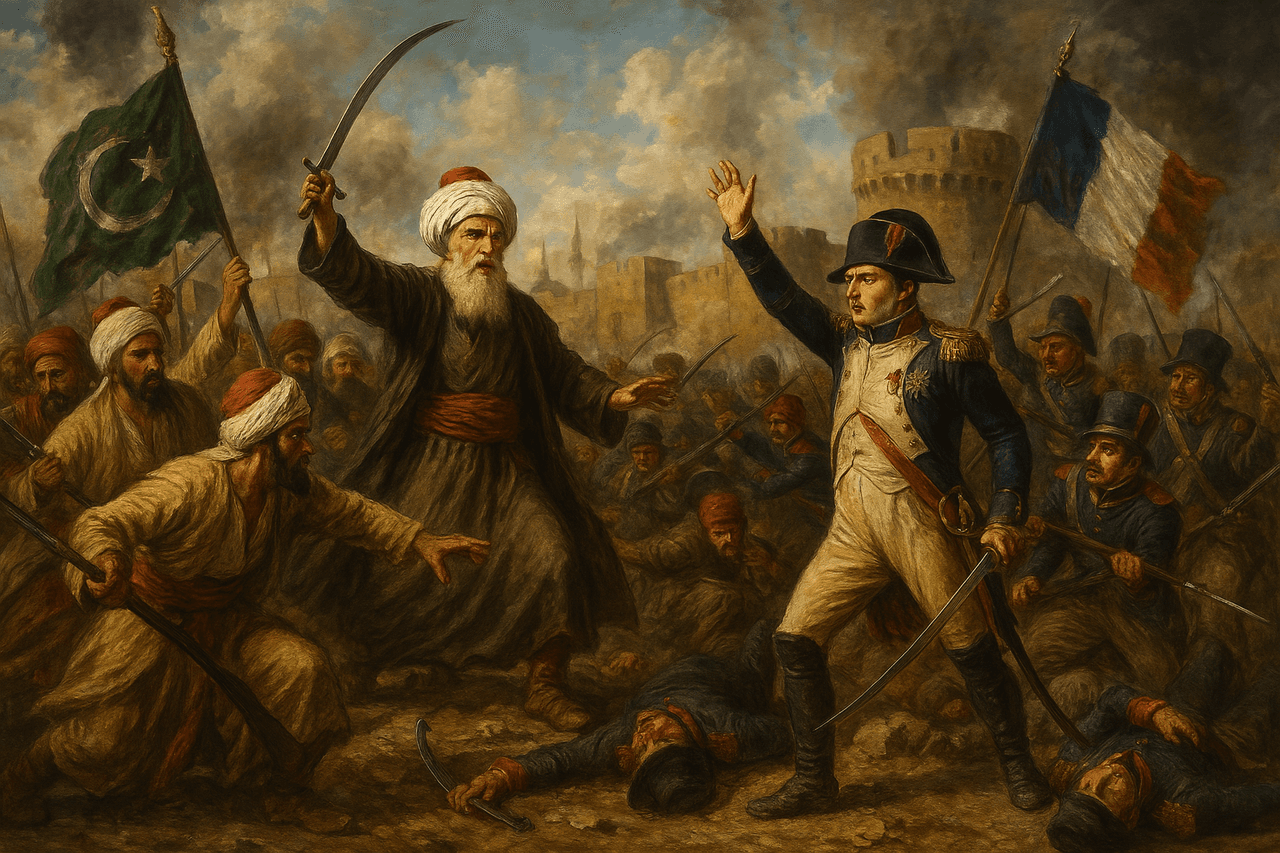
Representative Image of the Siege of Acre (Generated by Artificial Intelligence)
Cezzar Ahmed Pasha, responsible for the defense of Acre, was a prominent figure in the late 18th-century Ottoman administrative and military structure. Believed to have been born between 1720 and 1730 in Bosnia, Ahmed Pasha traveled to Istanbul at a young age, received religious education at a madrasa, and later held various posts in Egypt and Syria. Described as stern, authoritarian, yet resolute, Cezzar Ahmed Pasha was appointed governor of Syria in 1775 and established a powerful administrative-military base centered in Acre.
Predicting the French threat, Cezzar Ahmed Pasha repaired Acre’s fortifications, strengthened its armories, and organized the local population for defense. He maintained communication with the Ottoman central government (Divân-ı Hümâyûn) to request reinforcements and supplies. During this period, he coordinated with Britain and leveraged British naval support, particularly in maritime defense.
Napoleon Bonaparte reached the outskirts of Acre on 19 March 1799 and laid siege to the fortress. He commanded experienced generals (Kléber, Lannes, Junot) and a force of approximately 13,000 troops. During the siege, the French employed modern siege equipment and artillery to breach Acre’s walls, but they failed due to the strength of the fortifications and the determined resistance of the defenders.
Meanwhile, the British fleet under Admiral Sir Sidney Smith destroyed a large portion of the French naval forces anchored in Acre’s harbor, cutting off French supply lines from the sea. Additionally, British forces captured French ships transporting siege cannons intended for use from Egypt and handed them over to Cezzar Ahmed Pasha, significantly enhancing the defenders’ firepower.
The Siege of Acre (Ministry of Culture and Tourism of the Republic of Türkiye)
Cezzar Ahmed Pasha’s defensive strategy was built on a participatory structure that united the city’s population and various ethnic and sectarian groups. According to Ottoman sources, the defense included local militias, Albanian and Kurdish military units, reinforcements from Egypt, and Arab tribes.
During the siege, Napoleon attempted to capture the fortress thirteen times but failed on each occasion. The French employed intensive artillery bombardments, tunneling, and night raids. However, every assault was repelled by Cezzar Ahmed Pasha’s defense and the fire of British naval artillery. Cezzar Ahmed Pasha personally fought alongside his troops on the walls, carefully maintaining civilian morale.
On 10 May 1799, Napoleon was forced to withdraw after realizing the siege could not succeed. This retreat marked the failure of Napoleon’s military plans in the Eastern Mediterranean. He later described this setback as “Fate made me the plaything of an old man.”
The Siege of Acre is recorded as one of the most significant and rare military victories achieved by the Ottoman Empire in the late 18th century. The victory halted French expansion, strengthened the alliance between the Ottoman Empire and Britain, and greatly enhanced the reputation of Cezzar Ahmed Pasha.
In Ottoman archival documents, the Siege of Acre is recorded as “a significant achievement of Cezzar Ahmed Pasha” and was met with praise by the central administration. The documents detail Napoleon’s persistent attacks, the success of the defense, and the resilience demonstrated by the population. Furthermore, the victory letters sent by Cezzar Ahmed Pasha to Istanbul and the imperial commendations issued by the sultan in return illustrate the victory’s recognition within the central Ottoman bureaucracy.

Historical Background
Cezzar Ahmed Pasha and the Defense of Acre
The Siege and Course of the Battle
The Victory and Its Consequences
The Siege of Acre in Documentary and Archival Sources