

This article was automatically translated from the original Turkish version.
+2 More
Location | Türkiye Eskişehir | ||||||||
|---|---|---|---|---|---|---|---|---|---|
Year of Construction | First Structure 1650, Current Structure 1881 | ||||||||
Architect(s) | Minteş Panoyat | ||||||||
Period(s) | 19th Century | ||||||||
Material(s) | Red Cut Stone | ||||||||
Surp Yerrortutyun Armenian Church is a historically and architecturally significant place of worship located in the Sivrihisar district of Eskişehir. The church’s name derives from the Christian concept of the “Holy Trinity,” expressed in the term Surp Yerrortutyun. It is regarded as one of the largest Armenian churches in Anatolia.
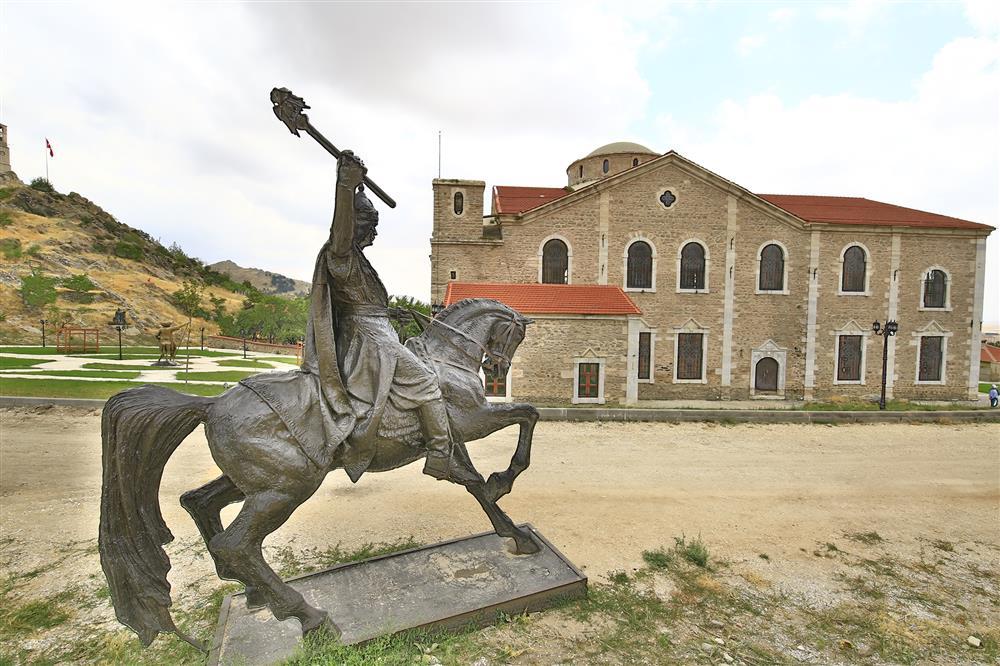
Sivrihisar Surp Yerrortutyun Armenian Church (Sivrihisar Municipality)
Originally built in 1650, the church suffered extensive damage in a fire that broke out in 1876. It was subsequently rebuilt in 1881 under the leadership of the Armenian Patriarch at the time, Nerses Varjabedyan, by the architect Mintes Panoyat.
Surp Yerrortutyun Armenian Church stands out as a monumental place of worship reflecting 19th-century provincial architecture. Its most striking structural elements are the two symmetrical bell towers rising on either side, which enhance the building’s verticality and create an imposing silhouette. The use of red-cut stone in construction has endowed the structure with both aesthetic appeal and a distinct regional identity, leading the local population to refer to it as the "Red Church." Although faded over time, traces of frescoes within the interior still remain, demonstrating the integration of religious and artistic decoration. The figurative representations in the frescoes reflect characteristic features of Armenian church art. Additionally, the building includes a baptismal chamber at the rear and a priest’s room in the southern section. This spatial arrangement reveals that the church was designed not merely as a place of worship but as a multifunctional structure serving the community’s religious and social needs.
The west façade is richly adorned with architectural ornamentation. It is divided into three sections by four pilaster-like plaster elements. The entrance is emphasized by a triple pointed arch system. Directly above the entrance are figurative and symbolic reliefs depicting:
Carved cross motifs on the keystones of the semicircular upper windows reinforce the Christian symbolism of the structure. These details illustrate that the building is not merely a place of worship but also a narrative space woven with artistic and faith-based symbols.
Numbers inscribed on the keystones of the windows on the west façade indicate that the church was rebuilt in 1881. Some columns inside the building bear restoration inscriptions referencing different dates. On the second, third, and fourth columns from the northwest corner, the years 1909, 1909/1902, and 1905 are legible. These inscriptions reveal that the structure underwent repairs during different periods in the early 20th century.
Although Surp Yerrortutyun Church remains largely standing physically, its interior has suffered significant damage. Nevertheless, this structure, which still preserves its original architectural details, holds value not only as a place of worship but also as a historical monument bearing traces of the multicultural Ottoman provincial life.
Sivrihisar Municipality. "Tarihi Surp Yerrortutyun Ermeni Kilisesi." Accessed August 16, 2025.
T.C. Ministry of Culture and Tourism Eskişehir Provincial Directorate of Culture and Tourism. "Surp Yerrortutyun Ermeni Kilisesi (Sivrihisar)." Eskişehir Kültür ve Turizm Portalı. Accessed August 16, 2025.
Turkish Ministry of Culture and Tourism. "Ermeni Kilisesi - Sivrihisar - Eskişehir." Kültür Portalı. Accessed August 16, 2025.

Location | Türkiye Eskişehir | ||||||||
|---|---|---|---|---|---|---|---|---|---|
Year of Construction | First Structure 1650, Current Structure 1881 | ||||||||
Architect(s) | Minteş Panoyat | ||||||||
Period(s) | 19th Century | ||||||||
Material(s) | Red Cut Stone | ||||||||
No Discussion Added Yet
Start discussion for "Sivrihisar Surp Yerrortutyun Armenian Church" article
Construction History and Reconstruction
Architectural Features
Façade and Decorative Elements
Restorations and Inscriptions
Current Condition