


This article was automatically translated from the original Turkish version.
+2 More
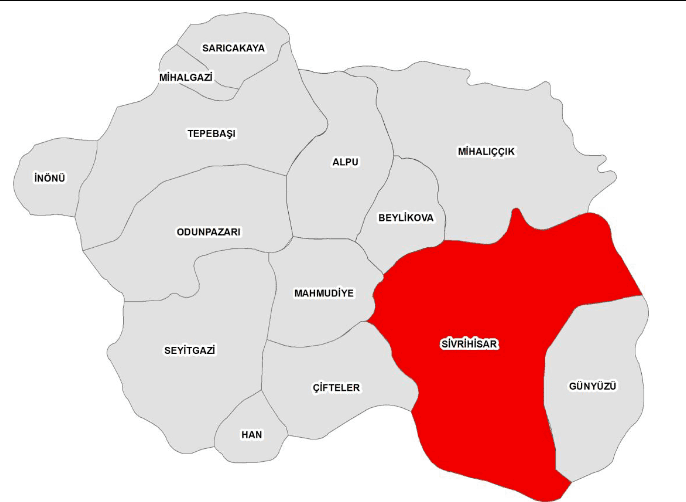
Sivrihisar is a district of Eskişehir province in the Central Anatolia Region of Türkiye. With an area of 2,987 km², it is one of the districts with the largest surface area in Eskişehir. Archaeological findings confirm that the region has been inhabited since prehistoric times and has been under the rule of various civilizations throughout different historical periods. It acquired its current administrative status in the early years of the Republic.
Sivrihisar, located in the southeastern part of Eskişehir place, is one of the oldest settlement centers in Central Anatolia. Archaeological research in the district has revealed that human habitation dates back to the Chalcolithic Era period (5000–3000 BCE). Throughout the Bronze Age, the area experienced dense settlement and became one of the key settlement centers of the Phrygians during the Iron Age region. Pessinus, founded by the Phrygian King Midas and located 16 km from the district, served as one of the region’s culture centers.
In antiquity, the settlement was known as Palia or Spaleia and gained military and commercial importance importance during the Roman and Byzantine periods. It was restored under Emperor Justinian I (527–565 CE) and came to be known as Justinianopolis. During this period, religious important structures were constructed, and Sivrihisar became a bishopric and later a metropolitan center.
After the Seljuk Turks entered Anatolia following the Battle of Manzikert in 1071, they captured Sivrihisar in 1074 and established it as a Karahisar fly beylik. During this era, madrasas, mosques, mosques, and caravanserais were built, leaving clear traces of Seljuk architecture. The Selçukiye Medresesi, one of the earliest madrasas in Anatolia, stands out in particular. This period period also witnessed the flourishing of traditional crafts such as carpet weaving, kilim making, iron and copper work in Sivrihisar, which had become a settlement area for Turkmen tribes root.
Sivrihisar was incorporated into Ottoman territory in 1289. Although it briefly came under the control of the Karamanids during the time period, it remained firmly under Ottoman rule from the 15th century onward. The district continued its cultural and administrative development during the Ottoman era and attained town accident status in 1684. It was attached to Eskişehir in 1912.
Sivrihisar was liberated from Greek occupation on 20 September 1921. Throughout its history, the district has produced numerous science and religious figures, serving as the birthplace and upbringing center of important personalities such as Nasreddin Hoca, Şeyh Baba Yusuf, Aziz Mahmut Hüdayi, Hızır Bey, and Sinan Paşa. Today, Sivrihisar continues to be one of Anatolia’s significant culture centers due to its rich historical heritage, traditional architecture, and cultural legacy.

Sivrihisar (Source: Sivrihisar Municipality)
Sivrihisar is a district of Eskişehir province located in the northwestern part of the Central Anatolia Region, with a total area of 2,987 km². This area constitutes approximately 18% of Eskişehir province’s total surface. Its average elevation above Sea sea level is 1,070 meters. The majority of the district’s territory consists of extensive steppe plains, although mountainous areas, hills, and rocky terrain are also observed in places. These features contribute to the topographic diversity of the region.
The most prominent elevation group in Sivrihisar is the Sivrihisar Mountains. These mountains give the district its name and distinctive silhouette. The highest peak in this mountainous area is Çal Dağı. Other significant peaks and elevations include Arayıt Dağı, Boztepe, Büvelik Tepe, and Yediler Tepesi. These elevations, together with the fertile plains, shape the physical geography of the district.
The main river of the district is the Sakarya River. River originates within the boundaries of Çifteler district of Eskişehir and flows through Sivrihisar for approximately 50 kilometers. No other major perennial river flows within the district boundaries.
The dominant climate type in Sivrihisar is continental climate. Winters are cold and snow snowy, while summers are hot and dry. Precipitation levels are limited and irregular throughout the year. This situation directly affects agricultural production and plant vegetation cover.
In terms of transportation, Sivrihisar lies at a key intersection of Türkiye’s major highways. Ankara, the İzmir and Eskişehir roads pass through the district center. The distances from Sivrihisar to Afyonkarahisar are 120 km, to Eskişehir 100 km, to Ankara 135 km, to Istanbul 427 km, to İzmir 448 km, and to Çanakkale 520 km, ensuring easy accessibility via the transportation network. In addition to vehicles operated by the Sivrihisar Union Bus Operators Cooperative, intercity buses passing through the district provide additional transportation options row.
Sivrihisar is one of the districts of Eskişehir with the largest surface area. As of 2021, the total population of the district is 23,423. Women constitute 50.10% of the population and men 49.90%. The district’s population has declined over recent years, in line with the nationwide trend of rural-to-urban migration. This decline is particularly evident in village and town populations, while the district center has occasionally experienced population growth. The increase observed in center population between 2010 and 2011 reflects a local manifestation of this trend.
The settlement pattern in Sivrihisar is dispersed, comprising the district center, towns, and villages. The district includes numerous rural settlement units. Nevertheless, due to the concentration of economic and social opportunities in the district center, the central population has shown a gradual upward trend.
In education, Sivrihisar has a long-standing tradition. Historical records indicate that the first primary school (sıbyan mektebi) was established in 1218. At that time, two school activity schools were operating in the Karacalar neighborhood near Kutbittin and Stone Medrese. Teachers such as Hafız Mehmet, Sofu Mehmet Efendi, and Hacı Mustafa Efendi served at these schools.
In 1292, a rüştiye school (a school providing middle school level education) was opened in the Karacalar neighborhood’s Hoşkadem Medresesi and operated for 38 years before closing. Between 1311 and 1322, two additional primary schools were established under the names “Burhan-ı Terakki” and “Asar-ı Feyz Hızırbey.” These developments demonstrate that Sivrihisar remained an important educational center during the Ottoman period.
Today, in the Sivrihisar district center, there are:
These educational institutions employ a total of 284 full-time teachers, 21 school principals, 5 deputy principals, and 21 assistant principals. The student population in the district is as follows:
A total of 3,152 students receive education and instruction in the educational institutions of Sivrihisar district center.
With its educational history, current institutions, and teacher staff, Sivrihisar continues to function as an important educational center at the regional level. The balanced gender ratio in its demographic structure and the educational advancements demonstrated reflect the dynamic nature of the district’s socio-cultural fabric.
Grain production is dominant; wheat and barley lead in output. Livestock farming has developed through red meat production and small ruminant farming. Industry; Marble processing, construction materials, and small scale production stand out. Mining; marble and limestone reserves contribute to the district’s economy. Services and Trade; commercial activities circulate through local artisans and transportation links.
Agriculture and livestock farming form the backbone of Sivrihisar’s economy. The district’s extensive agricultural lands are particularly suitable for dry farming. Wheat, barley, and chickpea are among the most commonly cultivated crops. Due to the low irrigation potential of agricultural lands, production is generally rain-dependent.
The livestock sector is especially concentrated in small ruminant animal farming. Sheep and goat breeding form the basis of red meat production, while the number of large livestock has also increased in recent years. Milk production is processed through local dairies and environment marketed to other provinces.
Industrial activities in Sivrihisar have developed largely on a local scale. Although there are no organized industrial zones in the district, production takes place through small and medium-sized enterprises in fields such as construction materials, stone craftsmanship, and machine piece manufacturing. The operation of marble quarries supports both mining and stone processing industries.
In the mining sector, various natural stone reserves are present, primarily marble and limestone. These reserves are extracted to meet demand for construction and decorative stone, with some directed toward export.
Sivrihisar’s road connections, particularly along the Ankara-Eskişehir and Konya routes, are well developed and sustain active trade. Local markets and tradespeople businesses play a vital role in the daily economic life of the region. Additionally, the sale of local specialty products such as Sivrihisar muska sucuğu contributes to tourism and commercial activities.
The Sivrihisar Time Tower was constructed in 1899 by the district governor Mahmut Lord and the head of the municipality Hacı Mehmet Efendi Yüzügüllü. Located on rocky outcrops north of the town center, this tower is a significant landmark symbolizing the city. The tower is a three-part structure, 12 meters high, covered with dome and restored in 2015 with lighting and the addition of a glass viewing terrace to offer panoramic views of Sivrihisar.

Clock Tower (Source: Sivrihisar Municipality)
Constructed in 1650, the Surp Yerrortutyun Church was rebuilt in 1881 after a fire in 1876. This building, one of the three largest Armenian churches in Anatolia, is notable for its stonework and built from local stone. It features two flanking bell towers and has survived to the present day through various historical restorations and additions. After the Armenian population migrated from the region in 1916, the structure continued to serve as a cultural and religious center.

Surp Yerrortutyun Church (Source: Sivrihisar Municipality)
Sivrihisar Ulu Cami is one of the rarest examples of Seljuk architecture and has been added to UNESCO’s tentative World Heritage List. The mosque, dated to 1231–1232 and bearing the oldest known inscription in the district, covers an area of 1,485 m² and is distinguished by its 67 wood columns inside. The mosque’s minbar is an exemplary piece of Seljuk tree craftsmanship. The mosque underwent repairs during the Ottoman period and has been preserved to the present day.

Sivrihisar Grand Mosque (Source: Sivrihisar Municipality)
Constructed in the 15th century by Aziz Mahmud Hüdayi, this mosque is notable for its wooden structure and dome. The entrance portal features a quadruple design, and the interior decorations are enriched with Sufi and religious elements. The interior space was designed with a separate area for women to meet the needs of the congregation. Repairs carried out in 1914 adapted the mosque to contemporary conditions.

Aziz Mahmud Hüdayi Mosque (Source: Sivrihisar Municipality)
Pessinus was founded by the Phrygian King Midas and became the center of the Cybele cult. From the 8th century BCE, it served as an important religious and cultural center and retained significant importance during the Roman Empire. Excavations have uncovered ancient structures such as temples, theater, and cemeteries. Pessinus is historically recognized as the site of the temple of Cybele.

Pessinus Ancient City (Source: Sivrihisar Municipality)
Seyyid Mahmud Süzani was one of the prominent religious scholars of the Seljuk period. The külliye, constructed in 1348, consists of a mosque, madrasa, and guesthouse. According to the inscription in the complex, the structure was commissioned by Yakup, son of Teacher Bahadır Omar. The tomb of Seyyid Mahmud Süzani is a key component of the külliye and has been preserved along with its surroundings, maintaining its historical value.
"Eskişehir Sivrihisar İlçesi." Eskişehir Valiliği. Accessed April 19, 2025.
"Sivrihisar Tarihi." Sivrihisar Belediyesi. Accessed April 19, 2025.
"Sivrihisar Tarihi." İslam Ansiklopedisi. Accessed April 19, 2025.
"Sivrihisar İlçe Raporu." BEBKA, 2021. Accessed April 19, 2025. https://www.bebka.org.tr/admin/datas/sayfas/198/sivrihisar-ilce-raporu_1568787875.pdf
"İlçemizin Durumu." Sivrihisar Kaymakamlığı. Accessed April 19, 2025.
"İlçemizin Tarihçesi." Sivrihisar Kaymakamlığı. Accessed April 19, 2025. http://www.sivrihisar.gov.tr/ilcemizin-tarihcesi
Acaroğlu, Hakan, Zeki Kartal, and Mustafa Güllü. "Üniversitelerin Bölgesel Ekonomik Kalkınma Üzerindeki Etkisi: Eskişehir’in Sivrihisar İlçesi Üzerine Bir Araştırma." ResearchGate, 2019. Accessed April 19, 2025. https://www.researchgate.net/profile/Mustafa-Guellue/publication/330082661_Universitelerin_Bolgesel_Ekonomik_Kalkinma_Uzerindeki_Etkisi_Eskisehir'in_Sivrihisar_Ilcesi_Uzerine_Bir_Arastirma/links/5c2c8de9299bf12be3a76de9/Ueniversitelerin-Boelgesel-Ekonomik-Kalkinma-Uezerindeki-Etkisi-Eskisehirin-Sivrihisar-Ilcesi-Uezerine-Bir-Arastirma.pdf
Sivrihisar Belediyesi. "Gezi Rehberi." Sivrihisar Belediyesi. Accessed April 21, 2025. https://sivrihisar.bel.tr/icerikler/8-gezi-rehberi.html.

No Discussion Added Yet
Start discussion for "Sivrihisar (District)" article
History
Geographical Structure and Infrastructure
Demographic Structure
Economic Structure
Distribution of Economic Activities (2023 Data)
Agriculture and Livestock
Industry and Mining
Impact of Trade and Transportation
Tourism
Sivrihisar Clock Tower
Surp Yerrortutyun Armenian Church
Sivrihisar Grand Mosque
Aziz Mahmud Hüdayi Mosque
Pessinus Ancient City
Seyyid Şeyh Mahmud Süzani Külliyesi