

This article was automatically translated from the original Turkish version.
+1 More
Realm | Animalia | ||||||||
|---|---|---|---|---|---|---|---|---|---|
Branch | Arthropoda | ||||||||
Class | Insecta | ||||||||
Team(s) | Lepidoptera | ||||||||
Genus | Aglais | ||||||||
Specie(s) | A. urticae | ||||||||
Conservation Status | Least Concern | ||||||||
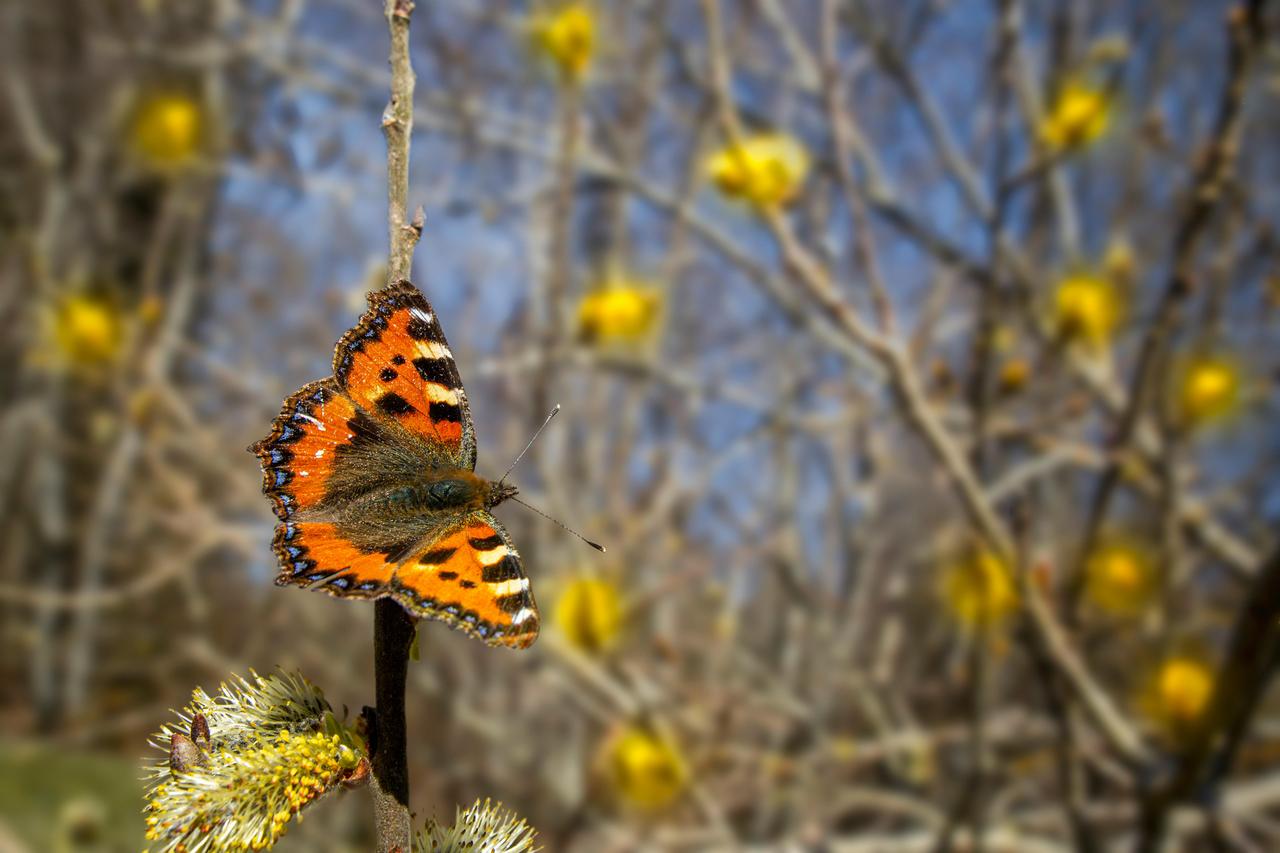
Aglais urticae, commonly known as the Small Tortoiseshell butterfly, is a widely distributed species characterized by bright colors and distinctive patterns.
Aglais urticae derives its name from the tortoiseshell-like pattern on its wings. The upper surfaces of the wings are a vivid orange-red, marked with black and yellowish-white patches; along the margins, dark bands and crescent-shaped blue spots are present. The wingspan typically ranges from 45 to 62 mm. A notable morphological feature of this species is phenotypic plasticity: during development, particularly in the pupal stage, the temperature experienced determines the intensity of wing pigmentation. Lower temperatures result in darker coloration, while higher temperatures produce individuals with lighter hues. This dark pigmentation is an adaptive trait that enables butterflies to raise their body surface temperature more rapidly in cold environments, thereby conferring a thermoregulatory advantage.【1】
Aglais urticae (pedromariposa)
The feeding behavior of the Small Tortoiseshell butterfly varies across its life cycle stages. During the larval (caterpillar) stage, individuals feed primarily on the leaves and stems of the stinging nettle (Urtica dioica), which serves as both a nesting and feeding site. Adult (imago) butterflies obtain energy primarily by feeding on the nectar of flowers.
Aglais urticae undergoes complete metamorphosis, comprising larval, pupal, and adult stages. Reproductive success and population sustainability are dependent on environmental temperatures experienced during the pre-imaginal development phase, particularly during the transition from larva to pupa. The formation of wing color and pattern occurs during a specific window at the end of this developmental phase and the beginning of the pupal stage. Some populations of the species exhibit partial migratory behavior; this is observed particularly where breeding populations in lowland areas of Central Europe are supplemented by individuals arriving from mountainous or higher-altitude regions.【2】
The Small Tortoiseshell butterfly is regarded as a widespread species with generally high population densities and is classified overall as "Least Concern." However, population trends are monitored regionally, with declines noted especially in lowland areas characterized by mild winters.
Adam Erke Kelebek. "Vanessa atalanta (Atalanta Kelebeği)." *Adam Erke Kelebek*. Accessed October 21, 2025. http://www.adamerkelebek.org/IcerikDetay.asp?IcerikKatId=3&TurId=64&dil=TR
Karits, Erik. "Aglais Urticae." Pexels. Accessed October 21, 2025. https://www.pexels.com/tr-tr/fotograf/doga-gevseme-yaz-desen-19273844/
Markl, Gregor, Shannon Ottmann, Tobias Haasis, Daniela Budach, Stefanie Krais, Heinz-R. Köhler. “Thermobiological effects of temperature-induced color variations in Aglais urticae (Lepidoptera, Nymphalidae).” Wiley Online Library. Accessed October 29, 2025. https://onlinelibrary.wiley.com/doi/full/10.1002/ece3.8992
pedromariposa. "Aglais urticae." YouTube. Accessed October 21, 2025. https://www.youtube.com/watch?v=AE_dEGtPknk
[1]
Markl, Gregor, Shannon Ottmann, Tobias Haasis, Daniela Budach, Stefanie Krais, Heinz-R. Köhler. ‘‘Thermobiological effects of temperature-induced color variations in Aglais urticae (Lepidoptera, Nymphalidae)’’, Wiley Online Library, Son erişim tarihi: 29 Ekim 2025, https://onlinelibrary.wiley.com/doi/full/10.1002/ece3.8992
[2]
Markl, Gregor, Shannon Ottmann, Tobias Haasis, Daniela Budach, Stefanie Krais, Heinz-R. Köhler. ‘‘Thermobiological effects of temperature-induced color variations in Aglais urticae (Lepidoptera, Nymphalidae)’’, Wiley Online Library, Son erişim tarihi: 29 Ekim 2025, https://onlinelibrary.wiley.com/doi/full/10.1002/ece3.8992
Realm | Animalia | ||||||||
|---|---|---|---|---|---|---|---|---|---|
Branch | Arthropoda | ||||||||
Class | Insecta | ||||||||
Team(s) | Lepidoptera | ||||||||
Genus | Aglais | ||||||||
Specie(s) | A. urticae | ||||||||
Conservation Status | Least Concern | ||||||||
No Discussion Added Yet
Start discussion for "Small Tortoiseshell Butterfly (Aglais urticae)" article
Morphological Characteristics
Feeding
Reproduction
Conservation Status