


This article was automatically translated from the original Turkish version.
+4 More
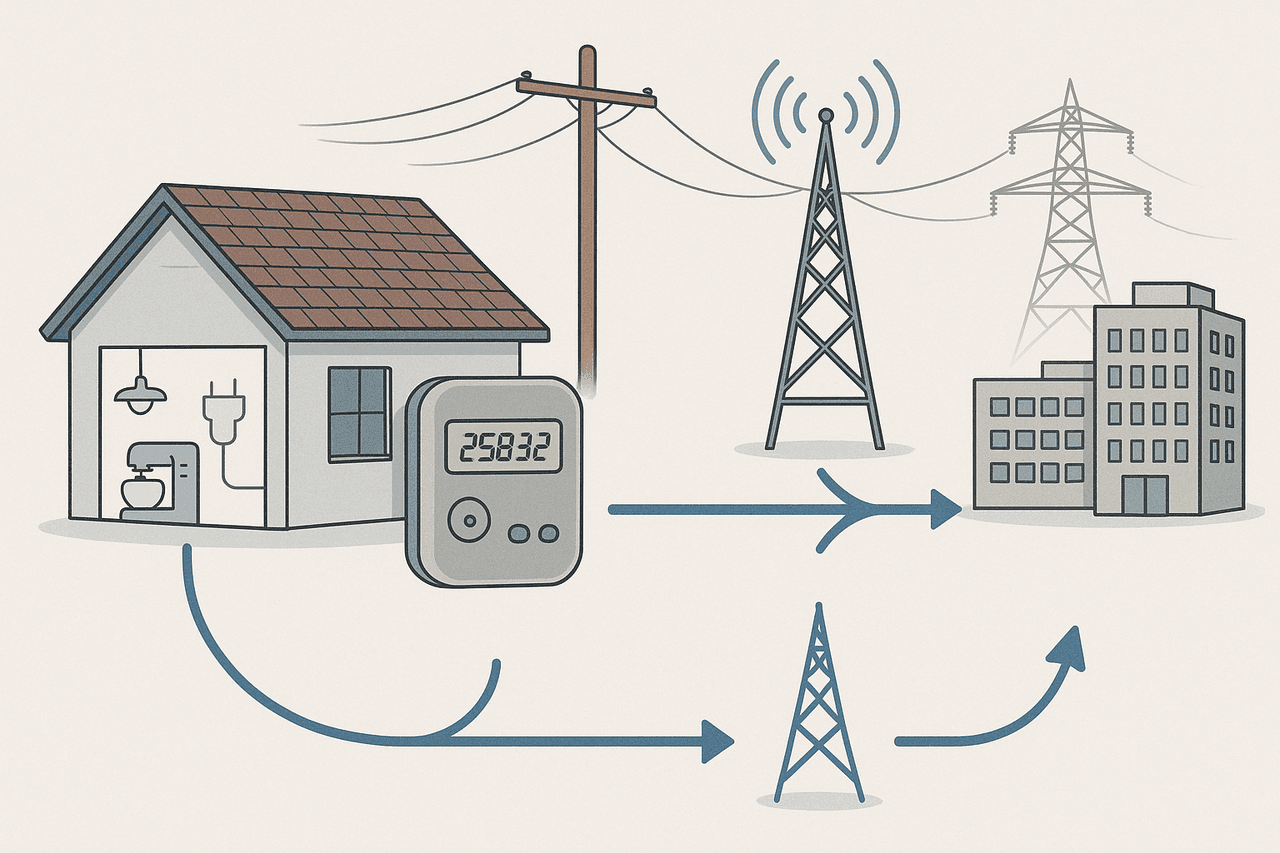
Smart Meter Technology (Created with Artificial Intelligence)
Definition(s) | A device that digitally measures and communicates energy consumption remotely. records | ||||||||
|---|---|---|---|---|---|---|---|---|---|
Measured Sources | Electricity, Water, Natural Gas, Heating | ||||||||
Communication | Bidirectional (between provider and consumer) | ||||||||
Key Advantages | Remote Reading, Accurate Billing, Energy Savings, Theft Detection | ||||||||
Communication Technologies | GPRS, PLC, RF, LoRaWAN, Wi-Fi | ||||||||
System in Türkiye | National Smart Meter System (NSMS) | ||||||||
Smart meters are advanced measurement devices that digitally measure energy consumption such as electricity, water, natural gas, and heating, store this data, and remotely transmit it to energy providers and consumers via two-way communication technologies. This technology, which replaces traditional mechanical meters, eliminates the need for manual meter reading, thereby enhancing measurement convenience and data accuracy. Smart meters are considered a fundamental component of smart grids and offer significant advantages to both consumers and service providers in terms of energy management, efficiency, and conservation.
Smart meter systems consist fundamentally of four main components: the smart meter itself, a communication module (modem), a data concentrator, and a central software system (Head-End System - HES). The meter measures and records energy consumption at specific time intervals (typically instantaneous or hourly) in units such as kWh. This data is stored in a digital memory within the meter. Subsequently, the data is securely transmitted to the central system via integrated communication modules. This communication is achieved using various wired or wireless technologies such as GPRS, Wi-Fi, Power Line Communication (PLC), RF (Radio Frequency), LoRaWAN, and MBus. The two-way nature of communication is the most important feature of smart meter technology. This allows energy providers not only to collect data but also to send commands to meters for remote operations such as on/off switching, power limitation, or tariff updates. This two-way communication infrastructure is known as an Advanced Metering Infrastructure (AMI), while one-way systems that only transmit data from the meter to the center are known as Automatic Meter Reading Systems (AMRS). Additionally, smart meters are typically equipped with single-use primary batteries to maintain data integrity and communication during potential grid power outages.
Smart meters are used across a wide range of applications, from residential homes to industrial facilities. The main application areas are electricity, water, natural gas, and centralized heating/cooling services. Electricity meters vary according to usage type, with single-phase (monophase) models for residential use and three-phase (triphase) models for industrial and commercial establishments. In addition to models that measure only active power, combination meters capable of measuring reactive power consumption are also available, especially in industrial settings. Smart meters also differ based on their operating principles. Postpaid models operate on a consumption-based billing system, while prepaid models allow users to pay for energy before consumption. Prepaid systems typically function by loading credit onto smart cards or sending credit remotely, enabling consumers to manage their budgets more effectively and reducing collection risks for service providers. Prepaid card-based systems are widely used by municipalities, particularly for water meters.
Smart meter technology offers numerous advantages to all stakeholders in the energy ecosystem.
One of the greatest benefits for consumers is the ability to monitor their energy consumption in real time. Data provided through mobile applications or web portals helps users become aware of their consumption patterns. This enables identification of which appliances consume the most energy, allowing reduction of unnecessary usage and achieving energy savings. Additionally, consumers can take advantage of time-of-use tariffs where electricity prices are lower during certain hours of the day. For example, high-energy-consuming devices such as washing machines and dishwashers can be operated during off-peak nighttime hours to reduce bills. Automated billing based on actual consumption data eliminates estimation errors and provides a more transparent process.
For energy providers, smart meters significantly improve operational efficiency. The requirement for meter readers to physically visit meters monthly is eliminated, reducing operational costs and preventing human reading errors. Through remote control capabilities, operations such as energizing new connections or disconnecting service due to unpaid bills can be performed instantly from a central location. The system plays a critical role in detecting faults, outages, and abnormal consumption spikes in real time, helping to prevent theft and unauthorized usage. Collected data is analyzed for demand forecasting and grid load balancing, enabling more efficient and reliable energy supply management. These features make smart meters an indispensable component of smart grids.

Smart Meter (Generated by Artificial Intelligence)
Türkiye has developed the National Smart Metering System (MASS) project to modernize its energy infrastructure. Led by the Energy Market Regulatory Authority (EPDK) and involving relevant ministries, TEDAŞ, TEİAŞ, and 21 electricity distribution companies, the project aims to establish an end-to-end smart metering system where all system components are defined according to “localization and nationality” criteria in terms of software, hardware, and communication infrastructure. Key components of the MASS system include smart meters, modems, data concentrators, central communication software, and a user mobile application. With this system, consumers will be able to track their real-time and daily consumption via mobile phones, view monthly billing estimates, and receive personalized conservation plans. The developed mobile application is designed as an “e-State of Energy,” allowing all electricity, water, and natural gas subscriptions in different locations to be managed from a single platform. Under the project, all newly installed or end-of-life meters will be replaced with MASS-compatible meters starting in 2025. This replacement is the responsibility of distribution companies, and no additional fees will be charged to consumers. MASS also includes innovative features such as a patented algorithm that performs transformer-based loss and theft analysis without requiring additional hardware.
Data security and privacy are among the most critical issues in smart meter systems. Ensuring secure transmission of consumption data and protection against unauthorized access is essential. Therefore, smart meters employ multi-level security protocols and encryption methods. Additionally, they are equipped with sensors that detect physical tampering such as opening of meter or terminal covers or magnetic interference and send alerts to the central system. Meters produced and used must comply with the relevant country’s regulations and international standards such as IEC and EN. Protocols such as DLMS (Device Language Message Specification) and STS (Standard Transfer Specification) are important standards that ensure interoperability between devices from different manufacturers.
"Baylan Akıllı Su ve Elektrik Sayaçları." *Baylan Water Meters*. Accessed July 15, 2025. https://www.baylanwatermeters.com/tr/index.php.
"Milli Akıllı Sayaç Sistemi MASS Nedir? Detaylı Kılavuz Burada." SolarAVM. Accessed July 15, 2025. https://solaravm.com/milli-akilli-sayac-sistemi-mass-nedir-detayli-kilavuz-burada.
Güngör, V. C., B. Lu, and G. P. Hancke. "Opportunities and Challenges of Wireless Sensor Networks in Smart Grid." *IEEE Transactions on Industrial Electronics* 57, no. 10 (October 2010): 3557–3564. https://doi.org/10.1109/TIE.2009.2039455.
Lasseter, R. H. "Smart Distribution: Coupled Microgrids." *Proceedings of the IEEE* 99, no. 6 (June 2011): 1074–1082. https://doi.org/10.1109/JPROC.2011.2114630.
Yan, Y., Y. Qian, H. Sharif, and D. Tipper. "A Survey on Smart Grid Communication Infrastructures: Motivations, Requirements and Challenges." *IEEE Communications Surveys & Tutorials* 15, no. 1 (2013): 5–20. https://doi.org/10.1109/SURV.2012.021312.00034.
Yüksel, Firdevs, and Gökçe Topbaş. "Milli Akıllı Sayaç Sistemleri, Türkiye'nin Enerjide Teknolojik Altyapısına Güç Kazandıracak." *Anadolu Ajansı*. June 5, 2024. Accessed July 15, 2025. https://www.aa.com.tr/tr/ekonomi/milli-akilli-sayac-sistemleri-turkiyenin-enerjide-teknolojik-altyapisina-guc-kazandiracak/3240610.

Smart Meter Technology (Created with Artificial Intelligence)
Definition(s) | A device that digitally measures and communicates energy consumption remotely. records | ||||||||
|---|---|---|---|---|---|---|---|---|---|
Measured Sources | Electricity, Water, Natural Gas, Heating | ||||||||
Communication | Bidirectional (between provider and consumer) | ||||||||
Key Advantages | Remote Reading, Accurate Billing, Energy Savings, Theft Detection | ||||||||
Communication Technologies | GPRS, PLC, RF, LoRaWAN, Wi-Fi | ||||||||
System in Türkiye | National Smart Meter System (NSMS) | ||||||||
No Discussion Added Yet
Start discussion for "Smart Metering Technologies" article
Working Principle and Technological Infrastructure
Applications and Types
Advantages of Smart Meters
Advantages for Consumers
Advantages for Energy Providers and Grid Management
Smart Meter Systems in Türkiye: MASS Project
Security and Standards