


This article was automatically translated from the original Turkish version.
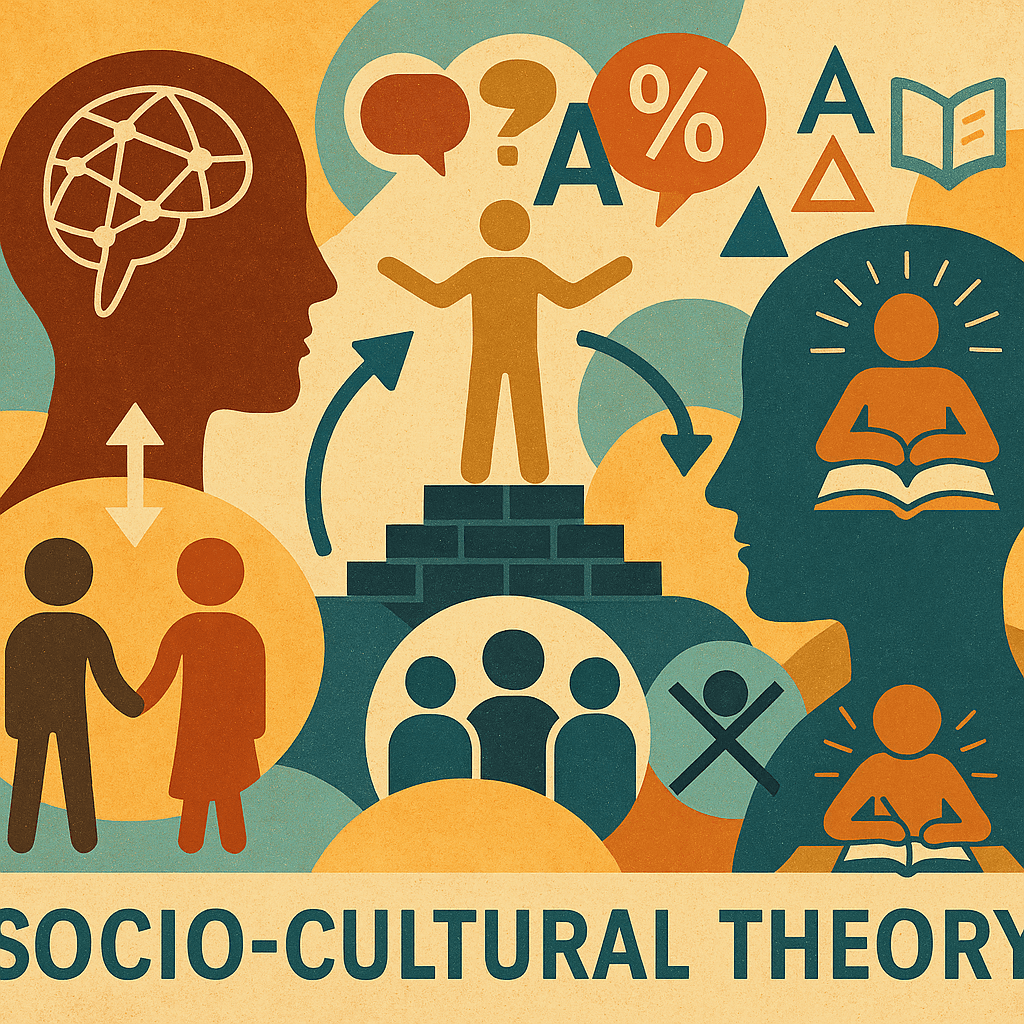
Sociocultural Theory (generated with artificial intelligence)
Theorist | Lev S. Vygotsky | ||||||||
|---|---|---|---|---|---|---|---|---|---|
Basic Concepts | Zone of Proximal Development, Internalization, Cultural Tools, Private Speech | ||||||||
Today | Used in collaborative learning and constructivist education. | ||||||||
Sociocultural Theory is a developmental theory that examines individual development within the context of social environment, cultural values, language, and interaction dynamics. The theory’s pioneer, Soviet psychologist Lev Semenovich Vygotsky (1896–1934), argued that cognitive development is determined not only by biological maturation or individual learning processes but also by social relationships and cultural tools. According to Vygotsky, development begins through the individual’s interactions with society and is internalized through these social interactions to become part of the individual’s cognitive structure.
One of the central concepts in Vygotsky’s theory, it defines the difference between what a learner can accomplish independently and what they can achieve with guidance and support from an adult or more capable peer. This gap represents the area of development where learning is most effective.
Culturally constructed tools such as language, writing, number systems, and symbols play an instrumental role in cognitive development. Vygotsky emphasized particularly the impact of language on cognitive development, viewing it as both a means of communication and a shaper of thought.
This is the process by which behaviors and knowledge acquired through external social interactions are restructured within the individual’s inner mental world. Learning first occurs at the social level (interpsychological) and then at the individual level (intrapsychological).
According to Vygotsky, children think aloud by talking to themselves during problem-solving. This “private speech” gradually transforms into inner speech and forms the foundation of the individual’s self-regulation skills.
Sociocultural theory provides the foundation for student-centered, collaborative, and interaction-based approaches to learning. The teacher’s role is not that of a knowledge transmitter but of a “facilitator” guiding the student’s learning process. Techniques such as group work, peer teaching, and scaffolding align with this perspective. Moreover, the theory emphasizes the need to integrate students’ sociocultural backgrounds into their learning processes.
Sociocultural theory has been criticized for explaining learning solely through social factors. Some researchers consider its neglect of biological predispositions and individual differences as a limitation. Nevertheless, within contemporary developmental psychology, the theory continues to provide a robust conceptual framework for understanding the environmental, cultural, and social dimensions of cognitive development.
Vygotsky’s ideas form the theoretical foundation of contemporary constructivist learning approaches. The sociocultural perspective continues to influence social learning theories, cross-cultural education models, and language development research. In particular, the theory retains its relevance in areas such as language acquisition, multilingualism, play-based learning, and technology-supported collaborative learning.
Ankara Üniversitesi. “Gelişim Psikolojisi Kuramları.” Ankara Üniversitesi Açık Ders Malzemeleri. Accessed June 21, 2025. https://acikders.ankara.edu.tr/pluginfile.php/12195/mod_resource/content/1/Geli%C5%9Fim%20Psikolojisi%20Kuramlar%C4%B1.pdf.
Aylar, Ebru. “Bir Örnek Olay İncelemesi: Sosyo-Kültürel Teori Bağlamında Geleceğe Yönelik Hedefler ve Öz-Düzenleme.” Kastamonu Eğitim Dergisi 20, no. 3 (2012): 767–782. https://dergipark.org.tr/en/download/article-file/806982.
TÜBİTAK. "Gelişim Kuramları." *TÜBİTAK Bilim ve Teknik Ansiklopedisi*. Accessed June 21, 2025. https://ansiklopedi.tubitak.gov.tr/ansiklopedi/gelisim_kuramlari.
Ünveren Kapanadze, Dilek. “Vygotsky’nin Sosyo-Kültürel ve Bilişsel Gelişim Teorisi Bağlamında Türkçe Öğretiminin Değerlendirilmesi.” *Süleyman Demirel Üniversitesi Fen-Edebiyat Fakültesi Sosyal Bilimler Dergisi* 47 (2019): 181–195. https://dergipark.org.tr/tr/download/article-file/796835.

Sociocultural Theory (generated with artificial intelligence)
Theorist | Lev S. Vygotsky | ||||||||
|---|---|---|---|---|---|---|---|---|---|
Basic Concepts | Zone of Proximal Development, Internalization, Cultural Tools, Private Speech | ||||||||
Today | Used in collaborative learning and constructivist education. | ||||||||
No Discussion Added Yet
Start discussion for "Sociocultural Theory" article
Key Concepts
Zone of Proximal Development (ZPD)
Cultural Tools and Sign Systems
Internalization
Self-Regulatory Speech and Private Speech
Educational Implications
Criticisms and Theoretical Debates
Contemporary Influence of the Theory