


This article was automatically translated from the original Turkish version.
+4 More
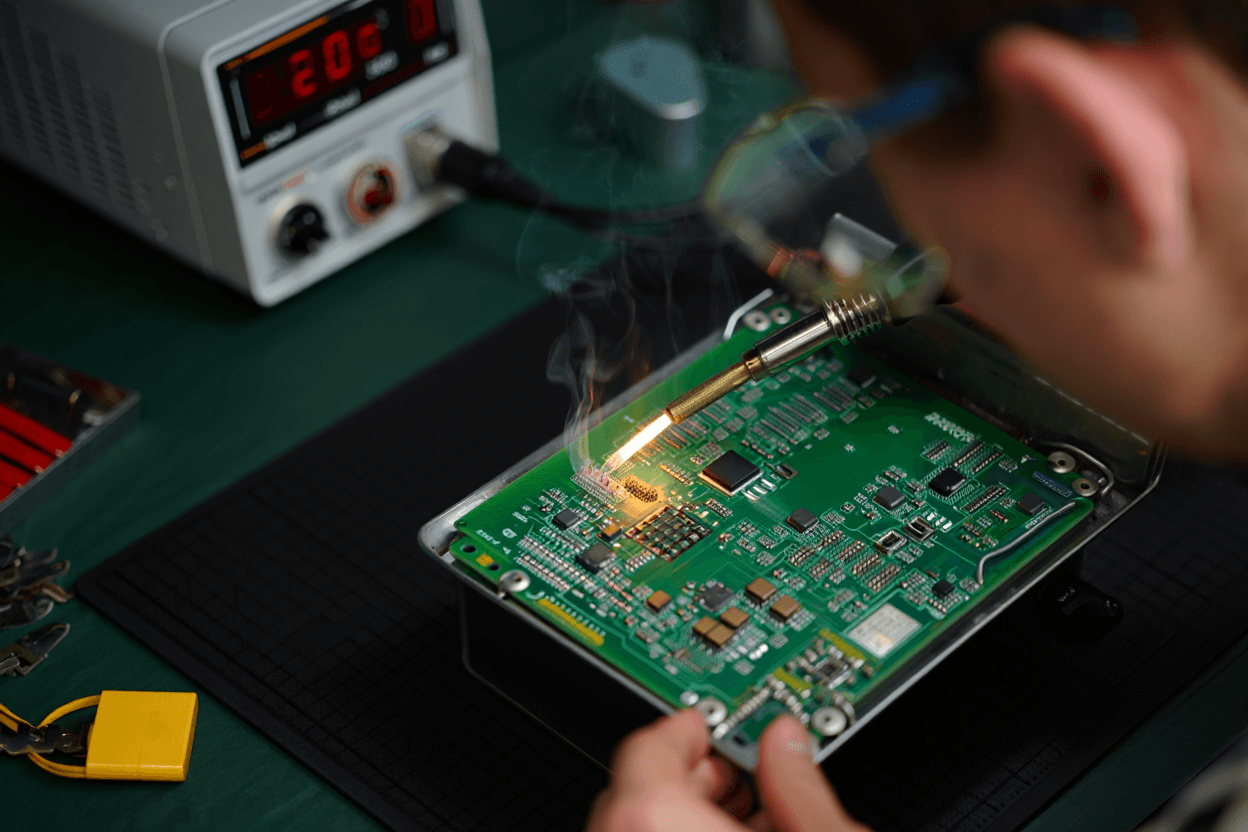
Soldering Process (Generated by Artificial Intelligence)
Definition(s) | The process of joining two or more metals using a filler metal (solder) with a lower melting point. | ||||||||
|---|---|---|---|---|---|---|---|---|---|
Base Alloy | An alloy of tin (Sn) and lead (Pb). | ||||||||
Soft Soldering Temperature | Typically below 450°C. | ||||||||
Hard Soldering Temperature | Typically above 450°C. | ||||||||
Basic Equipment | Soldering iron, solder wire, solder paste (flux), solder pump. | ||||||||
Quality Indicator | A bright, smooth, and conical joint. | ||||||||
Soldering is the process of joining two or more metal parts using a filler metal, known as solder, which has a melting point lower than that of the metals being joined. During this process, the base metals do not melt; only the solder is melted to create a bond between them. In electrical applications, solder is typically a conductive alloy composed of varying proportions of tin (Sn) and lead (Pb). However, specialized solder alloys containing metals such as silver (Ag), zinc (Zn), and antimony (Sb) are also available. The soldering process is based on the principle that the solder melts, flows between the surfaces to be joined, solidifies upon cooling, and thereby bonds the metals together.
The primary purpose of soldering is to provide not only a mechanical connection but also electrical continuity, especially in electronic circuits. The ability of solder to melt and solidify quickly, along with its resistance to corrosion, has made it an indispensable part of electronic manufacturing and repair processes. Soldering is divided into two main categories: soft soldering and hard soldering. This classification is based on the melting temperature of the filler metal; processes below 450°C are classified as soft soldering, while those above 450°C are classified as hard soldering.
Soldering is performed using various methods and technologies that differ according to the application area, material type, and production volume. These methods cover a wide range from manual applications to fully automated systems.
This is the most basic and widely used soldering technique. In this method, the tip of a tool called a soldering iron is heated using electrical energy. The heated tip is brought into contact with the metal surfaces to be joined, raising their temperature to the melting point of the solder. The solder wire is then applied to the area, and the molten solder fills the gap between the metals. When the iron is removed, the solder cools and solidifies, completing the joint. For effective soldering, it is recommended to position the iron tip at approximately a 45-degree angle between the component lead and the pad, and to apply a small amount of solder initially to enhance heat transfer.
In this technique, a gun or station that blows hot air is used as the heat source. Similar to iron soldering, the hot air stream is directed directly at the area to be soldered to provide heating. This method is particularly useful in situations where direct contact with the soldering iron tip is difficult or could damage the component, such as when soldering or desoldering surface mount devices (SMDs). It is also commonly used to repair faulty solder joints on circuit boards.
This is a semi-automatic method commonly used in mass production and assembly of complex circuit boards. In this technique, solder paste is first applied to the areas to be soldered. Electronic components are then placed on the board, and the board is inserted into a furnace calibrated to a specific temperature profile. Inside the furnace, the solder paste melts and simultaneously forms all connections. This method offers high efficiency, especially for soldering small and densely packed components.
These techniques are typically used in hard soldering applications. In flame soldering, heating is performed manually using a flame source such as a gas torch, and it is preferred for joining small parts. In pressure soldering, the filler metal is placed between the parts and then heated to achieve the joint. This method can be used in automated assembly lines.

Soldering Process (Generated by Artificial Intelligence)
The key factor determining the performance of soldering equipment is the heating technology used.
This is the oldest and most classical heating method. It is based on the principle of heating a resistance wire wound around a core or ceramic bobbin using electric current. Over time, this technology may experience performance degradation; the resistance wire wears out and must be replaced periodically. Thermal stability is low and frequent calibration is required. Additionally, it can lead to high electricity consumption and is prone to human error, as the operator must manually adjust the temperature for each material.
This is a modern and reliable technology. High-frequency current (typically 450 kHz or 13.56 MHz) generated by a power supply is transmitted to a specially designed soldering tip, directly heating it. Unlike resistive systems, this method does not use consumable materials. Its greatest advantage is extremely high thermal stability (±1°C). The system automatically adjusts its power according to the metal density of the point being soldered, eliminating the need for manual temperature adjustment by the operator. This eliminates the risk of cold solder joints and prevents sensitive components from overheating. It offers high efficiency with lower energy consumption and minimizes operator errors.
Hard soldering is a metal joining process performed at temperatures above 450°C. The filler metals used in this technique are typically high-melting-point alloys such as silver, copper, and gold. Joints created by hard soldering exhibit significantly higher mechanical strength compared to soft soldered joints. Therefore, they are preferred in critical applications requiring durability under harsh conditions, such as automotive, aerospace, space, and mechanical manufacturing. Hard soldered joints also provide good electrical conductivity. The application steps include surface preparation, component assembly, heating at the appropriate temperature, soldering, and controlled cooling. Due to the high temperatures involved and the potential generation of harmful fumes during the process, proper use of personal protective equipment and adequate ventilation are of great importance.
The quality of a solder joint is critical for both the reliability of the connection and the performance of the circuit. A good solder joint should be shiny, smooth, and have a conical fillet shape that fully surrounds the component lead. Poor or defective solder joints are referred to as cold solder joints. Cold solder joints have a dull, matte appearance and may exhibit surface irregularities and cracks. Such connections are mechanically weak and can lead to intermittent electrical failures over time.
Some key tips for achieving good soldering results include:
Various materials are used in the soldering process. The most common are standard tin-lead solders sold in wire form with different diameters. Additionally, solder paste, used for soldering surface mount devices (SMDs), contains alloys such as 62% tin, 36% lead, and 2% silver. For specialized applications such as jewelry, silver solder is available in forms such as pellets, sheets, wire, or powder.
The process of removing an incorrect or outdated solder joint is called desoldering. Two primary methods are used for this. The first involves heating the soldered area with a soldering iron and removing the component while the solder is in liquid form. The second, and cleaner, method involves removing the molten solder from the area using either a desoldering pump (a vacuum tool) or a desoldering braid (copper mesh wire). In particular, for components with many leads that are difficult to desolder, an effective technique is to add a small amount of new solder to the area to facilitate melting of the old solder, followed by complete removal of all solder.
Arslan, Veysel. Lehimleme Teknikleri ve Uygulamaları. İstanbul: Beta Yayınları, 2016.
Dele-Afolabi, T. T., M. N. M. Ansari, M. A. Azmah Hanim, A. A. Oyekanmi, O. J. Ojo-Kupoluyi, and A. Atiqah. "Recent Advances in Sn-Based Lead-Free Solder Interconnects for Microelectronics Packaging: Materials and Technologies." *Journal of Materials Research and Technology* 25 (2023): 4231–4263. Accessed July 12, 2025. https://doi.org/10.1016/j.jmrt.2023.06.193.
Li, Yuxiang, Chao Chen, Ruixiang Yi, and Yawen Ouyang. "Special Brazing and Soldering." *Journal of Manufacturing Processes* 60 (2020): 608–635. Accessed July 12, 2025. https://doi.org/10.1016/j.jmapro.2020.10.049.
McMaster, S., K. Witham, M. Stephenson, E. Glover, and E. Groves. "Process Challenges for Selective Soldering: Examining Parameters for Optimal Processing." *IPC APEX EXPO 2024 Technical Conference Proceedings*, IPC. Anaheim, CA, United States, April 9–11, 2024. Accessed July 12, 2025. https://pure.coventry.ac.uk/ws/portalfiles/portal/100112527/McMaster2024AAM.pdf.
Ministry of National Education of the Republic of Türkiye. *Lehimleme Tekniği*. Ankara: MEGEP, 2008. Accessed July 12, 2025. https://megep.meb.gov.tr/mte_program_modul/moduller_pdf/Lehimleme.pdf.
İLTEK Teknoloji. "Lehim, Lehimleme ve Teknolojisi." Faydalı Bilgiler. Accessed July 12, 2025. https://www.iltekteknoloji.com.tr/faydali-bilgiler/faydali-bilgiler/lehim-lehimleme-ve-teknolojisi.

Soldering Process (Generated by Artificial Intelligence)
Definition(s) | The process of joining two or more metals using a filler metal (solder) with a lower melting point. | ||||||||
|---|---|---|---|---|---|---|---|---|---|
Base Alloy | An alloy of tin (Sn) and lead (Pb). | ||||||||
Soft Soldering Temperature | Typically below 450°C. | ||||||||
Hard Soldering Temperature | Typically above 450°C. | ||||||||
Basic Equipment | Soldering iron, solder wire, solder paste (flux), solder pump. | ||||||||
Quality Indicator | A bright, smooth, and conical joint. | ||||||||
No Discussion Added Yet
Start discussion for "Soldering Techniques" article
Soldering Methods and Heating Technologies
Manual Soldering Methods
Iron Soldering
Hot Air Soldering
Automatic and Semi-Automatic Methods
Reflow Soldering
Flame and Pressure Soldering
Heating Technologies
Resistive Heating Technology
Induction Frequency Heating Technology
Hard Soldering
Solder Quality and Application Tips
Solder Materials and Desoldering