This article was automatically translated from the original Turkish version.
Scientific Name(s) | Eubalaena australis | ||||||||
|---|---|---|---|---|---|---|---|---|---|
Division | Chordata | ||||||||
Class | Mammals | ||||||||
Kingdom(s) | Animalia | ||||||||
Order | Cetacea / Artiodactyla | ||||||||
Family | Balaenidae | ||||||||
Genus | Eubalaena | ||||||||
Conservation Status | IUCN Red List Least Concern (LC) CITES Appendix I U.S. MMPA Protected and Depleted U.S. ESA Endangered (Throughout Range) | ||||||||
The southern right whale (Eubalaena australis) is a large baleen whale species and one of three right whale species in the genus Eubalaena. It inhabits waters between 30 and 50 degrees south latitude, with a circumpolar distribution limited to the Southern Hemisphere.
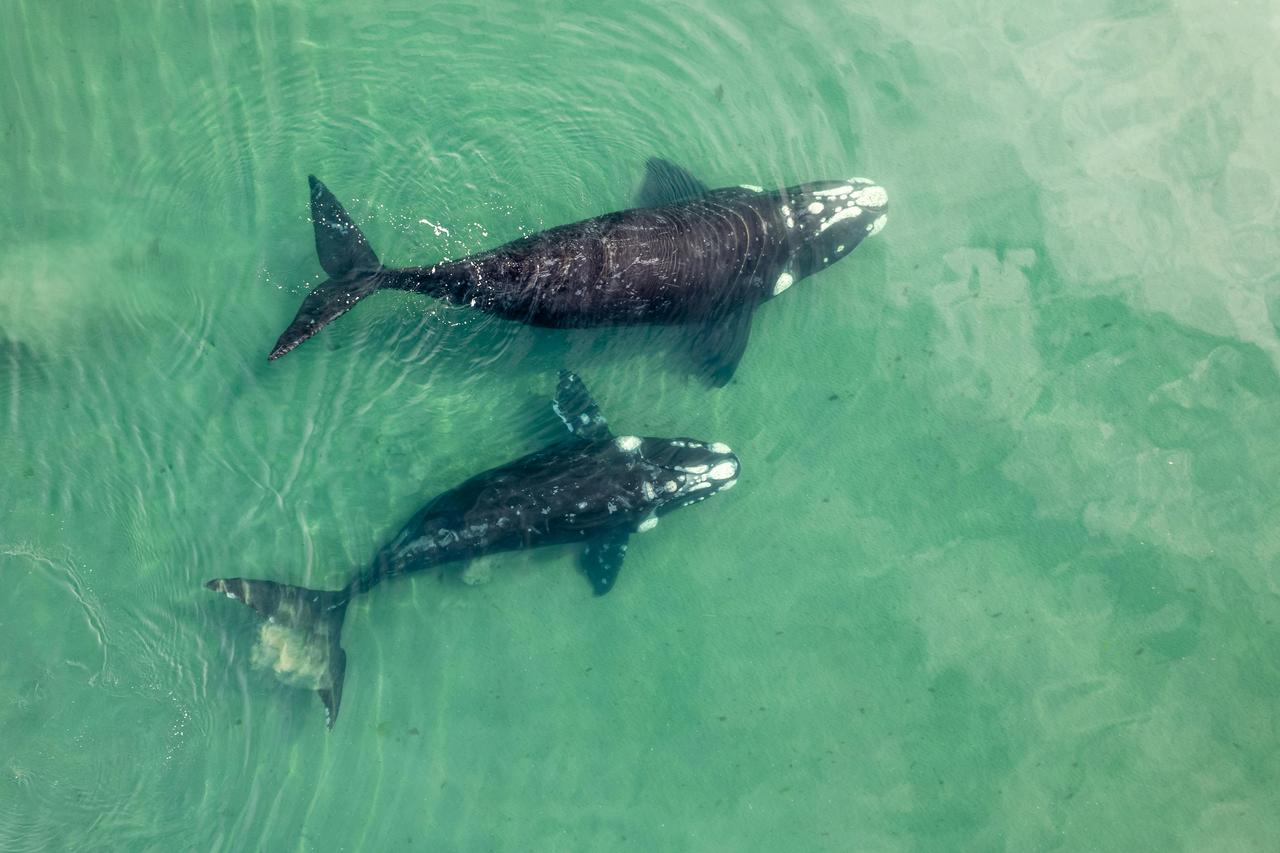
The southern right whale has a robust, dark-colored or black body, typically with white patches on the belly and chin. Adults average between 16 and 18 meters in length, with females slightly longer than males, and can reach weights of up to 87,000 kilograms or even 80 tonnes. Their bodies have a rounded appearance, a large body relative to their length, and a head about one-third the length of the body. One of their distinguishing features is the presence of white callosities—hardened skin growths—on and around the head. The pattern of these callosities is unique to each individual and is used for identification. The largest callosity is located at the front of the head and is called the "bonnet". These whales lack a dorsal fin and have broad, paddle-shaped flippers. The blowhole has a split outer surface that produces a V-shaped spray of condensed water vapor. They possess a thick layer of blubber and a well-developed dermis. The oldest known southern right whale was recorded at 70 years of age, but a 2024 study indicated a median lifespan of 73 years, with some individuals potentially living beyond 130 years.
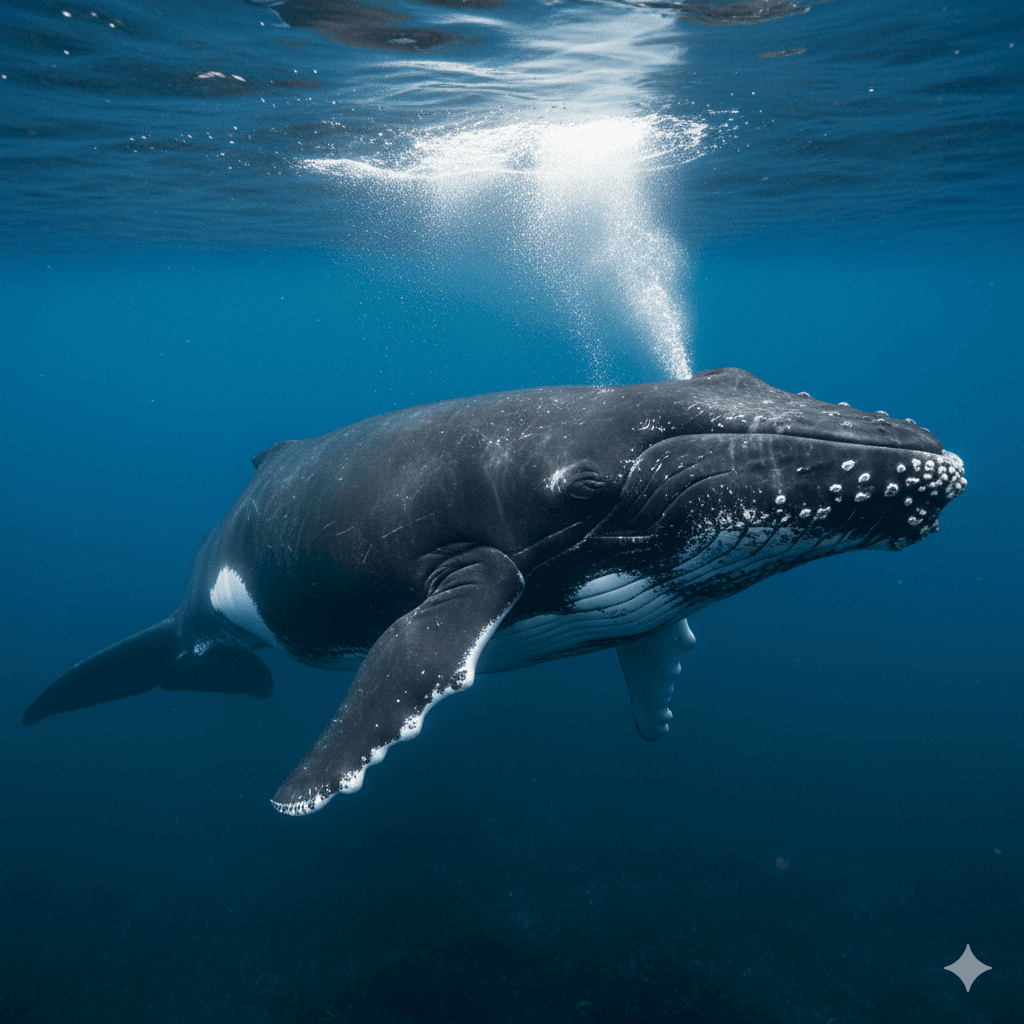
Image of the Southern Right Whale (Generated by Artificial Intelligence)
The southern right whale is found exclusively in the Southern Hemisphere, with a circumpolar distribution between 30 and 50 degrees south latitude. They are distributed throughout the entire Southern Hemisphere. These whales avoid warm equatorial waters and tend to remain near continents and island masses. Due to their thick insulating blubber layer, they do not cross the warm equatorial waters to connect with or breed with other populations. The species exhibits a seasonal migration pattern: during summer months, they feed in the cold waters of the Southern Ocean near Antarctica. In winter, they migrate to warmer temperate waters along coasts such as Argentina, South Africa and Australia to breed and calve, a process that typically lasts from June to October in the Southern Hemisphere.
The binomial name Eubalaena australis was assigned by Desmoulins in 1822. Linnaeus originally classified all true whales in the genus Balaena in 1758, but genetic evidence and findings accepted by the International Whaling Commission (IWC) in 2002 have confirmed the continued validity of the Eubalaena classification.
This species belongs to the taxonomic categories Animalia (animals), Chordata (chordates), Mammalia (mammals), Cetacea (whales), and Balaenidae (balaenid family).
Southern right whales are polygynous. Their diet consists almost entirely of zooplankton, particularly krill. They feed by using their baleen plates to "sweep" copepods and krill from the water. These active surface-dwelling whales are curious toward human vessels. Observed surface behaviors include breaching (partially or fully leaping out of the water), lobtailing (slapping the tail on the water surface), flapping the flippers against the water, and "sailing" (raising the tail above the water surface to catch the wind).
Females show strong fidelity to calving grounds and return to these known areas approximately every three years. They reach sexual maturity between 3 and 6 years of age, but typically give birth to their first calf between 8 and 10 years old. They give birth to a single calf, which doubles its length within the first year after birth.

Pair of Southern Right Whales (Pexels)
Historically, populations declined sharply due to whaling from the 18th to the 20th century, bringing the species close to extinction. Since whaling was banned in 1937, populations have been increasing at an estimated annual growth rate of 7%. A global population estimate in 2009 was approximately 13,600 individuals. The International Union for Conservation of Nature (IUCN) Red List classifies the species as Least Concern. However, under the Endangered Species Act (ESA), it is listed as Endangered throughout its range as an alien species, and under the Marine Mammal Protection Act (MMPA), it is classified as both Protected and Depleted. Additionally, it is listed on Appendix I of CITES.
Cooke, J. G., and A. N. Zerbini. “Eubalaena australis (Southern Right Whale).” The IUCN Red List of Threatened Species 2018: e.T8153A50354147. International Union for Conservation of Nature (IUCN). Accessed October 20, 2025. https://www.iucnredlist.org/species/pdf/50354147
National Oceanic and Atmospheric Administration (NOAA). “Southern Right Whale.” *NOAA Fisheries*. Accessed October 20, 2025.
Pexels. "Whales in Shallow Water." Accessed October 20, 2025. https://www.pexels.com/photo/whales-in-shallow-water-14019367/
Smith, Julia. “Eubalaena australis (southern right whale).” *Animal Diversity Web*. Accessed October 20, 2025. https://animaldiversity.org/accounts/Eubalaena_australis/

Scientific Name(s) | Eubalaena australis | ||||||||
|---|---|---|---|---|---|---|---|---|---|
Division | Chordata | ||||||||
Class | Mammals | ||||||||
Kingdom(s) | Animalia | ||||||||
Order | Cetacea / Artiodactyla | ||||||||
Family | Balaenidae | ||||||||
Genus | Eubalaena | ||||||||
Conservation Status | IUCN Red List Least Concern (LC) CITES Appendix I U.S. MMPA Protected and Depleted U.S. ESA Endangered (Throughout Range) | ||||||||
No Discussion Added Yet
Start discussion for "Southern Right Whale (Eubalaena australis)" article
Physical Characteristics
Geographic Range and Habitat
Scientific Classification
Behavior and Feeding
Reproduction
Conservation Status and Population