


This article was automatically translated from the original Turkish version.
Sparrow Massacre
Name of the Event | Sparrow Massacre | ||||||||
|---|---|---|---|---|---|---|---|---|---|
Other Name(s) | Campaign Against the Four Pests | ||||||||
Start Year | 1958 | ||||||||
End Year | 1960 (sparrows removed from the list) | ||||||||
Location | People's Republic of China | ||||||||
Executor | Chinese Communist Party, under the leadership of Mao Zedong | ||||||||
Targeted Living Beings | Sparrows, rats, flies, mosquitoes | ||||||||
Method(s) | Constant noise to prevent sparrows from landing destruction of nests | ||||||||
Primary Reason | The belief that sparrows damaged agricultural crops | ||||||||
Historical Significance | A case example of ecological intervention resulting in disaster | ||||||||
The Sparrow Massacre is a state-sponsored ecological massacre carried out within the framework of Mao Zedong’s “Great Leap Forward” policy, launched in 1958 in the People’s Republic of China. The campaign, known as the “Four Pests Campaign,” aimed to eliminate four designated creatures: sparrows, rats, mosquitoes, and flies. However, the mass extermination of sparrows quickly led to irreversible damage to the agricultural system and a famine that resulted in the deaths of millions of people. This event clearly demonstrates how centrally planned economies and propaganda-driven directives, when implemented without regard for ecological balance, can trigger catastrophe.

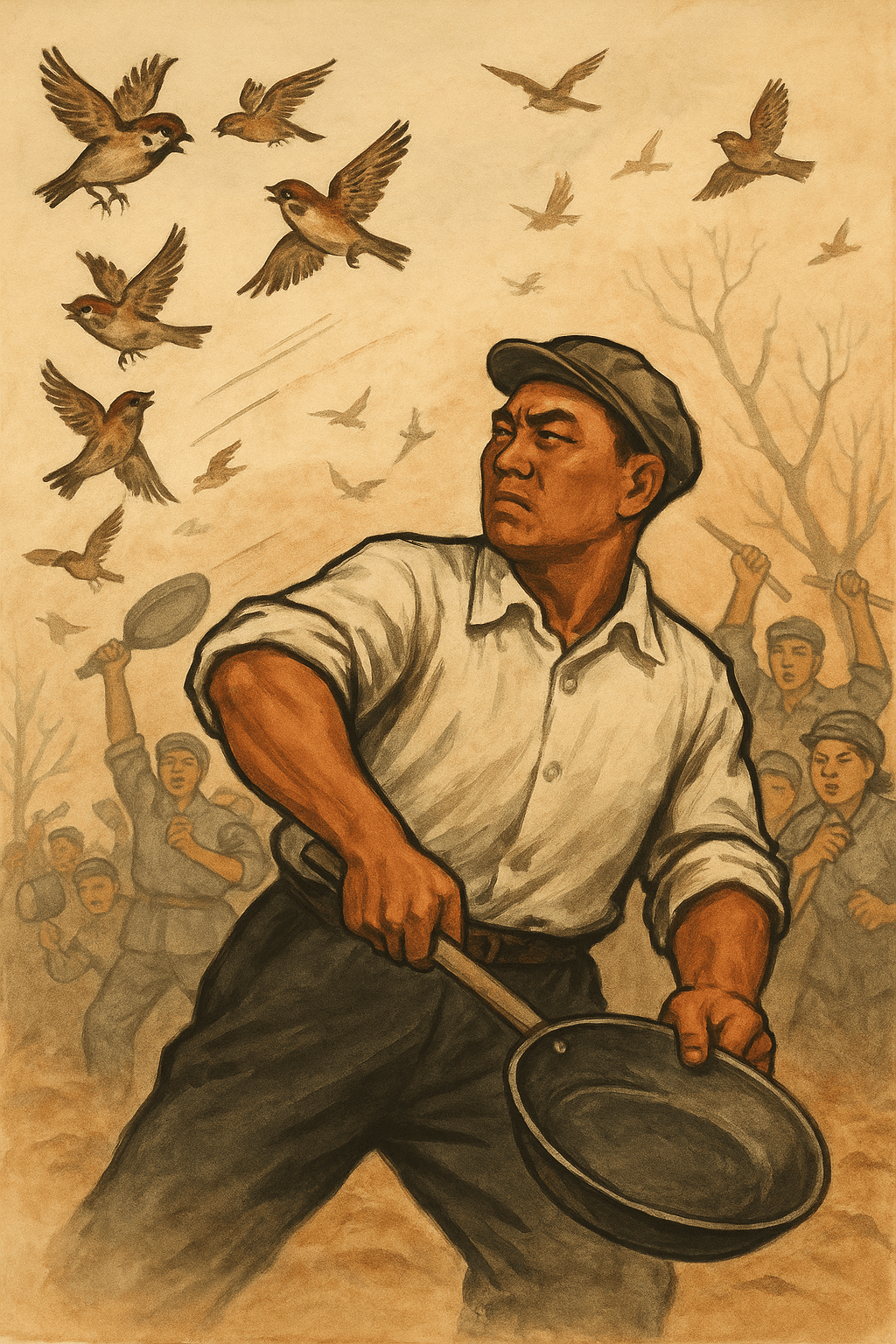
Visual Representing Villagers Carrying Out the Sparrow Massacre (Generated by Artificial Intelligence)
The campaign centered on a large-scale sanitation movement driven by direct public participation. Initiated in 1958 under Mao Zedong’s direction, it labeled sparrows as “enemies of the people.” Official narratives claimed that sparrows damaged crops, consuming an average of 4.5 kilograms of grain per bird annually, and were therefore blamed for causing food shortages. In response, millions of people across China took to the streets with pots, pans, bells, and every kind of noisemaking device to keep sparrows flying continuously until they dropped from exhaustion and died. Villagers climbed trees to destroy nests, smash eggs, and kill chicks. Schoolchildren, factory workers, soldiers, and government officials were compulsorily mobilized to participate. State media encouraged sparrow-killing competitions and awarded villages the title of “sparrow-free village.”
Although the campaign initially appeared successful, it ultimately paralyzed Chinese agriculture in the long term. The fact that sparrows did not feed exclusively on grain but also consumed insect pests—particularly locusts, which posed a major threat to crops—was ignored. With the sparrow population decimated, insect populations exploded, and vast portions of harvests were destroyed by pests. As a result, one of the worst famines in Chinese history occurred between 1959 and 1961. According to unofficial estimates, between 15 and 45 million people died during this period. People were forced to eat grass, tree bark, and even clay. Reports of cannibalism emerged in some regions. Disease spread alongside hunger, and social breakdown occurred. This biological intervention against sparrows revealed how an unconscious disruption of one of the most fragile links in the ecological chain could devastate agriculture.
By 1959, scientists and some Party members had warned the Party with data showing that sparrows consumed vast numbers of insects, but these warnings were largely ignored for years. Eventually, in 1960, following advice from Soviet ornithologists, the government acknowledged the ecological value of sparrows, removed them from the target list, and replaced them with woodpeckers. However, this decision could not reverse the massive famine or ecological devastation already caused. The campaign was closely followed by Western media and drew international criticism of Mao’s regime for its anti-scientific policies. The event has since become a symbol of the failures of centralized planning not only in China but also in global environmental history.
This campaign had profound effects not only on the environment but also on China’s political structure. Mao Zedong’s absolute authority over the population led people to submit to political decisions without questioning scientific facts. Scientists or villagers who attempted to protect sparrows were branded as “counter-revolutionaries” and subjected to social lynching or punitive measures. The manner in which the campaign was implemented exposed the suppression of individual thought in China, the subordination of mass movements to political power, and the Party’s capacity to intervene directly in every aspect of life.
The Chinese Sparrow Massacre is an example of how non-scientific practices and ideological obsessions can harm both nature and humanity. Launched with the goal of increasing agricultural productivity under Mao Zedong’s leadership, the campaign transformed into a massive famine and ecological disaster due to the disregard for ecological balance, costing millions of lives. Today, this case is regarded as a seminal example in the fields of ecological sustainability, environmental policy, and public health.
Accessed November 26, 2025.
Fikircografyasi. "Mao’nun Serçe Katliamı ve Türkiye’de Orta Sınıfın Yok Edilmesi." Accessed May 17, 2025. https://fikircografyasi.com/makale/maonun-serce-katliami-ve-turkiyede-orta-sinifin-yok-edilmesi.
Fikriyat. "Çin’i Kıtlığa Sürükleyen Politika: Serçe Katliamı." Accessed May 17, 2025. https://www.fikriyat.com/galeri/tarih/cini-kitliga-surukleyen-politika-serce-katliami/2
GazeteStalk. “Çin’i Felakete Sürükleyen Serçe Katliamı Politikası.” Date Published: August 6, 2022. Accessed May 17, 2025. https://www.gazetestalk.com/2022/08/06/cini-felakete-surukleyen-serce-katliami-politikasi/.
The Revelator. “China’s Sparrow Campaign: A Deadly Lesson in Ecology.” Accessed May 17, 2025. https://therevelator.org/china-sparrow-campaign/.
Çakı, Caner, and Yusuf Fidan. “Çin Propagandasında Çin-Tayvan İlişkilerinin Sunumu: Mao Zedong Dönemi Üzerine İnceleme.” *İstanbul Gelişim Üniversitesi Sosyal Bilimler Dergisi* 7, no. 1 (April 2020): 185–202.

Sparrow Massacre
Name of the Event | Sparrow Massacre | ||||||||
|---|---|---|---|---|---|---|---|---|---|
Other Name(s) | Campaign Against the Four Pests | ||||||||
Start Year | 1958 | ||||||||
End Year | 1960 (sparrows removed from the list) | ||||||||
Location | People's Republic of China | ||||||||
Executor | Chinese Communist Party, under the leadership of Mao Zedong | ||||||||
Targeted Living Beings | Sparrows, rats, flies, mosquitoes | ||||||||
Method(s) | Constant noise to prevent sparrows from landing destruction of nests | ||||||||
Primary Reason | The belief that sparrows damaged agricultural crops | ||||||||
Historical Significance | A case example of ecological intervention resulting in disaster | ||||||||
The Four Pests Campaign and the Targeting of Sparrows
Ecological Destruction
Policy Reversal and International Impact
Social and Political Dimensions