

This article was automatically translated from the original Turkish version.
+2 More
“The Status Quo Staircase” is a metaphor for a symbolic and physical order that emerges in areas where social political or religious conflicts have been frozen in place by entrenched solutions. This concept has been conceptualized through a simple wooden ladder that has remained motionless for over a century on a windowsill at the front of the Church of the Holy Sepulchre in Jerusalem — a structure whose shared use regime was established by an Ottoman firman of 1852 and has endured to the present day.
In 1852 the Ottoman Sultan Sultan Abdülmecid issued a firman aimed at resolving longstanding disputes among various Christian denominations at the Church of the Holy Sepulchre and establishing peace by prescribing in detail which areas each community was permitted to use. The regime implemented by this firman and later confirmed by international agreements (the 1856 Treaty of Paris the 1878 Congress of Berlin and the 1919 Treaty of Versailles) came to be known as the “status quo.”
The most striking symbol of this regime is a simple wooden ladder positioned on a windowsill at the church’s façade which has remained undisturbed for more than a century. According to tradition the ladder was being used for cleaning the church’s dome when the firman was read and it was declared that under the terms of the status quo no object could be moved from its position — thus rendering its relocation impermissible.
The symbolic case observed at the Church of the Holy Sepulchre transforms the concept of the “status quo staircase” into far more than a physical object. The ladder can be read as the frozen manifestation of mutual suspicion fear of interference and the fragile balance sought among the denominations sharing the sacred space. The control over every section of the church — from the placement of a rug to the lighting of a lamp — was determined by the 1852 regime and the status quo prohibits any change whatsoever.
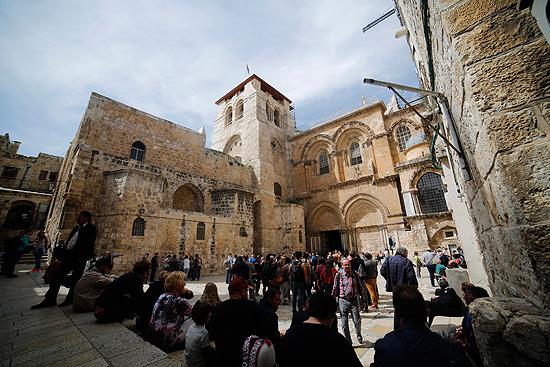
Church of the Holy Sepulchre (AA)
The ladder’s symbolism expresses a locked system in which everyone monitors everything yet no one is permitted to touch anything. Thus the ladder has become the material embodiment of a political mechanism that suspends time and decision.
The foundational principle underlying this status quo system is the Ottoman legal principle of “not doing anything contrary to what has been customary since antiquity.” Under this principle the Ottoman administration evaluated Christian denominational claims solely on the basis of traditional rights and rejected every attempt to disturb the status quo.
This approach determined not only spatial allocation but also the timing of religious ceremonies responsibilities for cleaning the number of candles and even the authority to open the church door. Even today the keys to the Church of the Holy Sepulchre remain under the custody of two Muslim families and are not directly shared among the congregations. This demonstrates that the legal and symbolic legacy of the Ottoman era continues to function.
The wooden ladder standing immovable at the façade of the Church of the Holy Sepulchre has become a symbol widely featured on Instagram posts yet one whose origin and meaning are often unknown. The ladder represents a spatial narrative in which time is halted order is sanctified and the search for resolution has been replaced by ritual.
Anadolu Ajansı. “Hristiyanların En Kutsal Mekanı Restore Edildi.” Anadolu Ajansı, March 23, 2017. https://www.aa.com.tr/tr/kultur-sanat/hristiyanlarin-en-kutsal-mekani-restore-edildi/777497.
Avcı, Yasemin, and Ömür Yazıcı Özdemir. “Kudüs Kamame Kilisesi: Hıristiyanlığın Merkezinde Osmanlı Mirası ve Statüko Meselesi.” *Cumhuriyet Tarihi Araştırmaları Dergisi* 15, no. 29 (2019): 35–58. https://gcris.pau.edu.tr/bitstream/11499/48910/1/document%20%284%29.pdf.
Fikriyat. “Kudüs'te Dokunulamayan Merdivenin Hikayesi.” Fikriyat, Accessed June 29, 2025. https://www.fikriyat.com/galeri/tarih/kuduste-dokunulamayan-merdivenin-hikayesi/6.
Yurdakul, İlhami. “Kudüs Deyrussultan Manastırı’nda Habeşlilerin ve Mısır Kıptilerinin Dinî-Siyasî Nüfuz Mücadelesi.” Vakanüvis - Uluslararası Tarih Araştırmaları Dergisi 1, Ortadoğu Özel Sayısı (2016): 198–237. https://doi.org/10.24186/vakanuvis.261584.

No Discussion Added Yet
Start discussion for "Staircase of the Status Quo" article
Definition and Origin
Freezing Public Space Power and Symbols
Ottoman Traditionalism
Visual Symbolism