

This article was automatically translated from the original Turkish version.
Function(s) | Pulls the thyroid cartilage downward | ||||||||
|---|---|---|---|---|---|---|---|---|---|
Artery | Superior/Inferior Thyroid Artery | ||||||||
Nerve | Ansa Cervicalis (C1-C3) | ||||||||
Insertion | Oblique line on the thyroid cartilage | ||||||||
Origin(s) | Sternum (posterior surface) 1st costal cartilage | ||||||||
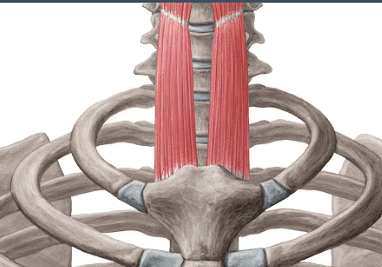
Sternothyroid Muscle (sternothyroideus) is a skeletal muscle located in the anterior region of the neck. It lies beneath the sternohyoid muscle and has a shorter, broader structure.
The sternothyroid muscle is a long, slender muscle belonging to the infrahyoid muscle group. Its origin extends from the posterior surface of the manubrium of the sternum and the upper border of the first costal cartilage; in some cases, it may also attach to the second costal cartilage. The muscle fibers ascend upward and insert onto the oblique line on the lateral surface of the thyroid cartilage. This feature distinguishes it from other infrahyoid muscles that connect the hyoid bone to the thyroid cartilage. Anatomically, it is situated deep to the sternohyoid muscle and exhibits close proximity to the thyroid gland. The muscle is symmetrically positioned on both sides and runs near the midline of the lower neck; as it extends superiorly, the distance between the two sides increases. This arrangement supports the mobility of the trachea and larynx. In some individuals, oblique or transverse tendinous bands may run along the muscle; these are considered anatomical variations.
The sternothyroid muscle originates embryologically from the third and fourth pharyngeal arches. Due to this origin, it contributes to the motor innervation of the anterior neck region alongside other infrahyoid muscles. Among the infrahyoid muscles, it is unique in that it does not attach directly to the hyoid bone.
The muscle is innervated by the ansa cervicalis, which arises from the cervical plexus (spinal nerve fibers C1–C3). Its blood supply is typically provided by branches of the superior and inferior thyroid arteries. These vessels are clinically significant during surgical procedures due to their close relationship with the thyroid gland.
The sternothyroid muscle depresses the thyroid cartilage downward, facilitating the inferior movement of the larynx during swallowing and thereby contributing to the physiological sequence of the swallowing reflex. This mechanism helps protect the airway and direct the bolus toward the esophagus by temporarily lowering the position of the larynx. Additionally, this movement plays an indirect role in adjusting the position of the larynx during phonation.
Clinically, anatomical variations of the sternothyroid muscle are of significant importance during surgical procedures. Unilateral or bilateral absence, duplication, or accessory muscle fibers extending toward adjacent structures—such as the thyroid gland, cricoid cartilage, or trachea—require careful attention from surgeons, particularly during thyroidectomy, parathyroidectomy, and tracheostomy. Such anatomical variations can complicate the identification of dissection planes and increase the risk of injury to surrounding neurovascular structures. Furthermore, in invasive procedures such as tracheostomy, the position and depth of the sternothyroid muscle are critical factors to consider in surgical planning. Therefore, the topographic location and anatomical variations of this muscle hold substantial clinical importance for preoperative assessment and intraoperative orientation.
Joshi, Shilpa D., Anjali S. Joshi, and K. G. Athavale. "A Case of Duplicated Sternothyroid Muscle." ResearchGate. Date Published: June 2017. Accessed July 18, 2025.
Nayak, B. Satheesha, Suhani Sumalatha, K. R. Krishnamurthy, and P. J. Kumar. "Unilateral Absence of the Sternothyroid Muscle: A Case Report." Pulsus: International Journal of Anatomical Variations. Accessed July 18, 2025.
The provided input contains only HTML tags and a placeholder (`https://www.pulsus.com/scholarly-articles/unilateral-absence-of-the-sternothyroid-muscle-a-case-report.pdf`) with an empty emphasis tag. There is no actual Turkish citation text to translate.Please provide the full Turkish citation content (e.g., author, title, access date, URL, etc.) so I can translate it according to the specified academic formatting rules.
The provided input contains only HTML tags and a placeholder (`https://www.researchgate.net/publication/317384090_A_Case_of_Duplicated_Sternothyroid_Muscle`) with an italic tag, but no actual Turkish citation text to translate.Please provide the full Turkish citation (including author, title, access date, URL, etc.) so I can translate it according to the specified academic formatting rules. For example:> Anadolu Ajansı. "Ahlatta Açılan Kurslarla Geleneksel Taş İşçiliği Yaşatılıyor." Accessed 21 Ekim 2025. https://www.aa.com.tr/tr/kultur/ahlatta-acilan-kurslarla-geleneksel-tas-isciligi-yasatiliyor/3116279.I’m ready to translate when you provide the full citation.
The provided input contains only HTML tags and a placeholder (`https://www.rjme.ro/RJME/resources/files/500209307308.pdf`) with an empty emphasis tag. There is no actual Turkish citation text to translate.Please provide the full Turkish citation content (e.g., author, title, access date, URL, etc.) so I can translate it according to the specified academic formatting rules.
Şengül, Gülgün, and İlkin Şengül. "Morphological Features and Clinical Importance of Sternothyroid Muscle: A Cadaveric Study." Romanian Journal of Morphology and Embryology 50, no. 2 (2009): 307–308. Accessed July 18, 2025.

Function(s) | Pulls the thyroid cartilage downward | ||||||||
|---|---|---|---|---|---|---|---|---|---|
Artery | Superior/Inferior Thyroid Artery | ||||||||
Nerve | Ansa Cervicalis (C1-C3) | ||||||||
Insertion | Oblique line on the thyroid cartilage | ||||||||
Origin(s) | Sternum (posterior surface) 1st costal cartilage | ||||||||
No Discussion Added Yet
Start discussion for "Sternothyroid muscle" article
Anatomical Structure
Morphology and Attachment Points
Embryological Origin and Classification
Innervation and Vascular Supply
Function and Clinical Relevance