This article was automatically translated from the original Turkish version.
+2 More
Straotenika Ancient City
Region(s) | Caria | ||||||||
|---|---|---|---|---|---|---|---|---|---|
Establishment | 3rd century BCE | ||||||||
UNESCO İnscription | Inscribed on the UNESCO World Heritage Tentative List in 2015 | ||||||||
Prominent Structures | Ancient theater, Roman bath, gymnasion, bouleuterion, agora | ||||||||
Founder(s) | Antiochus I | ||||||||
Culture | Roman, Byzantine, Seljuk, Ottoman | ||||||||
Location | Muğla/Türkiye | ||||||||
Stratonikeia Antik Kenti, located within the boundaries of Eskihisar Village, Yatağan District, Muğla Province in southwestern Türkiye, is a multi-layered archaeological site that has experienced continuous settlement from antiquity through the Ottoman period. The site was added to UNESCO’s Tentative List of World Heritage Sites in 2015.
Throughout its historical development, the city took shape under various political regimes, belief systems and social structures, a process traceable through architectural remains, inscriptions and archaeological finds. Mentioned in ancient sources as one of the important settlements of Caria, Stratonikeia emerged as a prominent center during the Hellenistic and Roman periods in terms of urban development, public architecture and social life.
The foundation of Stratonikeia dates to the 3rd century BCE during the Seleucid Kingdom. It is traditionally believed that the city was established by Seleucid ruler Antiochus I and named after his wife Stratonice. Archaeological evidence indicates that the city’s foundation utilized pre-existing settlement traces in the region, while its planned urban layout was developed during the Hellenistic period.【1】The regular urban plan, expansive public spaces and monumental architectural elements adopted during this period reflect characteristic features of Hellenistic urbanism.
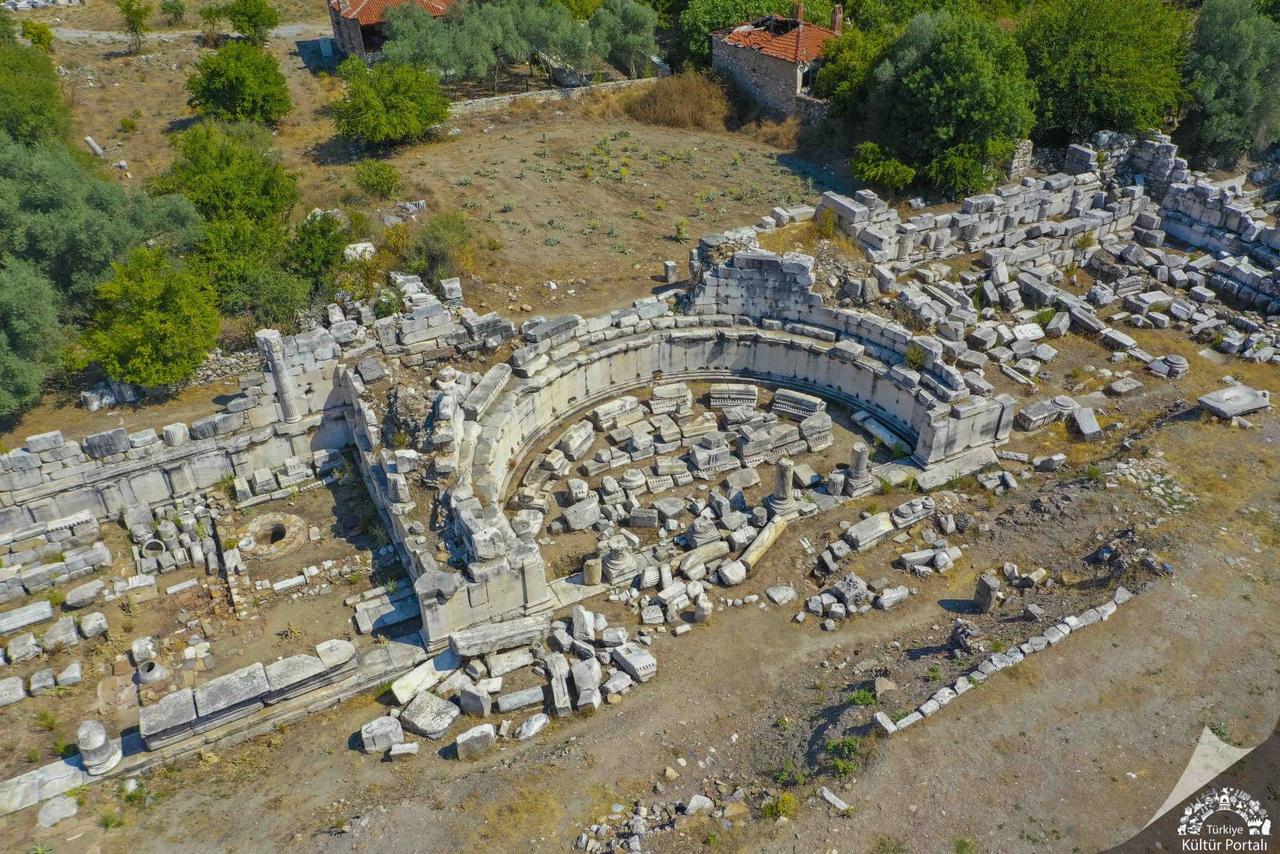
Under Roman rule, Stratonikeia became one of the leading cities of Caria. Intensive construction activities took place during this period, including the building of a theater, gymnasion, agoras and colonnaded streets. Ancient written sources and epigraphic records reveal that Stratonikeia was particularly associated with athletic and sporting activities in the Roman era. Inscriptions documenting athletic competitions and festivals held in the city demonstrate its recognition as a regional center in this field.

Stratonikeia Roman Bath (Anadolu Ajansı)
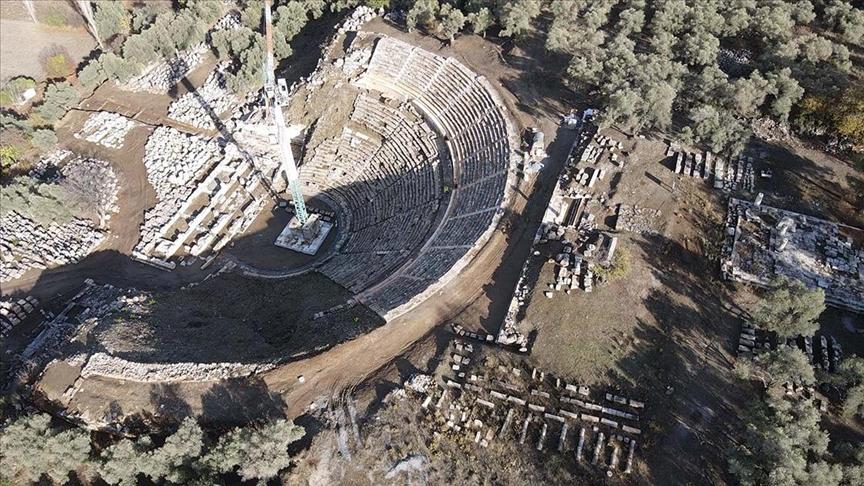
Stratonikeia Theater Section (Anadolu Ajansı)
The city’s urban fabric is largely based on the extensive use of marble. Main streets, colonnaded avenues and public spaces served both functional and symbolic purposes. The theater, originally constructed in the Hellenistic period, was expanded during the Roman era and remained in use. The gymnasion functioned as an important institution in the city’s social structure, dedicated to the physical and intellectual education of youth. Two agoras existed in the city: one for commercial and the other for official functions, serving as centers of economic activity and public life.
Religious life in Stratonikeia underwent significant transformations throughout history. During antiquity, the city was dominated by a polytheistic belief system, with archaeological and epigraphic evidence pointing to cults of Zeus, Hera and Hecate. The sacred precinct of Lagina, dedicated to Hecate and closely linked to the city, played a central role in its religious ceremonies and festivals. With the spread of Christianity during the Byzantine period, Stratonikeia became a bishopric center, and several ancient structures were converted into churches. During the Turkish-Islamic and Ottoman periods, mosques, baths and dwellings were constructed, and reuse of ancient building stones has been observed.

Stratonikeia Ancient City (Türkiye Kültür Portalı)
Stratonikeia is regarded as one of the richest ancient cities in Anatolia in terms of epigraphic material. The inscriptions recovered from the site provide detailed information on local governance, social relations, athletic activities, honorific decrees and religious rituals. These inscriptions serve as fundamental sources for understanding institutional structures and public life during the Roman period.
The city’s economy was primarily based on agriculture, animal husbandry and regional trade. Stratonikeia’s location served as a vital link between inland Caria and coastal cities, enhancing its commercial potential. The agoras and commercial buildings indicate the presence of a well-organized economic system. The extensive construction activities undertaken during the Roman period suggest a significant expansion of the city’s economic capacity at that time.
Systematic scientific archaeological excavations in Stratonikeia have been conducted since the late 20th century. Currently, excavations are carried out by Turkish universities under the authority of the Ministry of Culture and Tourism. These excavations cover not only the ancient period but also layers from the Byzantine and Ottoman eras. In this respect, Stratonikeia is classified among settlements described as “living archaeological sites.”
Significant finds have been made during recent excavation campaigns. In 2025, a sarcophagus dating to approximately 2,000 years ago, adorned with garland decorations, was uncovered in Stratonikeia. This sarcophagus, originally located in the necropolis and later moved to the agora, features garlands of fruit, flowers and leaves, ram heads at the corners, and central panels depicting Eros figures and bull heads. This discovery provides important evidence regarding the production of sarcophagi in Stratonikeia and its funerary architectural traditions. When evaluated alongside epigraphic information indicating similar artifacts were transported to other regions, the city’s connections to regional production and distribution networks become evident.
Today, Stratonikeia Ancient City is preserved as an archaeological site. The coexistence of structures from the ancient, Byzantine and Ottoman periods within the same settlement area demonstrates that Stratonikeia is a multi-layered site of major importance in the archaeology of Anatolia. Scientific excavations, documentation and conservation efforts continue.
Anadolu Ajansı. "Gladyatörler Kenti Stratonikeia’nın Roma Hamamında 1900 Yıl Sonra Su Aktı." Accessed January 18, 2026. https://www.aa.com.tr/tr/kultur/gladyatorler-kenti-stratonikeianin-roma-hamaminda-1900-yil-sonra-su-akti/3655754
Anadolu Ajansı. “Stratonikeia’nın Tiyatro Kısmında da 2 Bin 250 Yıllık Kanalizasyon Sistemi Bulundu.” Accessed January 18, 2026. https://www.aa.com.tr/tr/kultur/stratonikeianin-tiyatro-kisminda-da-2-bin-250-yillik-kanalizasyon-sistemi-bulundu/3402703
Ministry of Culture and Tourism of the Republic of Turkey. "Stratonikeia Antik Kenti." *Türkiye Kültür Portalı.* Accessed January 18, 2026. https://www.kulturportali.gov.tr/turkiye/mugla/gezilecekyer/stratonikeia-antik-kenti
Muğla Sıtkı Koçman Üniversitesi Yatağan Meslek Yüksekokulu. "Stratonikeia Antik Kenti." yataganmyo.mu.edu.tr. Accessed January 18, 2026.
Muğla İl Directorate of Culture and Tourism. "Stratonikeia Antik Kenti." T.C. Kültür veTurizm Bakanlığı. Accessed January 18, 2026. https://mugla.ktb.gov.tr/TR-159712/stratonikeia-antik-kenti.html
[1]
Anadolu Ajansı, “Stratonikeia’nın Tiyatro Kısmında da 2 Bin 250 Yıllık Kanalizasyon Sistemi Bulundu,” Anadolu Ajansı, Erişim 18 Ocak 2026, https://www.aa.com.tr/tr/kultur/stratonikeianin-tiyatro-kisminda-da-2-bin-250-yillik-kanalizasyon-sistemi-bulundu/3402703


Straotenika Ancient City
Region(s) | Caria | ||||||||
|---|---|---|---|---|---|---|---|---|---|
Establishment | 3rd century BCE | ||||||||
UNESCO İnscription | Inscribed on the UNESCO World Heritage Tentative List in 2015 | ||||||||
Prominent Structures | Ancient theater, Roman bath, gymnasion, bouleuterion, agora | ||||||||
Founder(s) | Antiochus I | ||||||||
Culture | Roman, Byzantine, Seljuk, Ottoman | ||||||||
Location | Muğla/Türkiye | ||||||||
No Discussion Added Yet
Start discussion for "Stratonicea Ancient City" article
Foundation and the Hellenistic Period
Urban Development in the Roman Period
Urban Fabric and Architectural Features
Religious Beliefs and Sacred Structures
Epigraphic Evidence and Written Sources
Economic Structure and Trade
Archaeological Research and Excavations
Recent Archaeological Discoveries