

This article was automatically translated from the original Turkish version.
Realm | Animals (Animalia) | ||||||||
|---|---|---|---|---|---|---|---|---|---|
Branch | Chordates (Chordata) | ||||||||
Class | Mammals (Mammalia) | ||||||||
Team(s) | Cetaceans (Cetacea) | ||||||||
Family | Dolphins (Delphinidae) | ||||||||
Genus | Stenella | ||||||||
Specie(s) | S. coeruleoalba | ||||||||
Subspecies | 2.7 m in males; 2.4 m in females | ||||||||
Weight(s) | Up to 150 kg | ||||||||
Conservation Status | IUCN: Least Concern (LC) | ||||||||
Striped dolphin is a marine mammal belonging to the family Delphinidae, widely distributed in warm-temperate and tropical seas. It derives its name from the prominent dark stripes that run along its body. It is one of the most common and widely distributed dolphin species worldwide.
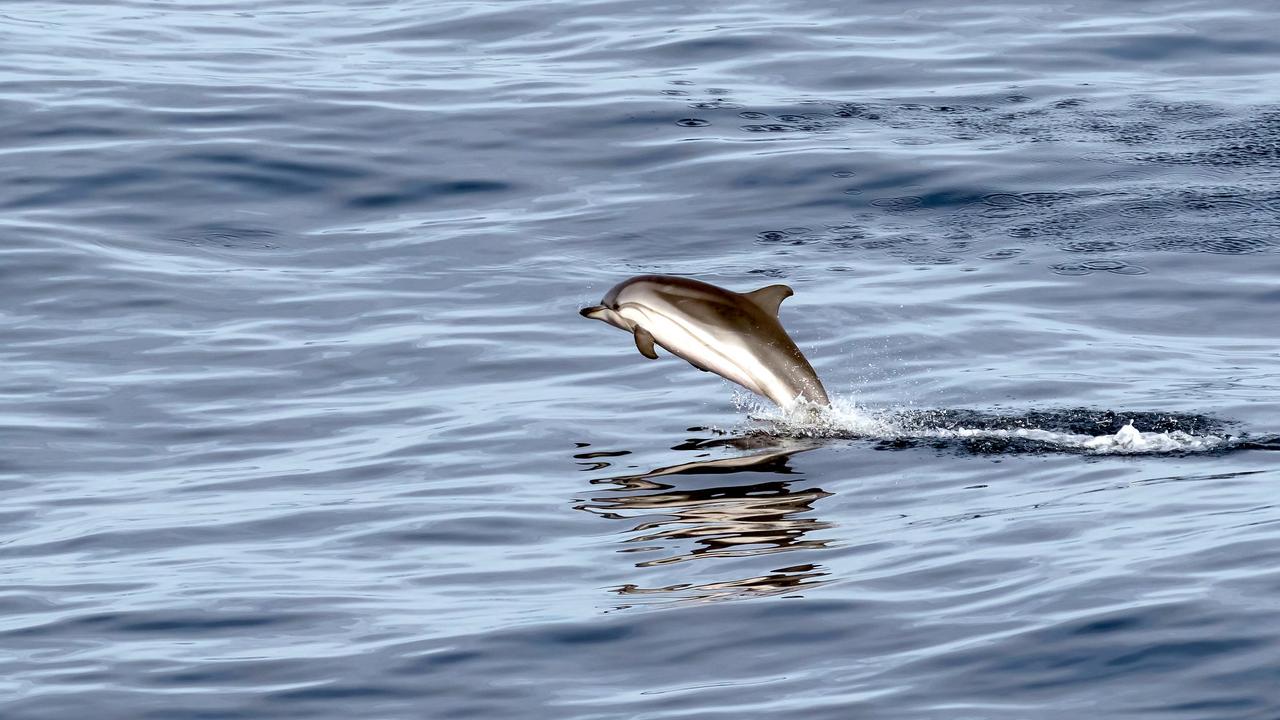
Striped dolphins are classified as small to medium-sized. Males reach an average length of 2.7 metres and a weight of 150 kg, while females attain approximately 2.4 metres in length. Their bodies are aerodynamic and fusiform in shape. They possess long beaks and a distinct dorsal fin located midway along the back.
The most distinctive features are the dark stripes extending from the eyes to the pectoral flippers and toward the anal region. The back is dark blue-grey, the sides are light grey, and the belly is white or pale pink. Coloration and patterning vary among individuals and regions; calves are generally paler than adults. Each jaw contains 43 to 50 pairs of conical teeth.
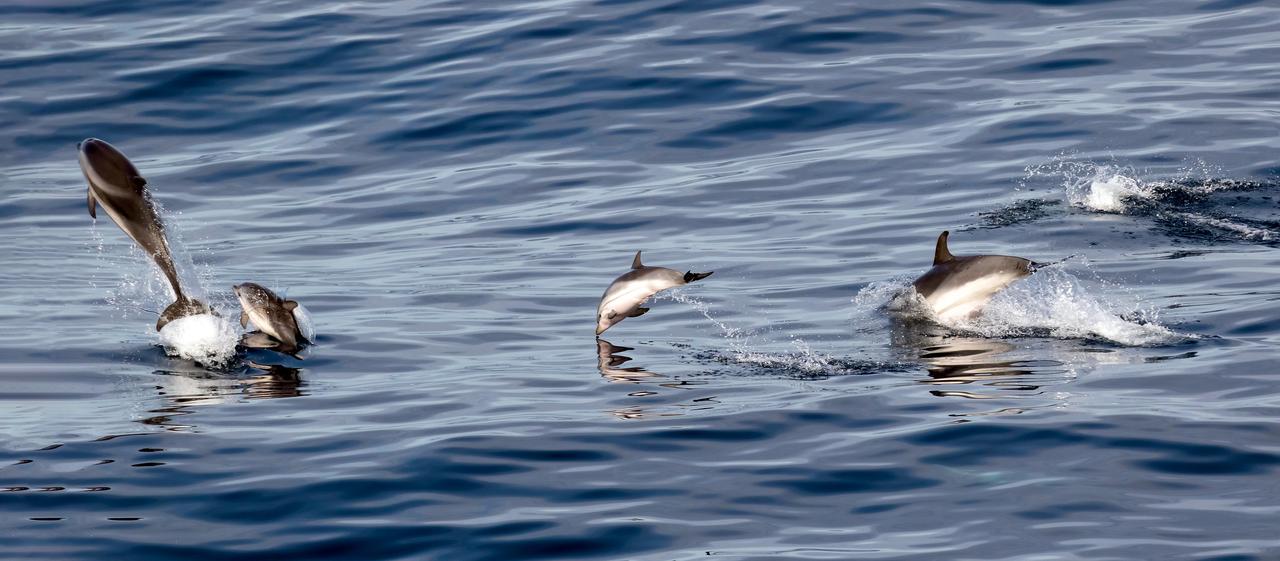
Striped dolphins (flickr)
Striped dolphins are commonly found in the Atlantic, Pacific and Indian Oceans, as well as the Mediterranean and Caribbean Seas. They inhabit regions extending northward to approximately 50° latitude and southward to 40° latitude.
They typically prefer open ocean waters and deep waters over the continental shelf. Observations indicate they avoid sea surface temperatures below 20 °C. They are especially concentrated in areas with nutrient-rich upwellings and oceanic convergence zones.
Striped dolphins are highly social and active animals. They usually form groups of 25 to 100 individuals, though group sizes can reach several thousand. Group structure varies according to age, sex and reproductive status.
They are very active at the surface, performing acrobatic behaviors such as breaching, leaping, spinning and “roto-tailing”—a behavior in which they spin rapidly while leaping out of the water. Due to this energetic activity, they are sometimes referred to as “streakers” in certain regions.
Striped dolphins are curious and frequently approach boats, swimming alongside the bow. They communicate vocally using whistles and clicks.
Striped dolphins are opportunistic predators. Their primary prey includes fish, squid, octopus and some crustaceans. Feeding habits vary regionally; for example, in the Mediterranean they feed mostly on cephalopods, while in the Northeast Atlantic they consume mainly fish. They are known to dive to depths of up to 700 metres.
Females reach sexual maturity between 5 and 13 years of age, while males mature between 7 and 15 years. Mating seasons vary by region: in the Northwest Pacific they occur in winter and spring, while in the Mediterranean they peak in autumn.
The gestation period lasts approximately 12 to 13 months. Females give birth to a single calf every 3 to 4 years. Newborn calves measure 90 to 100 cm in length and weigh about 11 kg. Nursing lasts 12 to 18 months. The species can live for more than 50 years.
Striped dolphins are listed as Least Concern on the IUCN Red List, but they remain vulnerable to local threats. In U.S. waters, they are protected under the Marine Mammal Protection Act (MMPA). Major threats include:
Animal Diversity Web. “Stenella coeruleoalba.” ADW. Michigan State University Museum of Zoology. Accessed August 16, 2025. https://animaldiversity.org/accounts/Stenella_coeruleoalba/
Flickr. "Striped Dolphin JPG." Accessed August 16, 2025. https://flic.kr/p/2gTuZy8
Flickr. "Striped Dolphin JPG." Accessed August 16, 2025. https://flic.kr/p/2gTux2E
NOAA Fisheries. “Striped Dolphin.” fisheries.noaa.gov. Accessed August 16, 2025. https://www.fisheries.noaa.gov/species/striped-dolphin
Whale & Dolphin Conservation. "Striped Dolphin." Whale & Dolphin Conservation. Accessed August 16, 2025. https://us.whales.org/whales-dolphins/species-guide/striped-dolphin/

Realm | Animals (Animalia) | ||||||||
|---|---|---|---|---|---|---|---|---|---|
Branch | Chordates (Chordata) | ||||||||
Class | Mammals (Mammalia) | ||||||||
Team(s) | Cetaceans (Cetacea) | ||||||||
Family | Dolphins (Delphinidae) | ||||||||
Genus | Stenella | ||||||||
Specie(s) | S. coeruleoalba | ||||||||
Subspecies | 2.7 m in males; 2.4 m in females | ||||||||
Weight(s) | Up to 150 kg | ||||||||
Conservation Status | IUCN: Least Concern (LC) | ||||||||
No Discussion Added Yet
Start discussion for "Striped dolphin (Stenella coeruleoalba)" article
Physical Characteristics
Distribution and Habitat
Behavior
Diet
Reproduction and Life Cycle
Conservation Status and Threats