


This article was automatically translated from the original Turkish version.
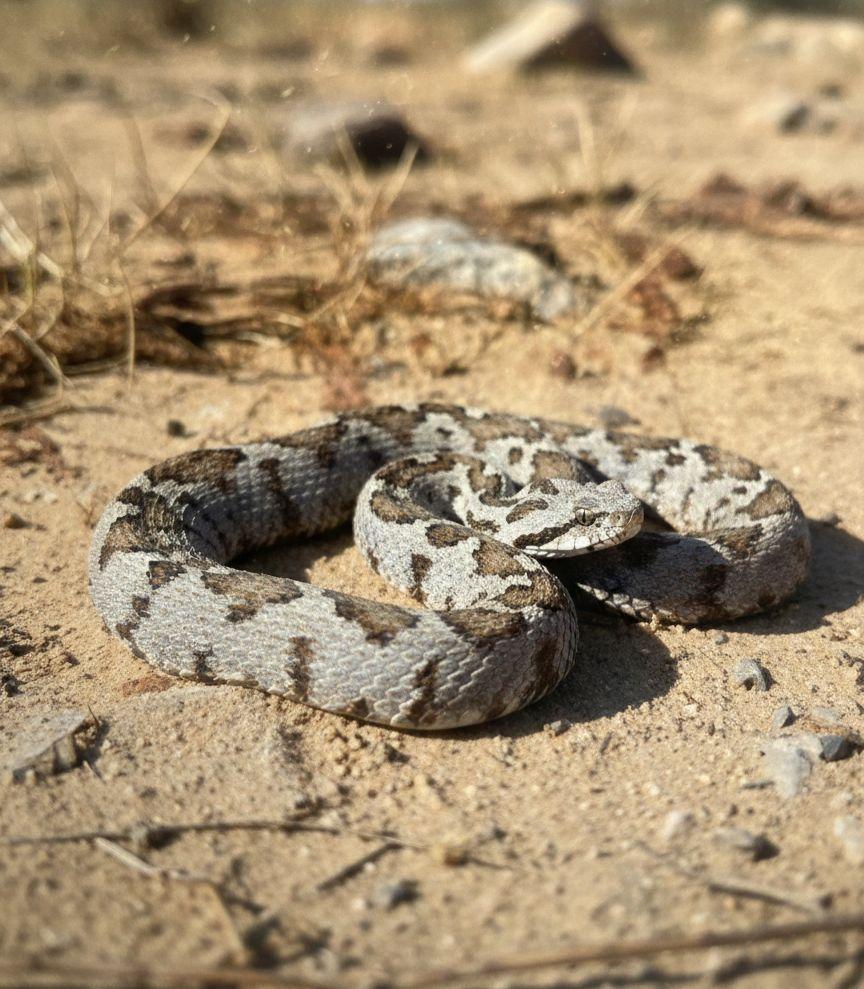
Şeritli Engerek (Vipera Xanthina) (Yapay Zeka İle Oluşturulmuştur)
Scientifically known as Vipera xanthina or Montivipera xanthina, this is a venomous snake species belonging to the Viperidae family. It is also referred to in the literature as the "Ottoman Viper". This species is considered one of the most dangerous venomous snakes in Türkiye in terms of venom potency and is endemic to Türkiye.

Striped Viper (Generated by Artificial Intelligence)
The striped viper typically reaches a length of 70 to 80 cm, with some individuals growing up to 100 cm. The dorsal region is generally gray or grayish-brown in color. Large black or dark brown spots run from the head to the tail; in some individuals these spots merge to form a baklava-like, wavy, or zigzag stripe pattern.
A single row of spots is also present on each side of the body. On the head, small black spots are visible, along with two large black spots extending from the rear toward the sides and a distinct black temporal band. The ventral region is pale yellowish-white and bears small black dots.
This species typically inhabits mountainous areas, treeless and stony terrain. It can be found at elevations up to 2000 meters above sea level. Geographically, it is distributed in central, southern and western Anatolia in Türkiye, wherever suitable habitat conditions exist.
Striped vipers primarily feed on small rodents, birds, lizards, and other snakes. Due to their predation on rodents, they are considered ecologically beneficial.
These animals spend their days hidden beneath rocks and in crevices and hunt at night. Their movements are generally slow, but they can move very rapidly during attacks or defensive maneuvers.
Vipera xanthina is a species with highly potent venom. Laboratory studies have revealed that the venom proteins exhibit both qualitative and quantitative variations depending on the snake's age and size.
Histopathological examinations on albino rats have shown that injection of striped viper venom into muscle tissue causes dermal edema, hemorrhage, cellular infiltration, and fatty necrosis. Severe damage has also been observed in liver tissue, including degeneration, and in muscle tissue, including myonecrosis. Although bites to humans are known to cause fatal wounds or dangerous envenomations, sufficient clinical data on this subject remain lacking in the literature.
The striped viper is endangered. The main factors contributing to this status are its limited geographic range and persecution by humans.

Şeritli Engerek (Vipera Xanthina) (Yapay Zeka İle Oluşturulmuştur)
No Discussion Added Yet
Start discussion for "Striped Viper (Vipera xanthina)" article
Physical Characteristics
Habitat and Distribution
Diet and Behavior
Venom Properties and Toxicity
Conservation Status