

This article was automatically translated from the original Turkish version.
Sugar Planner
Scientific Name(s) | Petaurus breviceps | ||||||||
|---|---|---|---|---|---|---|---|---|---|
Kingdom(s) | Animalia | ||||||||
Phylum | Chordata | ||||||||
Class | Mammalia | ||||||||
Order | Diprotodontia | ||||||||
Family | Petauridae | ||||||||
Genus | Petaurus | ||||||||
Specie(s) | P. breviceps | ||||||||
Habitat | Forests urban gardens agricultural areas savannas | ||||||||
Conservation Status | Least Concern (LC) | ||||||||
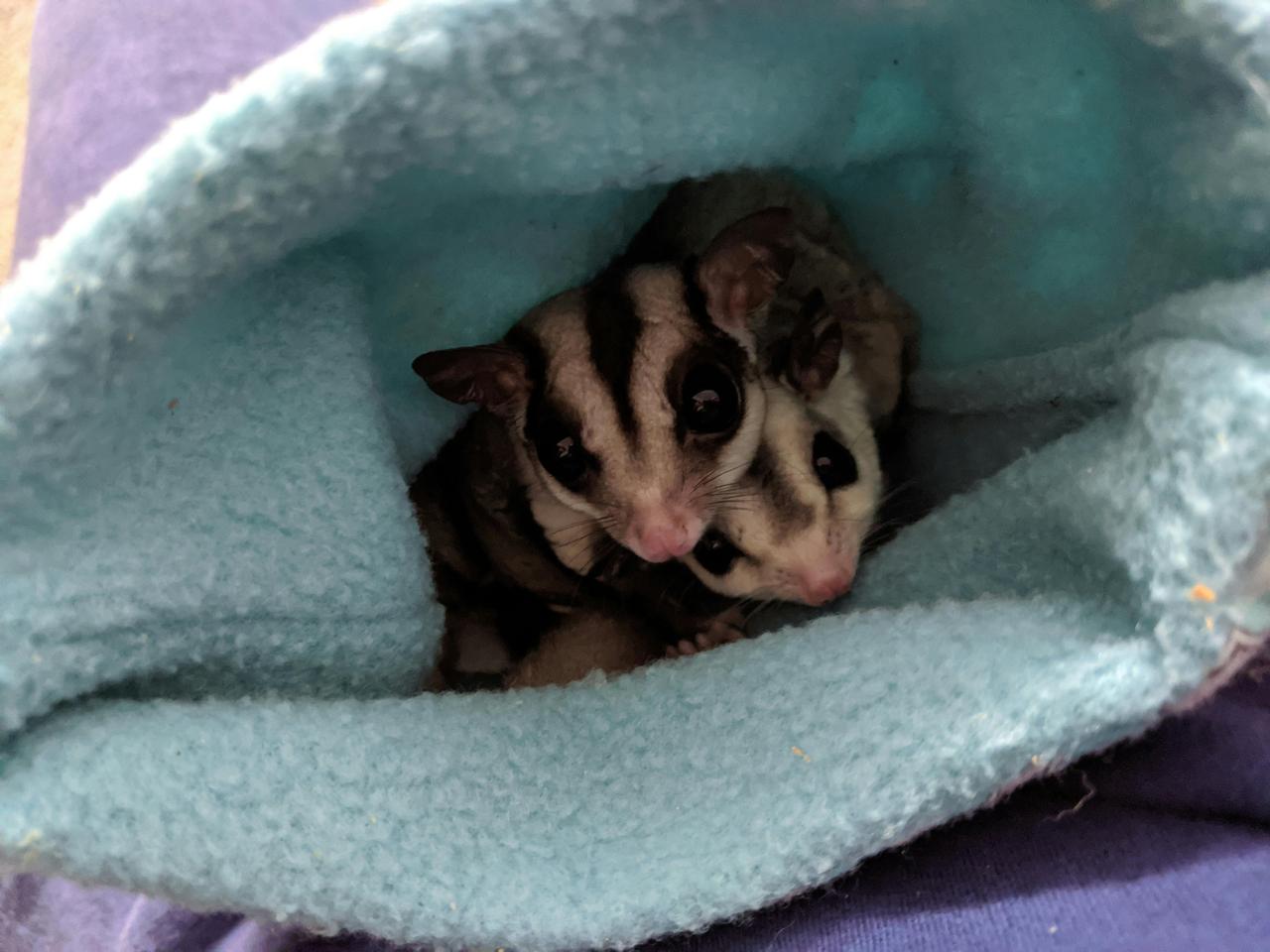
The sugar glider (Petaurus breviceps) is a small, marsupial, arboreal mammal belonging to the family Petauridae. Its most striking feature is the patagium, a membrane of skin extending between its fore and hind limbs, which allows it to glide between trees. It derives its name from its strong preference for sweet plant sap and nectar.
Body weight ranges from 60 to 150 grams. Head-body length measures 115–210 mm, and tail length is 150–210 mm. The fur is soft and dense; the back is typically gray, while the belly is cream or light gray. A dark stripe runs from the nose to the base of the tail, and dark rings surround the eyes. The tail is furred and partially prehensile; it is used to carry leaves and nesting material but does not support weight-bearing.
The patagium is a thin membrane stretching from the wrist to the ankle, enabling individuals to glide up to approximately 45 meters. During gliding, the tail functions as a rudder for balance and directional control.

Sugar glider. (Pexels)
Its natural range includes Australia, Tasmania, New Guinea, and several surrounding islands. It inhabits mature forests, rainforests, woodlands, agricultural areas, and urban gardens. It typically nests in tree hollows, resting there during the day and becoming active at night to forage.
Sugar gliders are nocturnal and excellent climbers. They live in social groups of 2 to 7 adults and juveniles, with group sizes reaching up to 10 to 12 individuals. Social groups are usually led by one or two dominant males. Territory marking is achieved through urine, saliva, and scent glands. Vocal communication is highly developed, with barks, hisses, and chirps conveying different social and environmental contexts. When threatened, they may adopt a defensive posture and release a strong secretion from their scent glands.
They are opportunistic omnivores. Their diet includes plant sap, gum, nectar, pollen, insects, spiders, small vertebrates, and bird chicks. In Tasmania, predation on the endangered swift parrot (Lathamus discolor) chicks has been documented. They play a significant role in pollination and seed dispersal within their ecosystems.
Sugar gliders generally have a polygynous mating system, though monogamy may occur in areas with limited food resources. They reach sexual maturity at 12 to 18 months of age. Gestation lasts 15 to 17 days; after birth, the young develop in the mother’s pouch for about 70 days. After leaving the pouch, they remain in the nest for several additional weeks.
Natural predators include owls, kookaburras, pythons, large lizards, feral cats, and foxes. Human-induced threats include habitat loss, deforestation, agricultural expansion, and urban development.
According to the IUCN Red List, the species is classified as “Least Concern” (2016). While overall populations are stable, some subspecies are threatened at local levels. Habitat fragmentation is the primary factor reducing population density.
The sugar glider is a popular exotic pet in Australia, Japan, and the United States. However, its ownership is prohibited in some countries. In captivity, it can live 10 to 12 years, occasionally up to 17 years; in the wild, its lifespan is typically 4 to 5 years.
Animal Diversity Web (ADW). "Petaurus." Animal Diversity Web, University of Michigan Museum of Zoology. Accessed August 16, 2025. https://animaldiversity.org/accounts/Petaurus/
Independent Library & Educational Center – San Diego Zoo Global. "Sugar Glider." San Diego Zoo Animals & Plants. Accessed August 16, 2025.
Pexels. "El, Hayvan, Sevimli, Tatlı." Photograph: Nguyen Nhan. Accessed August 16, 2025. https://www.pexels.com/tr-tr/fotograf/el-hayvan-sevimli-tatli-9516961/
Pexels. “Sugar Gliders in a Pouch.” Accessed August 22, 2025. “Adorable sugar gliders nestled inside a cozy fabric pouch, showcasing their curious nature.” https://www.pexels.com/photo/sugar-gliders-in-a-pouch-7173566/
San Diego Zoo Global – IELC LibGuides. "Sugar Glider Factsheet." San Diego Zoo Global LibGuides. Accessed August 16, 2025 https://ielc.libguides.com/sdzg/factsheets/sugarglider.

Sugar Planner
Scientific Name(s) | Petaurus breviceps | ||||||||
|---|---|---|---|---|---|---|---|---|---|
Kingdom(s) | Animalia | ||||||||
Phylum | Chordata | ||||||||
Class | Mammalia | ||||||||
Order | Diprotodontia | ||||||||
Family | Petauridae | ||||||||
Genus | Petaurus | ||||||||
Specie(s) | P. breviceps | ||||||||
Habitat | Forests urban gardens agricultural areas savannas | ||||||||
Conservation Status | Least Concern (LC) | ||||||||
Physical Characteristics
Distribution and Habitat
Behavior and Social Structure
Diet
Reproduction
Predators, Threats, and Conservation Status
Relationship with Humans