This article was automatically translated from the original Turkish version.
+2 More
Length(s) | 44.0 m - 44.5 m | ||||||||
|---|---|---|---|---|---|---|---|---|---|
Manufacturer(s) | Sukhoi Design Bureau (USSR) | ||||||||
Height(s) | 11.2 m | ||||||||
Maximum Speed (Targeted) | Mach 3.0 (approximately 3,200 km/h) | ||||||||
Engine Type | Four Kolesov RD-36-41 afterburning turbojets | ||||||||
Wing Area | 295.7 m² | ||||||||
Wingspan | 22.0 m - 22.7 m | ||||||||
Total Production | One flyable prototype (No. 101), three incomplete airframes | ||||||||
Crew | 2 (Pilot and Navigator) | ||||||||
Mission Description | Prototype Supersonic Strategic Bomber, Reconnaissance and Anti-Ship Aircraft | ||||||||
Full Name | Sukhoi T-4 (Project 100 / "Sotka") | ||||||||
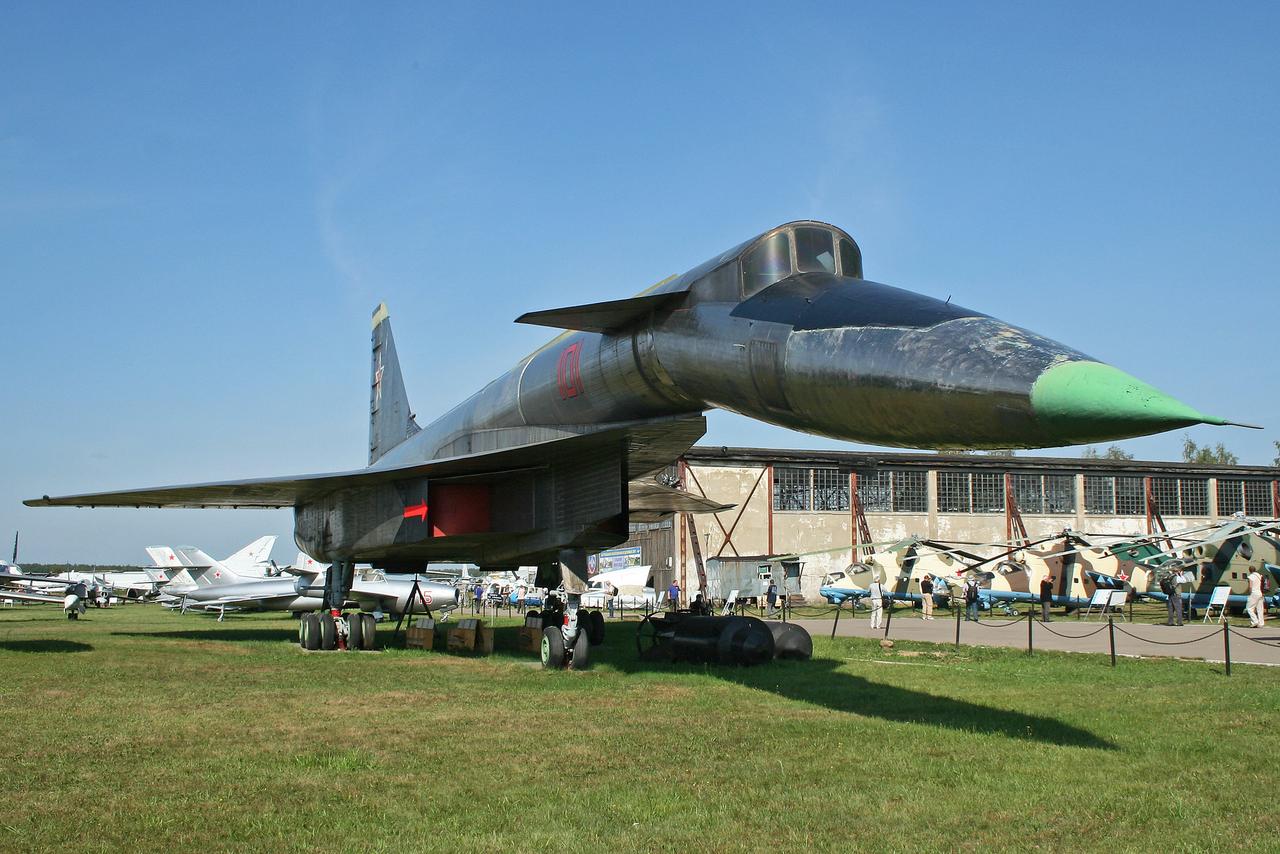
TheSukhoi T-4(known within the SSCB as "Sotka", "Project 100", or "Aircraft 100") is a high-speed prototype strategic bomber, anti-ship, and reconnaissance aircraft developed by the Soviet Union in the 1960s. Designed with a titanium and stainless steel airframe, the platform aimed to reach Mach 3 speeds (three times the speed of sound) and featured a delta wing configuration with canard (foreplane) control surfaces.【1】 The aircraft served as a technology demonstrator for Soviet aviation and became the first Soviet aircraft equipped with a fly-by-wire (electronic flight control) system.
Sukhoi T-4 Sotka at Monino (Johnny Comstedt)
The project was initiated in 1961–1962 as a response to the United States’ development programs for the Mach 3 XB-70 Valkyrie strategic bomber and SR-71 Blackbird reconnaissance aircraft.【2】 The Soviet government organized a competition to develop an aircraft capable of reaching speeds of 3,000–3,200 km/h; Sukhoi,Tupolev, and Yakovlev design bureaus participated. Sukhoi’s design was selected over the Tupolev (Tu-135) and Yakovlev (Yak-33) proposals due to its higher cruise speed (projected at 4,200 km/h) and superior aerodynamics, and in mid-1964 it was authorized for prototype production.【3】 The project was designated "100" or "Sotka" because the aircraft was expected to have a takeoff weight of approximately 100 tons.
Sukhoi T-4 Sotka (BlackbookN1)
The development of the T-4 required the creation from scratch of materials and manufacturing technologies capable of withstanding the extreme frictional heating at Mach 3 speeds, such as titanium processing and automated welding techniques. The first flight-ready prototype, designated "101", was completed in the autumn of 1971 and transferred to the Zhukovsky flight test center on 30 December 1971.
The aircraft made its first flight on 22 August 1972, piloted by Vladimir Ilyushin and navigated by Nikolai Alfyorov. A total of only ten test flights were conducted during the program, with a cumulative flight time of just 10 hours and 20 minutes.【4】
The Soviet Air Force initially planned to order 250 T-4 aircraft. However, the project never progressed to series production due to high costs, complex manufacturing processes, and shifting military doctrines. In 1974, the Ministry of the Aviation Industry suspended the project, and it was formally canceled on 19 December 1975.【5】 The decision to cancel was influenced by the desire to redirect resources toward more practical projects, including the MiG-23 fighter and Tupolev Tu-160 strategic bomber programs.
Sukhoi T-4 "101" Aircraft (Alan Wilson)
To resist aerodynamic heating, a major portion of the T-4’s airframe (over 60%) was constructed from titanium and stainless steel alloys. The aircraft was designed to withstand surface temperatures exceeding 300°C during Mach 3 flight.
The airframe design features a delta wing and canard configuration similar to the XB-70 Valkyrie, but the T-4 is smaller in scale. One of the aircraft’s most distinctive features is its movable nose section, which lowers during takeoff and landing to improve pilot visibility and retracts upward during supersonic flight to enhance aerodynamic efficiency. When the nose is in the upward position, pilots rely on a periscope for external visibility.
The T-4 was equipped with a quadruplex analog fly-by-wire flight control system, a first in Soviet aviation. It also featured a mechanical backup system that would activate in the event of an electronic failure. The aircraft was fitted with advanced navigation and fire-control radars capable of autonomous flight operations.
Characteristic
Value
Crew
2 (Pilot and Navigator)
Length
44.0–44.5 m
Wingspan
22.0–22.7 m
Height
11.2 m
Empty Weight
55,600 kg
Maximum Takeoff Weight (MTOW)
135,000 kg (Test data ranges from 114,000 to 135,000 kg)
Engine Type
4 × Kolesov RD-36-41 Artyakiculy Turbojet
Engine Thrust
Each 16,000 kgf (157–159 kN)
Maximum Speed (Targeted)
Mach 3.0 (approximately 3,200 km/h)
Maximum Speed (Tested)
Mach 1.36
Cruise Speed
Mach 2.8 (approximately 3,000 km/h)
Service Ceiling
20,000–24,000 m
Range
6,000–7,000 km (Ferry range)
• Air-to-Ground Armament: The T-4 was designed to carry two long-range, hypersonic, solid-fueled Kh-45 (X-45) air-to-surface missiles as its primary weapon system. These missiles had a range of approximately 1,500 km and were capable of carrying either nuclear or conventional warheads against naval or land targets.
• Defensive Systems: The aircraft did not carry any internal cannon or defensive weapons; its defense relied on itshigh speedand altitude.
• T-4 (101): The only prototype that conducted flight tests.
• T-4M (100I): An improved version with variable-geometry (swing-wing) design; remained in the design phase.
• T-4MS (200): A strategic bomber project featuring a flying wing/lifting body design; later evolved into theTupolev Tu-160program.【7】
• Civilian Passenger Variant: Studies were conducted on a civilian version with a capacity of 64 passengers, but it was never implemented.
Sukhoi T-4 101 Sotka (José Luis Celada Euba)
The T-4’s primary mission was to penetrate enemy air defense systems using its high speed (Mach 3) and high altitude (24,000 m) advantages to conduct strategic nuclear strikes and anti-ship operations, particularly against aircraft carrier groups.
The aircraft had no direct civilian or humanitarian operational history. However, the titanium processing and aerodynamic data obtained during its development were applied to the Soviet supersonic passenger aircraft programs Tu-144 and This is a space shuttle.
Sukhoi T-4 (Net-Maquettes)
• North American XB-70 Valkyrie (United States): The T-4’s closest counterpart and primary design inspiration. The XB-70 had six engines, while the T-4 had four. Both aircraft employed delta wings with canards, but the T-4 was smaller in size. The XB-70 featured folding wingtips, whereas the T-4 had fixed wingtips.
• Lockheed SR-71 Blackbird (United States): Both aircraft utilized titanium construction and Mach 3 speed capability. However, the SR-71 was an unarmed reconnaissance aircraft, while the T-4 was designed as an armed bomber.
• Advantages: High speed,nuclear strike capability, advanced fly-by-wire system.
• Weaknesses: Extremely high production and operating costs, complex maintenance requirements. The lack of forward visibility when the nose was raised, forcing pilots to rely solely on a periscope, was a significant design limitation. Additionally, the growing effectiveness of advanced air defense missiles rendered the high-altitude/high-speed concept obsolete, contributing to the project’s cancellation.
All-Andorra. “Sukhoi T-4. A Soviet strike-reconnaissance aircraft from 1972.” All Andorra. Accessed January 30, 2026. https://all-andorra.com/su-100-t-4-a-soviet-strike-reconnaissance-aircraft-from-1972/
BlackbookN1. "Sukhoi T-4 Sotka (100) Soviet Heavy Supersonic Bomber landin." YouTube. Accessed January 30, 2026. https://www.youtube.com/watch?v=gVzXyWSxTbI
Diaz, Luke. “How This Fighter Jet Quickly Set Over 20 World Records After It Was Introduced.” *Simple Flying*. Accessed January 30, 2026. https://simpleflying.com/fighter-jet-quickly-set-over-20-world-records-introduced/
Flyajetfighter. “Sukhoi T-4 Sotka: the Soviet aircraft that aimed to reach Mach 3.” Accessed January 30, 2026. https://www.flyajetfighter.com/sukhoi-t-4-sotka-the-soviet-aircraft-that-aimed-to-reach-mach-3/
Hancock, Austin. “Today in Aviation History: First Flight of the Sukhoi T-4.” *Vintage Aviation News*. Accessed January 30, 2026. https://vintageaviationnews.com/?s=Sukhoi+T-4
Johnny Comstedt. "Sukhoi T-4 Sotoka." Flickr. Accessed January 30, 2026. https://www.flickr.com/photos/johnnyflight/9283161497/in/photolist-eyu39g-ezrNcr-ezy6w1-ezyj7f-ezyddb-8sersz-eyZ8pu-eyYqHy-ezsxhu-225hQTY-Dvcivr-gzaXUH-DyVgXe-rV2u3F-2rMM6Eg-8kQbRm-f9ySs5-gzayo7-gzaw9s-semry4-seiJaH-rV2jGg-f9jCuz-rWUtKF-rWLgk5-2oeGGR2-2QAeLM-f9ySzL-9BDin3-ezxXsB-2QEK1E-5dhzkP-WntBc-WntCc-bjNi1v-7unYJh-f9jCz4-726urd-5dmVbo-7zWcSu-7unYL5-sc4BJw-9BDaQU-5FVvY5-51gxi6-5FVvRb-5FVvKb-6jNrJu-5FRfRe-2QF4jo
Johnny Comstedt. "Sukhoi T-4 Sotoka." Flickr. Accessed January 30, 2026. https://www.flickr.com/photos/joseluiscel/4739891590/in/photolist-8dRbCN-8dMW6F-8dRbAj-8dRbEy-8dRbHE-8dRbPN-6YqrbH-6YqpzP-6YqqrX-6YqsnH-ezuGnM-eyxcCN-ezuQcv-ezuJAz-ezxWXC-eyxdfb-ezysJw-ezuWkk-ezrNcr-ezy6w1-ezyand-ezyj7f-ezyddb-8sersz-Dvcivr-gzaXUH-DyVgXe-rV2u3F-2rMM6Eg-8kQbRm-f9ySs5-gzayo7-gzaw9s-semry4-seiJaH-f9jCuz-rWUtKF-rWLgk5-2oeGGR2-2QAeLM-f9ySzL-f9jCz4-bjNsrH-23dKvon-9BAnbV-9BDin3-2QF4jo-2QEK1E-5dhzkP-WntBc
Leone, Dario. “The Sukhoi T-4, the Soviet Mach 3 Strategic Bomber that never was.” *The Aviation Geek Club*. Accessed January 30, 2026. https://theaviationgeekclub.com/the-sukhoi-t-4-the-soviet-mach-3-strategic-bomber-that-never-was/
MiGFlug. "Sukhoi T-4 – The Russian Valkyrie." Accessed January 30, 2026. https://migflug.com/jetflights/russian-valkyrie-sukhoi-t-4/
MilitaryFactory. "Sukhoi T-4 (Sotka) Prototype Supersonic Strategic Bomber / High-Speed Reconnaissance Aircraft." MilitaryFactory. Accessed January 30, 2026. https://www.militaryfactory.com/aircraft/detail.php?aircraft_id=1497
Net-Maquettes. "Sukhoi T-4." YouTube. Accessed January 30, 2026. https://www.youtube.com/watch?v=G2ALS0xw7Hs
Obrazcova, Tatjana. “The Sukhoi T-4 Heavy Supersonic Bomber was an Experimental Craft, Here are 5 Cool Facts.” *Fifty Sky Shades.* Accessed January 30, 2026. https://50skyshades.com/news/manufacturer/the-sukhoi-t-4-heavy-supersonic-bomber-was-an-experimental-craft-here-are-5-cool-facts
T-4 Pilot. “T-4 («100») supersonic strategic bomber.” T-4 Pilot. Accessed January 30, 2026. www.testpilot.ru/russia/sukhoi/t/4/index_1_e.php
Wilson, Alan. "Sukhoi T-4 Sotoka." Flickr. Accessed January 30, 2026. https://www.flickr.com/photos/ajw1970/10220660826/in/photolist-ezysJw-ezuWkk-ezrNcr-ezy6w1-ezyand-ezyj7f-ezyddb-8sersz-Dvcivr-gzaXUH-DyVgXe-rV2u3F-2rMM6Eg-8kQbRm-f9ySs5-gzayo7-gzaw9s-semry4-seiJaH-f9jCuz-rWUtKF-rWLgk5-2oeGGR2-2QAeLM-f9ySzL-f9jCz4-bjNsrH-23dKvon-9BAnbV-9BDin3-2QF4jo-2QEK1E-5dhzkP-WntBc-bjNi1v-7unYJh-726urd-5dmVbo-7zWcSu-7unYL5-sc4BJw-9BDaQU-5FVvY5-51gxi6-5FVvRb-5FVvKb-6jNrJu-5FRfRe-WntCc-5FRfWB
Çernova, Evgeniya. “Sovyet bombardıman uçağı Sotka: T-4 projesi hakkında.” TopWar. Accessed January 30, 2026. https://tr.topwar.ru/166342-sovetskij-bombardirovschik-sotka-o-proekte-t-4.html

Length(s) | 44.0 m - 44.5 m | ||||||||
|---|---|---|---|---|---|---|---|---|---|
Manufacturer(s) | Sukhoi Design Bureau (USSR) | ||||||||
Height(s) | 11.2 m | ||||||||
Maximum Speed (Targeted) | Mach 3.0 (approximately 3,200 km/h) | ||||||||
Engine Type | Four Kolesov RD-36-41 afterburning turbojets | ||||||||
Wing Area | 295.7 m² | ||||||||
Wingspan | 22.0 m - 22.7 m | ||||||||
Total Production | One flyable prototype (No. 101), three incomplete airframes | ||||||||
Crew | 2 (Pilot and Navigator) | ||||||||
Mission Description | Prototype Supersonic Strategic Bomber, Reconnaissance and Anti-Ship Aircraft | ||||||||
Full Name | Sukhoi T-4 (Project 100 / "Sotka") | ||||||||
Prototype Stages and Testing
Transition to Series Production and Developments
Avionics and System Components
Technical Specifications Table【6】
Armament and Capabilities
Existing and Proposed Variants
Civilian and Humanitarian Roles
Performance Advantages and Weaknesses